

Walrus fundamentally changes the philosophy of blockchain infrastructure to separate storage and consensus execution to allow each system layer to be optimized to its purpose. Monolithic blockchain design (Traditional): Traditional blockchain designs place full history of ledgers in all data types- data categories such as transaction data, smart contract data and unstructured data all stored in limited node capacity. This architecture imposes scalability bottlenecks that can never be overcome in cases where applications need permanent giant datasets. The solution of this is provided by Walrus using positioning storage by module design where data is referenced by blockchain nodes instead of duplication of entire payloads.
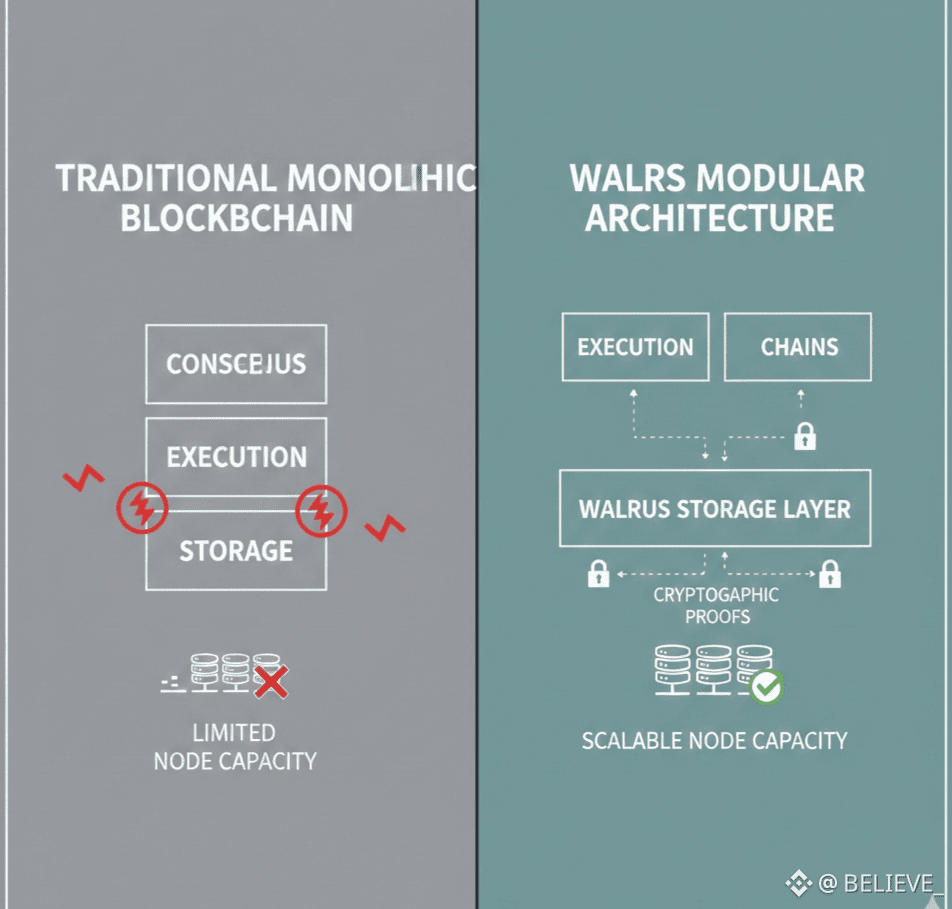
Chain-Separated Execution-Storage Separating Enabling Chain.
Walrus allows blockchains to optimize the speed of mission by delegating storage functionality. The settlement of transactions cuts down as expensive duplicate copies of historical datasets, media files and inference models are no longer kept by the nodes. Smart contracts do not resort to retrieving entire payloads but they validate the availability of data using cryptographic certificates. This architectural isolation allows chain scaling transaction irrespective of storage limits. Applications permanently store datasets at the scale of terabytes and chains handle thousands of transactions per second as part of decoupled infrastructure.
Sharing Infrastructure Network Effect Amplification.
More applications managing in unified storage backbone form positive reinforcement cycles that Walrus has created. The advantage of early adopters is low per-unit cost as fixed operator infrastructure is distributed over increased number of users. The infrastructure providers also scale horizontally in terms of applications instead of focusing towards single platform needs. This networking is a benefit to Walrus security and economic feasibility together. Multiple communities that are based on dissimilar chains use the same storage capacity with standardized protocols that remove ecosystem fragmentation.
Extensible Storage Providing Programmable Data storage.
Walrus smart contract integration allows applications that automate data lifecycle policies, but do not involve manual process. The files are automatically relocated to the archival levels, where they exit the hot storage, as the access patterns are observed. Content retrieval is with conditional access policies where content is unlocked with credentials of ownership verification or money confirmations. Periodic expiration eliminates storage. This programmability converts storage to a passive infrastructure, to an active application component. There are high level governance mechanisms that are hard coded in deployment specifications.
Cryptographic Data integrity No Payload download.
Walrus proposes availability certificates whereby one can verify with mathematical proof and not with content access. Smart contracts are used to ensure the existence of blobs on-chain without downloading gigabytes of media. This is a scalability mechanism of verification that can run thousands of parallel proofs at the same time without consuming resources proportional to the number of proofs being run. The applications are assured that storage will remain without costly retrieval processes. The efficiency will allow the use cases that were formerly inconvenient, insurance procedures automating the claim settlement when verification of documents occurs, NFT markets verifying the authenticity of the media immediately.
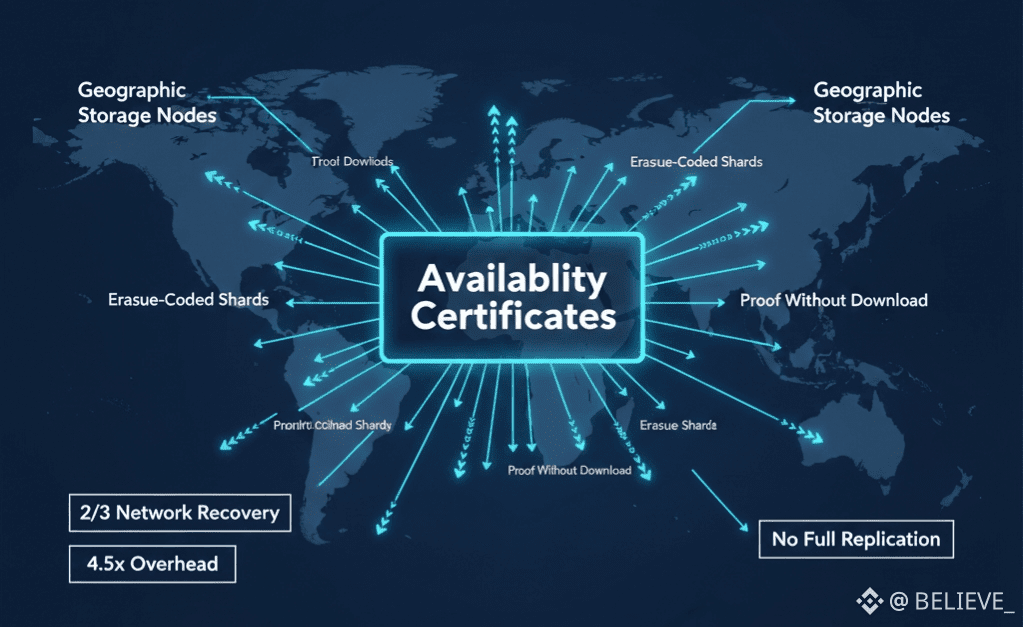
Geographically Redundant Availability Assurance.
Walrus assures two-thirds network downtime data recovery by mathematically guaranteed redundancy. The traditional replication models are not cost-effective on a global scale where they guard against correlated regional failures. Walrus erasure coding attains the same guarantees at 4.5x overhead compared to classical 100x methods. This translates directly into lower user costs that allow petabyte-scale deployments that are practically a cloud based cost. The businesses implement mission-critical infrastructure with confidence when permanence is formed of the mathematical certitude.
AI Infrastructure Foundation Learning Training Data Needs.
Walrus supports new AI economy with storage of permanent immutable training datasets. ML systems should have repeatable sets of data to test the model behavior at any point of evaluation. Walrus helps researchers to verify the precise training conditions and exclude the further disagreements on the origins of the model behavior. Decentralized AI systems involve Walrus storage that ensures transparency with auditable datasets. Users of OpenGradient who take advantage of Walrus hosting in mass training on multi-terabyte corpora rely on globally accessed training content, without dependency on a central provider.
Sustainable Economies with Incentive Compensations.
Walrus token policies bring the operator behavior in line with long-term network reliability. Storage providers receive WAL rewards based on confirmed uptime that shows commitment in addition to extracting profits. The slashing punitive strategies penalize wrongdoing that forms capital punishment that deters attack. Yield is awarded to token delegators (those delegating to operators). This economic structure makes infrastructural designs sustainable in which rational players keep networks continuously without external subsidies.
Modular Government Today that Empowers Community Development.
Walrus rule lays emphasis on these contributions of networks as opposed to capital concentration. The adjustments in the parameters, such as the pricing percentile, the structure of the committees, the reward schedule, etc., are implemented with the use of the token holder vote. Infrastructure priorities in communities are set by communities that make sure that the optimization is based on the actual application needs. This form of governance eliminates the possibility of discriminative changes being instituted by isolated groups of developers that negatively affect a wider ecosystem. The evolution of the protocol is dynamic to new use cases but fixed so as to ensure protection of long term investment.
Walrus explains that the maturation of the decentralized infrastructure occurs when the architectural design isolates the issues that allow specialization. Storage optimization is free of execution layers. Common infrastructure forms economies in which a wide range of applications are served. Programmability makes the fixed assets dynamic. Cryptographic validation eradicates access requirements on payload. The Byzantine resilience ensures permanence mathematically. The interest of AI works with the new data demands. Sustainability is ensured through economic alignment. Modular governance is in indication of community interests. Technical excellence places Walrus foundation layer in the development of Web3 ecosystems.

