


The Hidden Bottleneck in Regulated Blockchains
Most regularity applications do not fail because of technology. They fail because no one can agree on what auditors, regulators, and counterparties are allowed to see. Full transparency exposes sensitive business data. Full privacy creates blind spots that regulators cannot accept.
This is where many EVM-based solutions struggle. They treat audits as an off-chain process. Logs are exported, reports are generated, and trust is reintroduced manually. The blockchain becomes a record keeper, not a verifiable system.
What Hedger Changes at a Structural Level
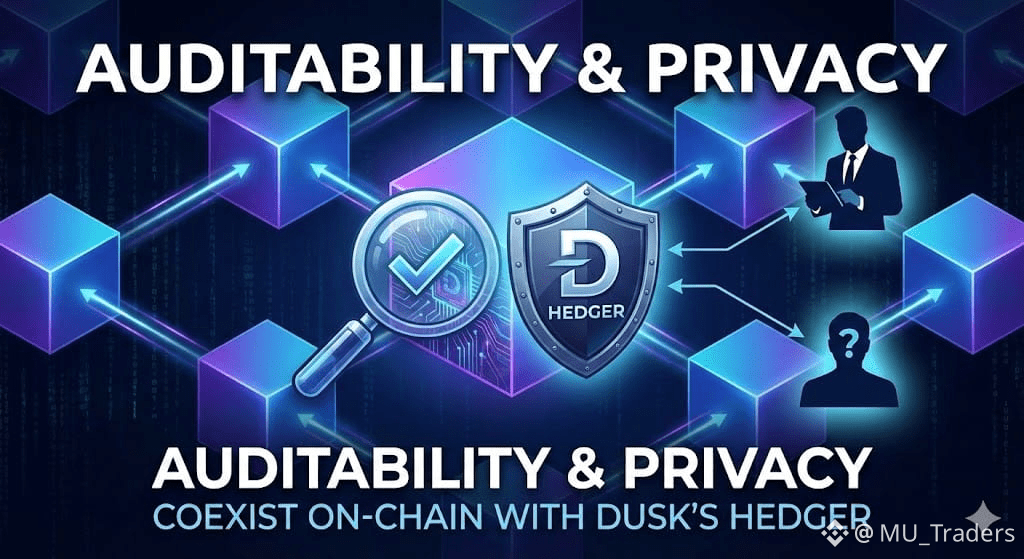
Hedger is not a monitoring tool layered on top of Dusk. It is part of how the network proves correctness.
Instead of revealing transactions, balances, or identities, Hedger allows specific properties of activity to be verified cryptographically. Auditors can confirm that rules were followed without seeing the underlying data. This is not selective transparency in the usual sense. It is selective verifiability.
The difference matters. It means audits no longer depend on trusting an operator to disclose information honestly. They depend on mathematical proofs that can be checked independently.
Why This Matters for Real Applications
Think about tokenized securities, private funds, or regulated marketplaces. These systems require periodic audits, compliance checks, and reporting obligations. On most chains, that forces sensitive data off-chain.
With Hedger, those obligations can be satisfied on-chain without exposing trade details, investor positions, or proprietary logic. The blockchain remains the source of truth, while privacy is preserved by design.
This approach reduces operational risk. It also reduces friction between builders and regulators, because verification does not require special access or privileged visibility.
Why You See This Now, Not Earlier
Compliant privacy is hard. It requires rethinking execution, proof systems, and data availability together. That is why many EVM-compatible chains still avoid the problem or postpone it.
Dusk’s recent progress shows a different priority. Instead of optimizing for general-purpose DeFi, it focuses on environments where audits are mandatory. Hedger reflects that focus. It is infrastructure for institutions that cannot compromise on either privacy or oversight.
The Broader Implication
If regulated finance moves on-chain, it will not adopt systems that force constant trade-offs. It will adopt systems that reconcile them. Hedger is a signal that Dusk is building for that future, even if it attracts less attention today.
In a maturing crypto landscape, credibility often grows quietly. And if cryptocurrency is expected to support serious financial activity, auditability without exposure may turn out to be one of the most important foundations.
