


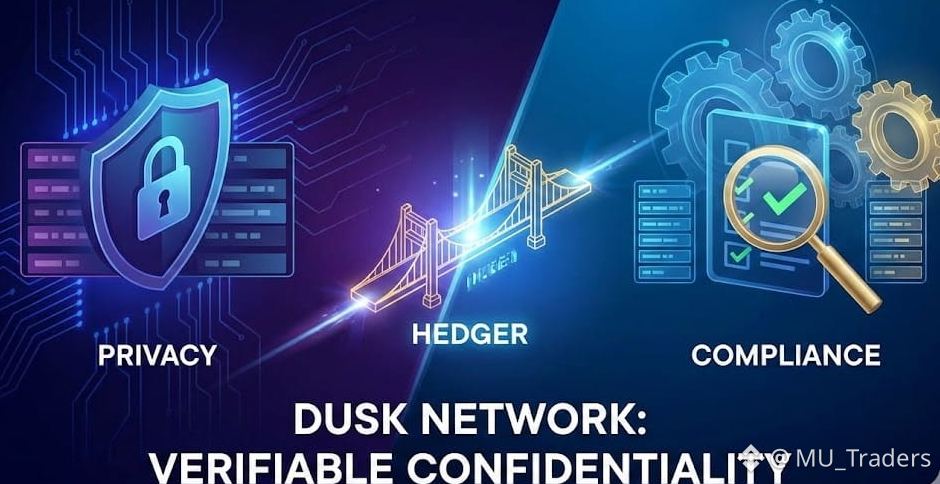
you might think privacy on blockchains simply means hiding balances or addresses. But that surface‑level definition misses something deeper: the difference between secrecy and verifiable confidentiality. Dusk Network is pushing past that line with Hedger, a development that addresses auditability without exposing sensitive data—something most crypto systems still cannot reconcile. (Dusk Forum)
Reframing Privacy for Regulated Applications
Most privacy tools in crypto focus on obscuring transactions from public view. That helps individual privacy, but it falls short for regulated use cases where oversight and audit trails are mandatory. Financial institutions and regulated markets cannot adopt systems where data is either fully public or completely opaque. Dusk addresses this by building privacy into the execution environment in a way that still supports compliance. (DOCUMENTATION)
Hedger is a good example of this shift. It is a privacy engine on DuskEVM that uses advanced cryptography like homomorphic encryption and zero‑knowledge proofs to keep transaction amounts and balances confidential. At the same time, these cryptographic proofs allow auditors and regulators to verify that the system followed rules without ever seeing the underlying private data. This combination is not common in other EVM ecosystems. (Dusk Forum)
Why This Matters Beyond Simple Privacy
When institutions tokenize real‑world assets, they need to maintain confidentiality for client data and trading strategies. At the same time, they must adhere to regulations that require verification and audit trails. Typical blockchains force developers into trade‑offs: either you mask data and lose verifiability, or you expose data and lose confidentiality.
Hedger’s design flips this trade‑off by building verifiability into private transactions. Instead of auditors asking for exported reports or snapshots, compliance can happen on‑chain through proofs. This means oversight does not require trusting a third party with sensitive data. It also cuts down the operational work institutions normally rely on to comply with regulations.
What Enables This Alignment
Three trends in Dusk’s development make this possible:
Modular Architecture: Dusk is evolving into a multilayer stack with DuskDS as settlement and data availability, and DuskEVM as an EVM execution layer with built‑in privacy primitives. That design lets familiar developer tools work with regulatory‑aware features. (Dusk Network)
Advanced Cryptography: Hedger’s mix of homomorphic encryption and zero‑knowledge proofs does more than hide data. It lets the system prove that regulations are respected without exposing the underlying information. (Dusk Forum)
Regulatory Integration: Dusk projects include on‑chain real‑world asset tokenization and institutional compliance layers, meaning that privacy and oversight are not bolted on later, but considered core to the system. (Dusk Network)
The Bigger Implication
In the broader crypto world, privacy and compliance are often treated as competing forces. Many EVM‑compatible chains have privacy add‑ons, but they still rely on off‑chain or trusted intermediaries for regulatory reporting. Hedger suggests another direction: privacy without loss of verifiability.
This is more than a feature. It reshapes how regulated markets can interact with decentralized systems. If institutions can use on‑chain mechanisms to fulfill audit obligations while preserving confidentiality, the barrier to real‑world adoption drops significantly. That shift may not dominate headlines, but it could quietly become one of the most important pieces of infrastructure for the next phase of mainstream crypto integration.
