
The storage of the data is one of the concerns that has continued to slow down the actual implementation of the blockchain technology. Blockchains can be well used in storing the records of transactions, whereas they are incapable of holding big files like pictures, videos, applications, and artificial intelligence information. In this respect, it is possible to mention Walrus ($WAL), a decentralized storage protocol that is focused on making the process of data storage more secure, scalable, and cheaper for the Web3 ecosystem.
Being a novice, one can imagine Walrus as a means of storing large amounts of data, which would be secure and not included in the blockchain and still verifiable and decentralized. It is an infrastructure project and a long-term requirement in Web3 for investors.
The significance of decentralized storage.
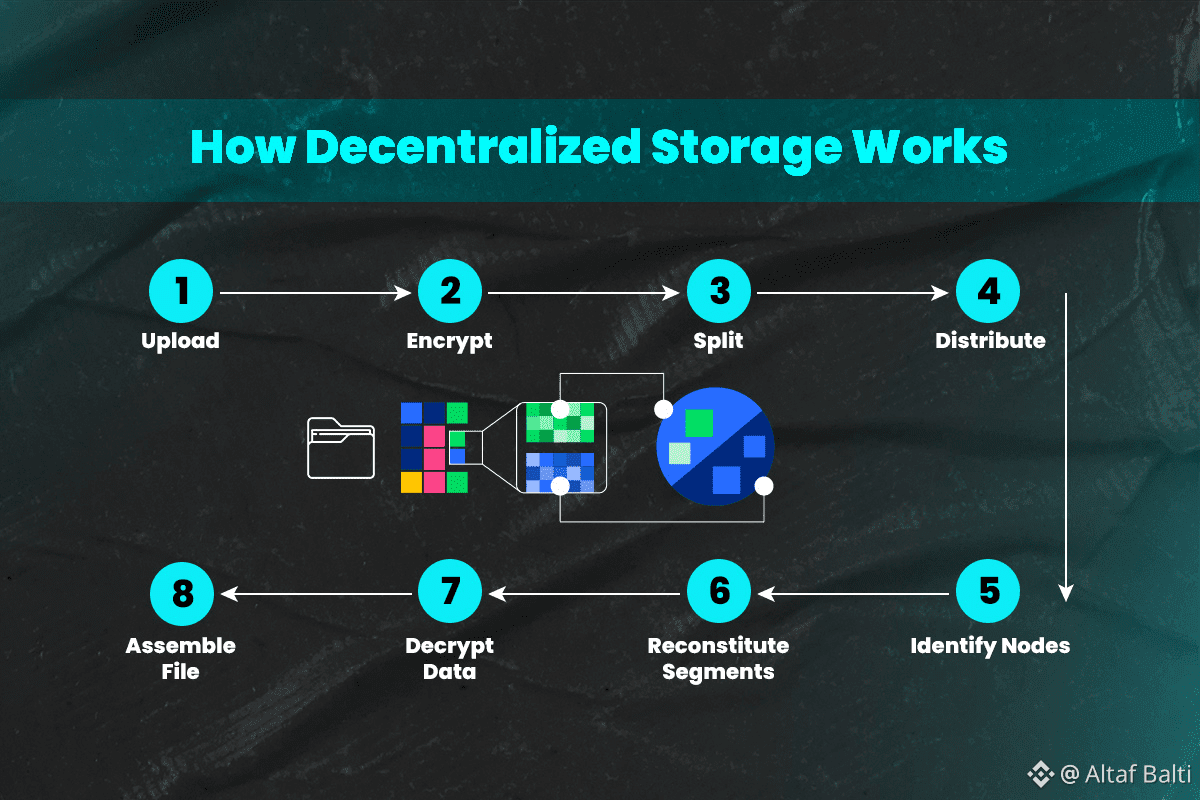
In the traditional systems, the data is stored in a centralized server of a single company. The information can be deprived of its access in case of the breakdown of such servers, hacking, or even collapsing. Web3 will attempt to eradicate this single point of failure by distributing the information to many untrusted nodes.
Storing data in a decentralized way is, however, not easy. Many storage networks manage it using multiplication of data stored in different nodes. This increases availability, but it increases the cost and is downsized. Such inefficiency is a big concern in the long run.
This is the very issue Walrus should solve: how to provide the safety and the availability of the information without wasting the storage space.
The process of how Walrus works in simple terms.

Another smarter storage is offered by Walrus, which is called Red Stuff (RedS) 2D Erasure Coding. Walrus encrypts large files as blobs and divides them into smaller parts of encrypted content rather than encrypting large copies. These data are then distributed with the different storage nodes.
The most crucial benefit is efficiency. One can also retrieve the original data with the help of the left bits in case some of the nodes have failed. It is also worth noting that Walrus does not need to recreate the entire file even in scenarios where it loses a small part of it. This is a bandwidth, time, and cost saving.
A simple real-world case example is of puzzle storage. Walrus does not save ten complete copies of a puzzle; instead, the pieces of the puzzle are separated in the other boxes. The puzzle is never lost, provided that there are enough pieces to the puzzle.
It was designed to operate under the real-world network conditions.
Actual networks experience delays. Messages can be lost during transit, links can break, and nodes can behave in an unscrupulous fashion. The majority of the storage systems are founded on ideal conditions, and this creates a security risk where the assumptions are not the case.
Walrus has also been structured to operate in asynchronous networks, i.e., it can work even when the communication is late or unreliable. This architecture cannot be attacked by those who may be lurking to store information when they are not. This will reduce the technical risk to the investor and increase the confidence in long-term commitment.
Roles of Blockchain in Walrus.
Walrus does not store large files in the blockchain. A blockchain is rather a layer of control and verification. It records useful information such as promises of storage, certificates of availability, and the information of staking.
The real files are stored off-chain in decentralized storage nodes. The division allows Walrus to run on a large scale without congesting the blockchain and increasing transaction costs. Objectively, in terms of investment, this architecture can be able to make any improvements without negatively affecting the performance.
Real-World Use Cases
Additional practical applications that should be grown in Web3 are with Walrus:
Digital media, where files must be accessible in the long term, and NFTs.
Layer 2 rollups are based on trusted data availability.
User content and frontends are stored in a decentralized application.
AI and data integrity, in which the data would be verifiable and readable.
As these industries expand, the demand to possess effective decentralized storage will be on the rise.
Network Incentives and Utility Tokens.
The Walrus economy has its basis on the SWAL token, which is employed in staking and securing the network. The bets are placed by the storers to remain part of and benefit in case they act in an honest way. They are penalized in the event that they fail to comply with the demands.
This is a system of incentives wherein the members will have an economic motivation to do right. This means increasing the reliability of the network to the newcomers. It is token utility to investors, which is not speculative but rather actual network activity.
Why Walrus is significant to investors.
The infrastructure projects tend to be vast because of their support of entire ecosystems. Walrus also has a more long-term, efficient, secure, and scale-oriented design than hype-oriented in the short term.
This will make the decentralized storage increasingly necessary as the Web3 applications will supply additional data. Walrus is a protocol to be used in that future and offers a tradeoff between cost, reliability, and decentralization.
Final Thoughts
Walrus is a remedy to one of the most major issues of Web3, which few have thought about: effective storage of information in a decentralized world. Its simplicity in design and practical security model, in addition to its clear-cut use cases, allow the beginners to know it and long-term investors to see this information as significant.
As the quantity of decentralized applications grows, these projects can be significant building blocks of the Web3 infrastructure, like Walrus.

