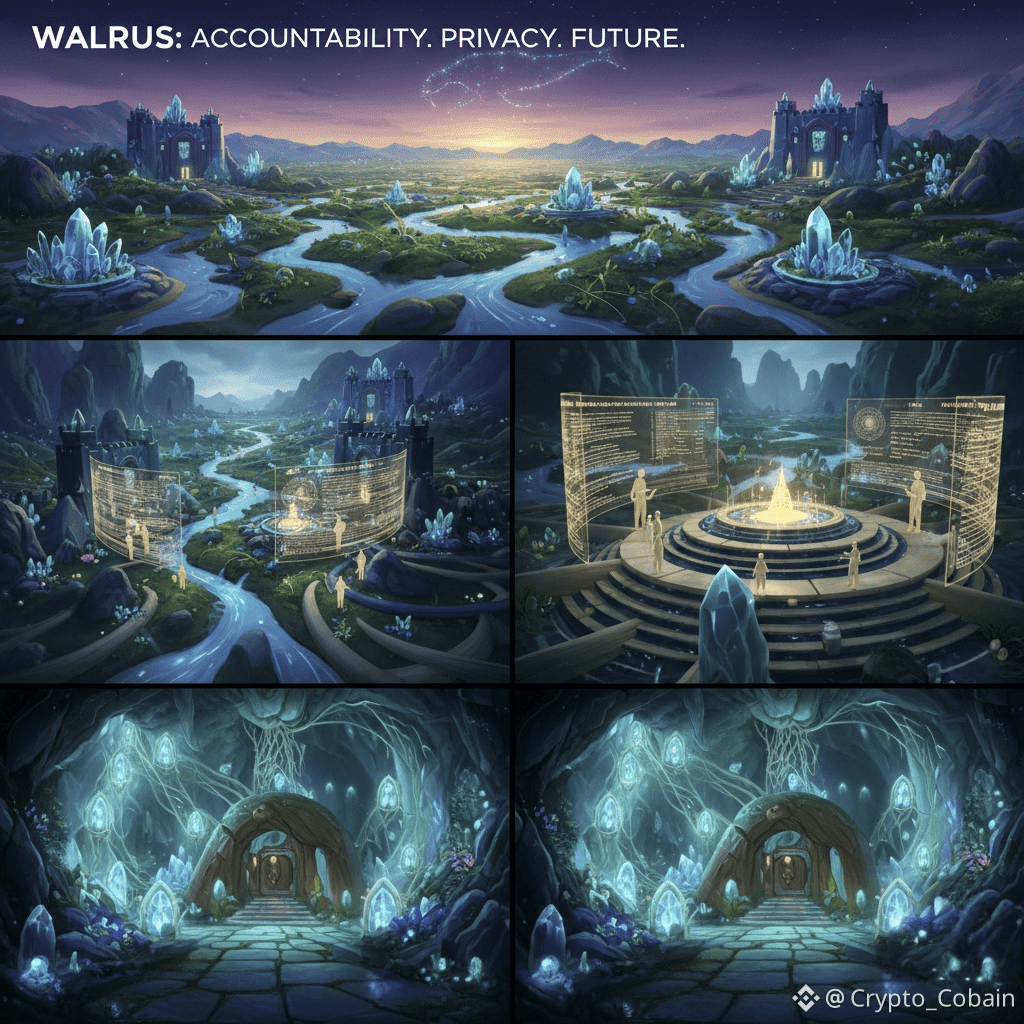
@Walrus 🦭/acc is not built to chase attention or hype. Instead, it focuses on a clear and practical mission. At a time when personal and organizational data is routinely collected, monitored, and controlled by centralized services, Walrus is designed around the idea that individuals should have ownership over their information. Users decide where their data lives, who can access it, and how it is protected. The WAL token supports this goal by powering the ecosystem and keeping the network functional and sustainable.
At its foundation,Walrus is a decentralized protocol that prioritizes secure and private data storage and transactions. Rather than depending on traditional cloud systems that store information on centralized servers, Walrus distributes data across a decentralized network. Files are split into encrypted fragments and stored across multiple locations, ensuring that no single party can view or control the complete dataset. This approach helps reduce censorship, strengthens privacy, and minimizes the risk of widespread data breaches.
Walrus operates on the Sui blockchain, which significantly enhances the protocol’s performance. Sui is designed for high speed, low latency, and parallel processing, allowing Walrus to handle large volumes of data efficiently. This results in faster access times and more predictable costs, avoiding the high fees and congestion issues commonly found on older blockchain networks. For both developers and users, this creates a smoother and more reliable experience.
Privacy within Walrus is not an added feature but a core principle. Every transaction and storage interaction is structured to limit unnecessary data exposure. By reducing the ability to track activity or connect user behavior across applications, Walrus provides a strong privacy layer. This makes it well suited for decentralized applications, enterprise-level data exchange, AI workflows, and any environment where sensitive information must remain confidential.
The WAL token plays a central role in maintaining the ecosystem. It is used to cover storage costs, incentivize network participants, and enable governance participation. WAL holders can stake their tokens to help secure the network while also contributing to decisions about the protocol’s future. Rather than emphasizing short-term market movements, the token is structured to promote long-term involvement and alignment with the network’s overall health.
Walrus also benefits from strong timing. As awareness around data ownership and privacy continues to grow among individuals, companies, and governments, decentralized storage is becoming less of an experiment and more of a necessity. Walrus does not rely on aggressive marketing or promises of instant success. Instead, it focuses on building reliable infrastructure that can support the evolving decentralized internet.
Ultimately,Walrus represents a shift away from speculation and toward accountability. It aims to create systems where users are not exploited, data is not locked behind centralized control, and privacy is embedded into the design itself. That long-term mindset may be what allows Walrus to remain relevant as digital ecosystems continue to evolve.