
Walrus ($WAL): A Real-World Decentralized Data Storage Solution.With the maturity of blockchain technology, data storage remains one of the problems that hinders its application in the real world. Although blockchains are brilliant in terms of transaction documentation and trust preservation, they are not scalable in terms of data archive. Images, videos, application data, AI datasets, and rollup data need a different approach. Walrus ($WAL) is a decentralized storage protocol designed to fulfill this increasing requirement in a practical, scalable manner.Walrus is developing into an underpinning infrastructure for Web3 with the intention to provide efficient, safe, and low-cost storage without compromising
decentralization.Storage: Why It Is a Crucial Web3 Problem.In the old system, there are centralized servers that contain data that are owned and managed by one company. This exposes data to outages, censorship, hacking, or policy modification. Web3 aims to eliminate these risks by storing the information on a large number of autonomous nodes.Nonetheless, decentralized storage is a source of new challenges. Several networks are based on high replication, where similar and identical information is duplicated many times in the system. This is beneficial in terms of improved availability but also makes it more expensive and less scalable. This inefficiency over the course of time becomes an impediment to mass adoption.This is the same problem that the decentralized storage in the work of Walrus is aimed at resolving without compromising the security or reliability.What Walrus Works Is and How It Works.Walrus employs a highly
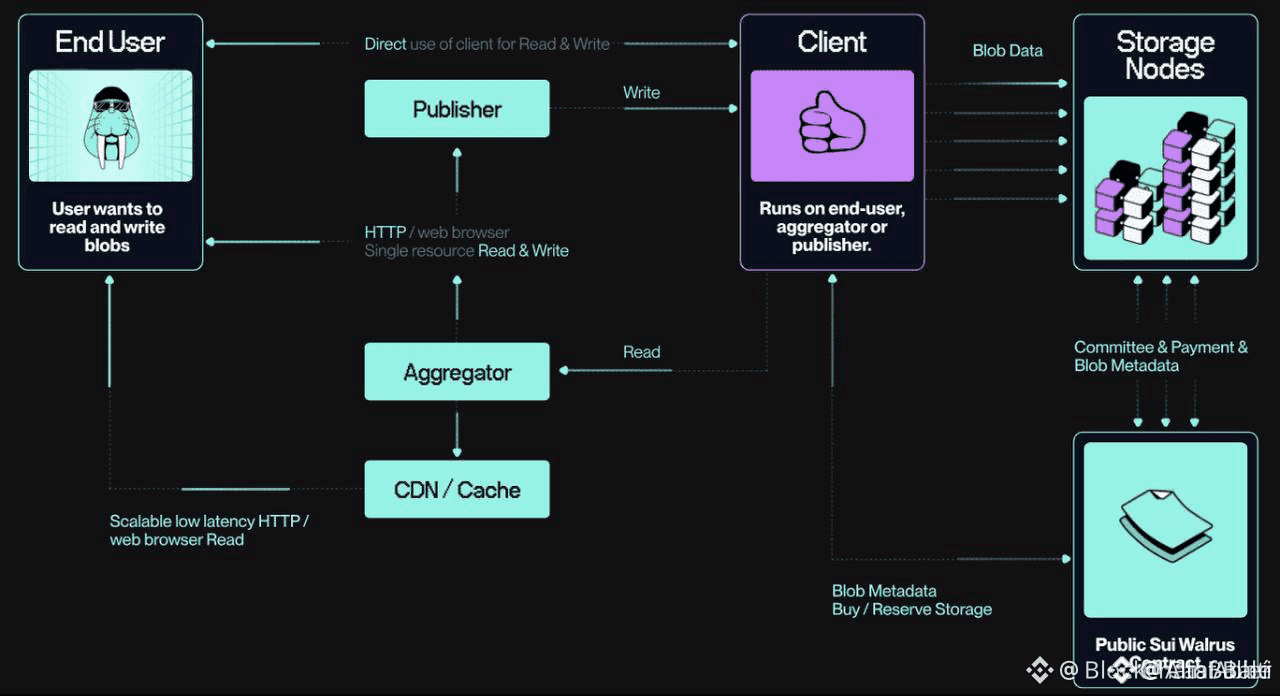
sophisticated technique of data distribution referred to as Red Stuff (RedS) 2D Erasure Coding. Walrus does not store entire copies of files but instead splits big data files (also known as blobs) into tiny pieces of encoded information. The works are shared in numerous storage nodes.The most important one is resilience. The original data can also be retrieved by the rest of the pieces even in the event that some of these nodes go offline or fail. Walrus also does not require the complete file to be rebuilt in case a partial piece is lost, as was required in older systems. This saves bandwidth, accelerates recovery, and minimizes total costs.One such example is cloud backup. Walrus distributes encoded fragments of a file throughout the network instead of running five complete copies of the file in a backup system, which ensures that the file is available even when multiple copies are lost.Construction to

Real-World Network Conditions.Network delays and interruptions are the order of the day in decentralized systems. Not all the messages are received in time, and there are some participants who may cheat. Most of the storage solutions presuppose optimal settings of a network, which poses a safety implication in the real-world setup.Walrus is created to work in asynchronous networks, i.e., it should work well even in the case when communication is slow or unreliable. This will ensure that the dishonest nodes do not fake pretense to store data, but in reality they do not.To users and investors, this implies that Walrus is not constructed on a hypothetical basis.The Use of Blockchain in Walrus.Walrus does not save huge data on the blockchain. Rather, the blockchain serves as a level of control and verification. It captures evidence of data stored, staking, and network regulations.Decentralized storage providers store the actual data off-chain. The separation enables Walrus to scale its network without congesting the blockchain or raising transaction charges. It also makes sure that the users do not have to trust one of the parties when they need to check the availability of the data.Real-World Use CasesWalrus is Web3 ready and is scalable to the growing Web3 needs:NFTs and digital media, in which pictures and metadata have to be available in the long run.The rollups that rely on security based on the availability of the reliable data are layer 2.Decentralized apps, frontends, and user-created data are stored.AI and data integrity, in which verifiable and tamper-hard data is necessary.The environmental condition is that with the growth of these areas, the search in the decentralized blob storage is going to grow.Network Incentives and Token Utility.The Walrus ecosystem is backed by the $WAL token, which is involved in network security and incentives. Storage providers place tokens to take part in the network and get rewarded for honest behavior. In case they do not achieve requirements, they are punished.The network can also be supported by delegators without infrastructure, who thus participate in decentralization. This establishes a system of incentives that matches up with the long-term health of the network.The reason why Walrus is important to investors.Infrastructure projects tend to develop in silence and sustain whole ecosystems. Walrus is concerned with efficiency, security, and scalability, which have greater value over time than temporal buzz.The
importance of decentralized storage is going to increase as Web3 applications produce more data. Walrus is a self-presented protocol developed to operate in that future and one that is positioned as a middle ground of both early technical development and practical use.Final ThoughtsWalrus, denoted as WAL, solves one of the most significant problems of Web3, and that is the problem of large-scale data storage in a decentralized, secure, and efficient manner. Its intuitive interface, practical security framework, and straightforward usage cases render it simple enough to be used by beginners while being pertinent to long-term investors.With the rise of the decentralized internet, solutions such as Walrus might play a vital role as a source of building blocks for the Web3 infrastructure.

