


From the immutable records of a blockchain to the vast datasets fueling artificial intelligence, the modern digital world is built on data. Yet, how we store and trust this data is at a turning point. Centralized cloud storage creates points of failure and control, while older decentralized networks often struggle with efficiency at scale. Enter Walrus, a next-generation decentralized storage protocol designed not just to hold data, but to make it a reliable, programmable, and integral component of the Web3 ecosystem .
Launched on Mainnet in March 2025, Walrus has rapidly evolved from a novel idea into a foundational pillar of the Sui Stack—a complete suite of decentralized infrastructure including execution, storage, access control, and indexing . Its mission is to enable a new paradigm of applications where data is not a passive asset locked in a corporate silo, but an active, verifiable, and valuable resource users truly own .
Why Do We Need Walrus? Beyond the Limits of the Ledger
Blockchains like Sui excel at processing transactions and managing state with unparalleled security and transparency. However, they are inefficient at storing large, unstructured files—known as "blobs"—such as high-resolution images, video content, scientific datasets, or entire website files . Requiring every network node to store a copy of every video or document is prohibitively expensive and slows the network.
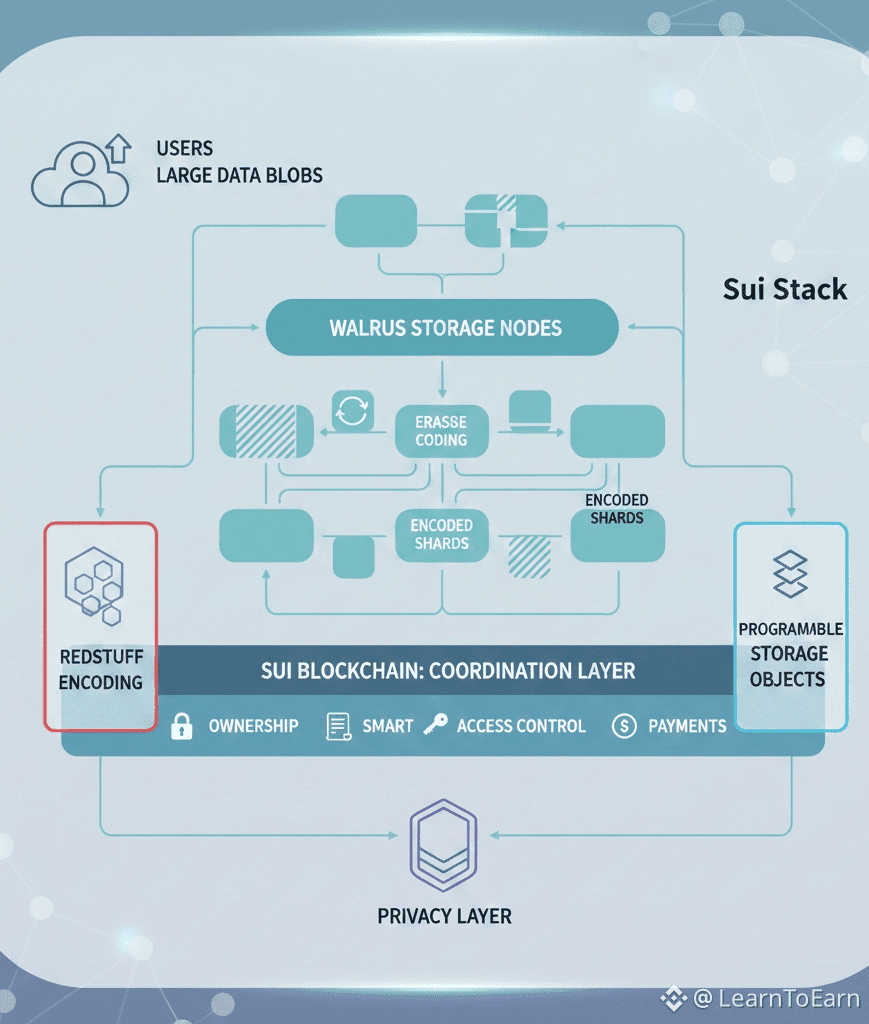
Walrus solves this by creating a specialized, complementary storage layer. It handles the heavy lifting of blob storage, while the Sui blockchain acts as a secure coordination layer, managing ownership, payments, and proofs . This separation allows each system to do what it does best: Sui ensures trust and execution, while Walrus ensures scalable, available, and cost-effective storage.
How Walrus Works: Innovation Under the Hood
Walrus isn't just another distributed drive. It's a sophisticated system engineered for resilience and efficiency, centered around three core technological breakthroughs:
1. RedStuff Encoding: The Efficiency Engine
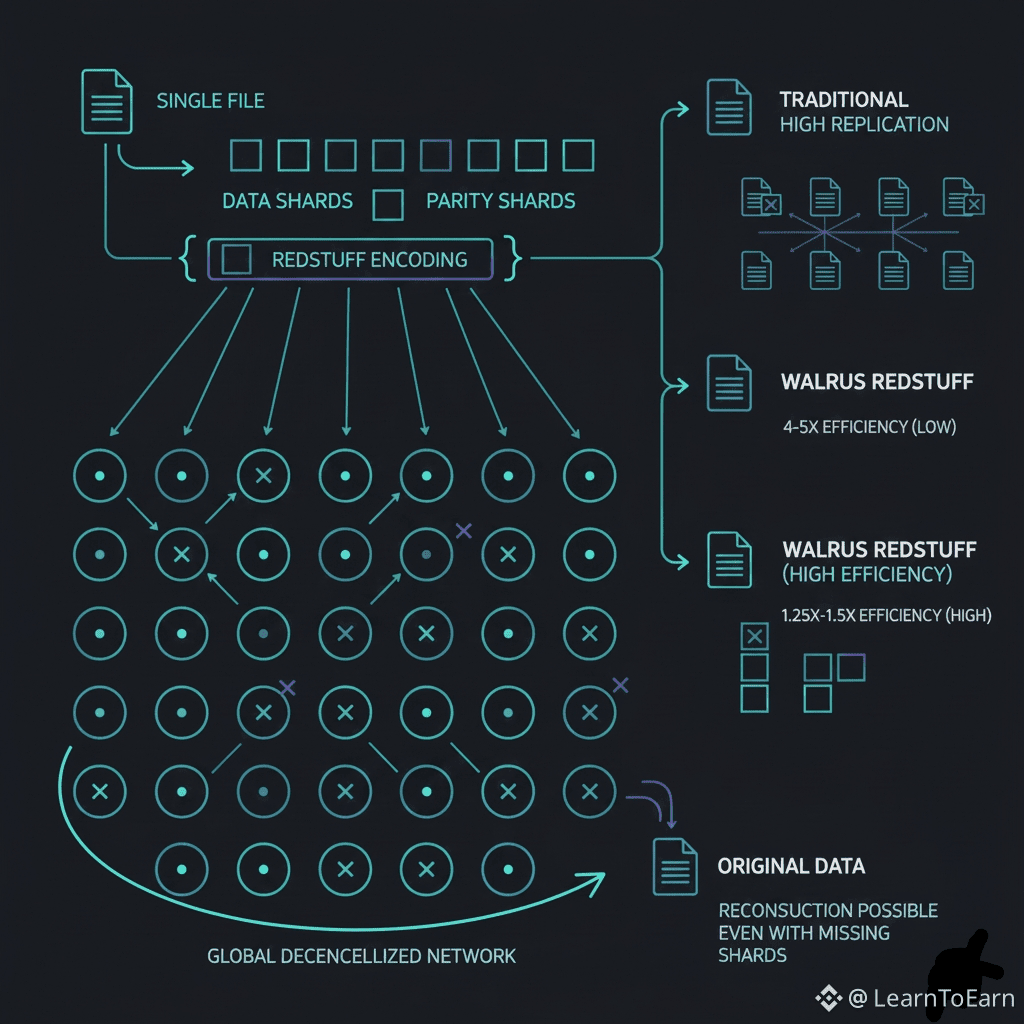
At the heart of Walrus is RedStuff, a proprietary two-dimensional erasure coding scheme . Instead of simply copying a file multiple times (full replication), RedStuff breaks data into smaller pieces, encodes them with redundancy information, and distributes these "shards" across a global network of independent storage nodes .
The magic lies in its efficiency. Where traditional methods might require 10-25x replication for security, Walrus's encoding achieves high durability with only 4–5x replication, dramatically lowering storage costs . More importantly, the original file can be perfectly reconstructed even if a significant portion of the shards are lost or unavailable, ensuring data survives individual node failures .
2. Programmability: Storage as a Smart Asset
This is where Walrus fundamentally diverges from simple storage services. Every file stored on Walrus is bound to a Sui object. This means the blob and its metadata—like ownership, storage duration, and access rules—become manageable on-chain assets .
Developers can write Move smart contracts (Sui's native language) that interact with this storage. Imagine a game that automatically deletes old player data after a season ends, an NFT whose artwork can be programmatically upgraded, or a data marketplace where access is sold via smart contract. Walrus makes this possible by turning static storage into a dynamic, programmable resource .
3. The Seal of Privacy: Built-In Access Control
A major barrier to blockchain adoption is the transparency of public ledgers. What if you need to store sensitive business, healthcare, or personal data? Walrus addressed this in 2025 with Seal, an integrated privacy layer .
With Seal, developers can encrypt data and define granular, on-chain rules for who can access it and for how long . This "programmable access control" is enforced natively, enabling private data marketplaces, confidential DeFi transactions, and secure personal data vaults without compromising decentralization .
Walrus in Action: Real-World Impact
The true test of infrastructure is what builders create with it. In its first year, Walrus has enabled a diverse range of applications that demonstrate its potential:
· AI & Autonomous Agents: Platforms like Talus use Walrus to give AI agents the ability to store, retrieve, and process data on-chain, enabling them to perform complex, real-world tasks .
· User-Controlled Data Economies: CUDIS empowers users to own and monetize their health data. DLP Labs allows electric vehicle drivers to control and earn rewards from their car's performance data .
· Transparent Advertising & Markets: Alkimi brings verifiable transparency to digital advertising, while Myriad has built prediction markets where all trading data is stored verifiably on Walrus .
· Decentralized Web Hosting (Walrus Sites): One of the most accessible innovations is Walrus Sites, which allows anyone to host tamper-proof, serverless websites directly on the network . This is a practical step toward fully decentralized web applications.
The WAL Token: Fueling the Ecosystem
The Walrus network is powered by its native $WAL token, which facilitates a circular economy:
· Payment for Storage: Users pay $WAL to store and manage data.
· Incentives for Operators: Storage node operators earn $WAL for providing reliable service.
· Network Security: Participants can stake $WAL to help secure the network and earn rewards.
· Governance: Token holders can participate in guiding the protocol's future.
Notably, the tokenomics are designed to be deflationary; a portion of WAL is burned with each transaction, creating scarcity as network usage grows . The project is backed by significant institutional support, having raised $140 million from leading investors to fund its development and growth .
Looking Ahead: The Decentralized Data Future
As we move into 2026, Walrus's trajectory is focused on making decentralized storage the default choice for developers . Key priorities include deepening integration with the Sui Stack, enhancing developer tools for effortless use, and doubling down on privacy features to make secure, verifiable data workflows the norm .
Conclusion: More Than Storage, a Foundation for Trust
Walrus represents a fundamental shift. It moves beyond the concept of data as something you simply rent space for, toward data as a verifiable, composable, and sovereign asset. By solving the critical challenges of cost, scalability, and privacy, it provides the missing piece for a new generation of applications—from consumer-grade AI and gaming to enterprise data markets—that are truly built on user ownership and trust.
In assembling the full Sui Stack, Walrus has helped close the gap between the promise of a decentralized internet and what developers can practically build. The infrastructure is now in place. The next chapter will be written by the innovators who use it to reshape our digital world .


