

In modern digital systems, security is often treated as a patch — something added after data has already been created, moved, and exposed. Firewalls protect the edges, encryption protects certain layers, and audits attempt to catch issues after the fact. But in a world increasingly powered by decentralized applications, AI pipelines, financial automation, and onchain logic, this approach is no longer sufficient. Security must exist across the entire lifecycle of data — from the moment data is created, to how it is stored, accessed, updated, and ultimately consumed. This is the philosophy behind Walrus.
Walrus is a decentralized storage and data availability protocol built on Sui, designed to secure systems end-to-end: from input to output. Instead of treating storage as a passive backend, Walrus turns data itself into a first-class, programmable, and provable onchain resource. Every version of data stored on Walrus is not only available and performant, but also verifiable, traceable, and tamper-resistant by design.
Securing the Input: Trust at the Point of Data Creation
Security begins at the moment data enters a system. In traditional architectures, users upload files to centralized servers, trusting opaque infrastructure to handle integrity, availability, and access control. Walrus flips this model. When data is uploaded to Walrus, it is immediately encoded using Red Stuff, Walrus’s two-dimensional erasure coding system. This process fragments data into primary and secondary slivers, distributing them across a decentralized committee of storage nodes.
At the same time, Walrus generates cryptographic commitments for every sliver and aggregates them into a single blob commitment. This commitment becomes the immutable fingerprint of the data. From the very first write, the system can mathematically prove what was uploaded, when it was uploaded, and that it is being stored correctly — without relying on trust in any single operator.
This is what it means to secure input at the protocol level: data cannot quietly change, disappear, or be corrupted without detection.
Securing Storage: Reliability Without Centralization
Once data is stored, the next challenge is reliability. Decentralized systems face constant churn — nodes go offline, networks fluctuate, and participants change. Walrus is built for this reality. Using Red Stuff’s 2D erasure coding, Walrus achieves high durability with far less replication overhead than traditional decentralized storage systems.
Unlike one-dimensional erasure coding, where recovering a single lost fragment can require downloading the entire file, Walrus enables lightweight self-healing. Nodes can recover missing slivers by communicating with only a subset of peers, minimizing bandwidth usage while maintaining availability. Even if up to two-thirds of nodes become unavailable, data can still be recovered once the network stabilizes.
This makes Walrus always reliable — not because it assumes perfect conditions, but because it is engineered to survive imperfect ones.
Securing Access: High Performance Without Compromising Integrity
Security often comes at the cost of speed. Walrus challenges this trade-off. By separating the control plane (on Sui) from the data plane (Walrus storage nodes), the system achieves lightning-fast reads and writes without sacrificing verification.
When a client retrieves data from Walrus, it does not blindly trust storage nodes. Each sliver is verified against onchain commitments before reconstruction. Only a one-third quorum of valid slivers is needed to read data, making retrieval resilient and efficient even during partial outages.
This architecture allows Walrus to serve high-throughput applications — from NFTs and games to AI pipelines and enterprise systems — while maintaining cryptographic guarantees that centralized CDNs simply cannot offer.
Securing Output: Provable, Traceable, Tamper-Resistant Data
What truly sets Walrus apart is its focus on provability. Every version of data stored on Walrus can be traced back to an onchain Proof-of-Availability (PoA) certificate published on Sui. This certificate proves that the data exists, was accepted by the network, and is contractually obligated to be stored for a defined period.
Because blobs and storage resources are represented as objects on Sui, developers can program rules around data usage. Storage can be renewed automatically, access can be gated by smart contracts, and outdated data can be disassociated without breaking integrity guarantees. This transforms data from a static file into a living, programmable asset.
In practice, this means applications can prove not just what data they output, but how it was stored, who paid for it, and whether it has been altered — all without relying on centralized trust.
Why “From Input to Output” Matters
Most systems secure fragments of the pipeline. Walrus secures the entire flow. From the moment data enters the system, through decentralized storage and recovery, to high-performance retrieval and verifiable output, Walrus ensures that security is continuous, not conditional.
This is why Walrus is increasingly chosen as the data layer for:
AI systems that require verifiable training data
Social platforms preserving authentic human records
Adtech and analytics platforms demanding auditability
Web3 applications that need scalable, trust-minimized storage
Enterprise systems bridging onchain and offchain worlds
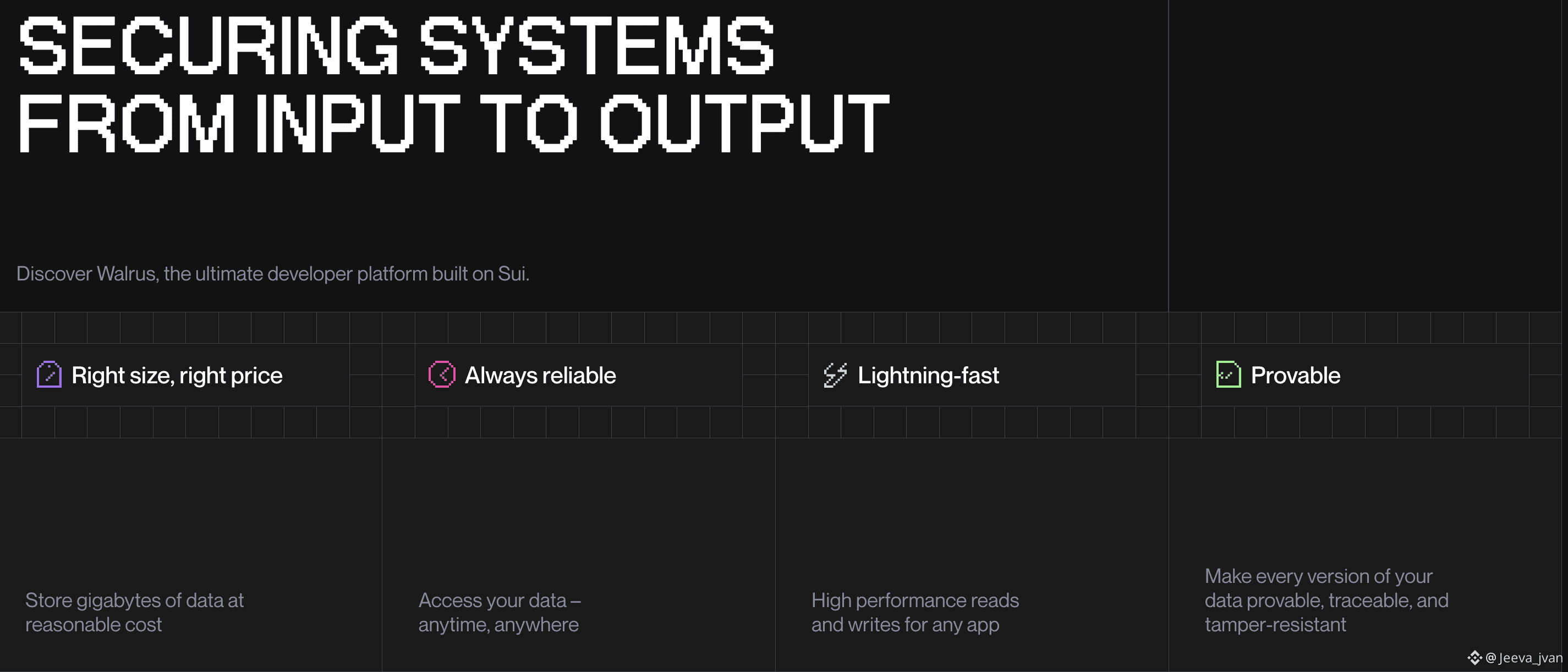
By making data right-sized in cost, always reliable, lightning-fast, and provable, Walrus is not just storing files — it is redefining how systems can be secured in a decentralized world.

Walrus as the Foundation for Secure Web3 Systems
As Web3 matures, infrastructure choices will define what is possible. Security can no longer be an afterthought, and storage can no longer be a black box. Walrus represents a new generation of decentralized infrastructure — one where data is verifiable, programmable, and resilient from start to finish.
Securing systems from input to output is not a slogan. It is a design philosophy. And Walrus is building it into the foundation of the decentralized internet.

