

Decentralized storage only becomes powerful when real applications use it. Walrus is now crossing that critical threshold. What started as a high-performance, programmable storage protocol has evolved into a living ecosystem of applications, all visible through the Walrus Directory—a public, community-driven map of projects building directly on Walrus Mainnet.
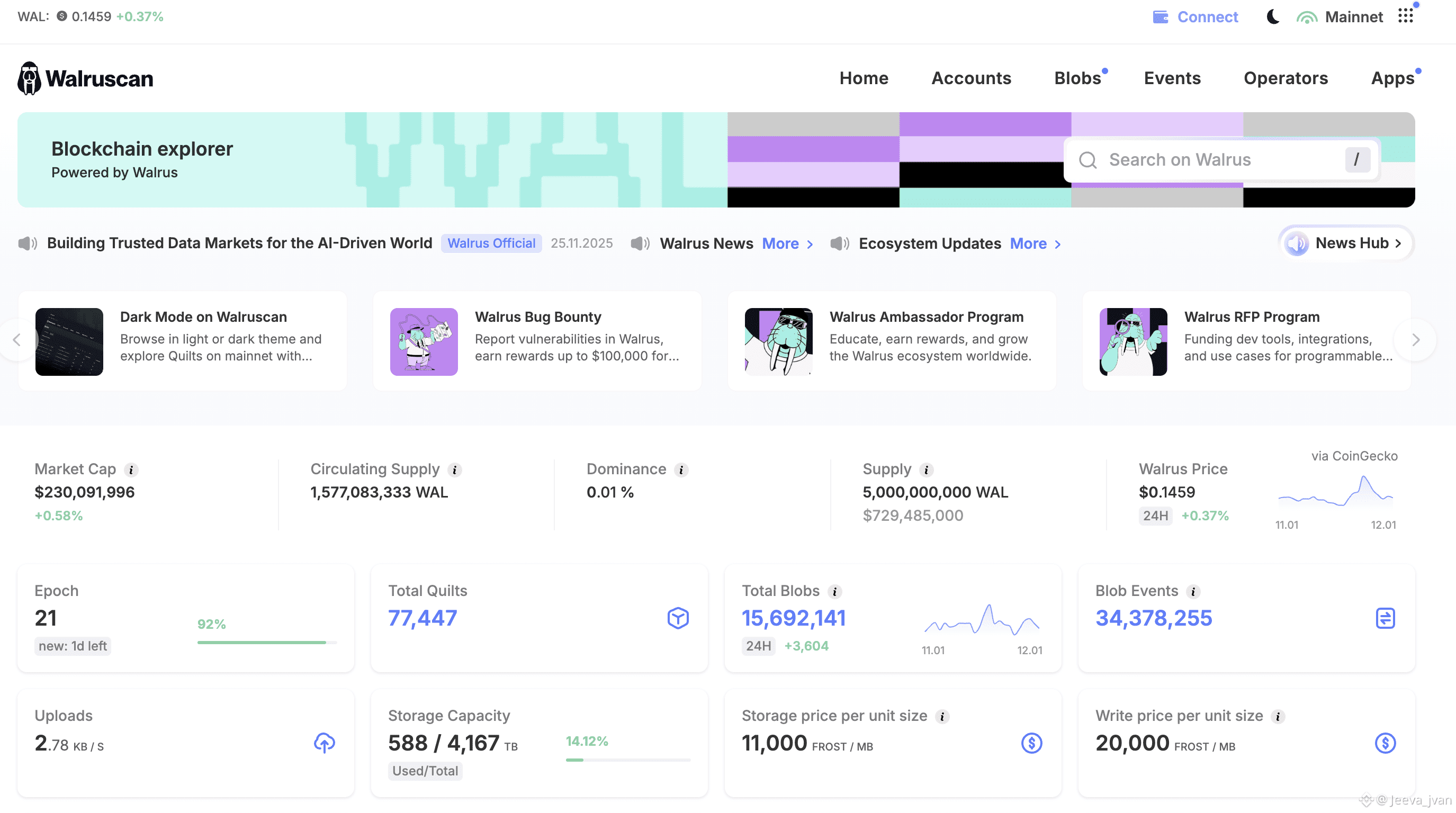
With 170+ live projects already listed, the Walrus ecosystem is no longer theoretical. It is actively powering prediction markets, agent systems, identity layers, creative platforms, and data-driven Web3 applications—each relying on Walrus as their core data layer.
The Walrus Directory: A Public Map of Real Adoption
The Walrus Directory is more than a showcase. It functions as:
A discovery layer for builders and users
A transparency tool showing real Mainnet usage
A living registry that evolves as the ecosystem grows
Because Walrus treats data as a programmable onchain resource, every project listed in the directory is not just “using storage,” but actively interacting with Walrus blobs, proofs, availability guarantees, and economic incentives.
The directory reflects a key shift: Walrus is no longer infrastructure waiting for users—it is infrastructure being used.
What Types of Projects Are Building on Walrus
The diversity of projects in the Walrus Directory highlights the flexibility of the protocol. Builders are not constrained to a single use case. Instead, Walrus supports multiple verticals simultaneously:
1. Prediction Markets & Data-Driven Finance
Projects like MYRIAD show how Walrus can power data-intensive markets where transparency, auditability, and long-term availability are essential. Prediction markets depend on immutable records, historical datasets, and verifiable outcomes—exactly what Walrus is designed to store efficiently at scale.
2. Creative & Cultural Platforms
Apps such as ReMeme demonstrate how Walrus enables onchain culture. Memes, media, and creative assets stored as blobs on Walrus gain permanence, ownership guarantees, and censorship resistance—transforming creativity into durable digital artifacts rather than disposable uploads.
3. Identity & Trust Infrastructure
Protocols like Humanity Protocol use Walrus to store sensitive but verifiable data, combining decentralized storage with cryptographic proofs. This highlights Walrus’s role in trust-minimized identity systems where integrity, privacy, and availability must coexist.
4. Agent & AI-Native Systems
Projects such as ElizaOS point to an emerging trend: agent-based systems that require persistent memory, versioned data, and reliable access. Walrus acts as a long-term memory layer for AI agents and autonomous systems operating across chains and environments.
Why Builders Choose Walrus
The rapid growth of projects in the Walrus Directory is not accidental. Walrus offers a combination that is still rare in Web3 infrastructure:
Programmable storage: Data and storage capacity exist as onchain objects
High availability guarantees: Proof-of-Availability certificates anchored on Sui
Efficient blob storage: Designed for large, unstructured data
Decentralized resilience: Red Stuff erasure coding enables fast recovery
Economic alignment: WAL staking ties security, storage, and incentives together
This allows builders to design applications where data is not an afterthought, but a first-class component of the protocol logic.
Community-Driven Growth, Not Curated Narratives
One of the most important aspects of the Walrus Directory is that it is community-managed. Projects can submit themselves, updates happen continuously, and the ecosystem evolves in public.
This openness matters. It ensures:
No artificial gatekeeping
No “paper partnerships”
No closed ecosystems
If an app is listed, it is building on Walrus. That transparency strengthens trust for developers, users, and integrators exploring the ecosystem.
From Storage Layer to Ecosystem Layer
The Walrus Directory makes one thing clear: Walrus is no longer just a protocol—it is an ecosystem layer.
As more applications rely on:
Persistent data
Verifiable history
Onchain programmability
AI-ready storage
Cross-chain data flows
…the importance of a decentralized, efficient data layer becomes unavoidable. Walrus is positioning itself at the center of that shift.
What Comes Next for Walrus
With:
A growing list of Mainnet projects
Active developer tooling
RFP programs funding new ideas
Expanding integrations across Web3
…the Walrus ecosystem is entering a compounding phase. Each new application increases demand for storage, staking, tooling, and innovation—strengthening the network from the inside out.
The directory is not the finish line. It’s the signal that Walrus is working in the real world.
Final Thought
Infrastructure only matters when people build on it. The Walrus Directory proves that builders are not just experimenting—they are committing.
Walrus is becoming the default data layer for applications that need storage they can trust, program, and scale.
And this ecosystem is just getting started. @Walrus 🦭/acc #walrus $WAL

