

As blockchain adoption expands beyond retail crypto into institutional finance, a fundamental problem becomes impossible to ignore: public blockchains were never designed for regulated markets. Financial institutions need compliance, privacy, fast settlement, and legal clarity—without sacrificing decentralization.
Dusk Network is built specifically to solve this gap. It is a privacy-enabled, regulation-aware blockchain designed to bring real-world financial markets on-chain while meeting strict regulatory and institutional requirements.
What Is Dusk?
Dusk is a Layer-1 blockchain purpose-built for regulated financial activity. It allows institutions and developers to launch and operate markets where:
Regulatory compliance is enforced on-chain
User balances and transfers remain confidential
Settlement is fast, final, and deterministic
Developers work with familiar EVM tools enhanced with native privacy
At its core, Dusk combines:
Zero-knowledge cryptography for confidentiality
On-chain compliance logic aligned with MiCA, MiFID II, GDPR, and the EU DLT Pilot Regime
Succinct Attestation, a proof-of-stake consensus protocol with instant finality
A modular architecture separating settlement from execution
Dusk is not a general-purpose blockchain retrofitted for finance—it is designed for finance from day one.
Why Dusk Exists
Most global financial markets still run on opaque, centralized infrastructure. While blockchains promise transparency and automation, fully public ledgers conflict with regulatory obligations around privacy, disclosure, and data protection.
Dusk bridges this divide by enabling:
Confidential transactions without sacrificing auditability
Permissioned and public flows within the same protocol
On-chain enforcement of real-world financial rules
In short, Dusk enables institutional finance to move on-chain without breaking the rules.
Built for Regulated Markets
Dusk is designed around the needs of regulated institutions such as banks, exchanges, asset issuers, and payment providers.
Key capabilities include:
Compliant issuance of securities and RWAs
Identity-aware transaction flows
Permissioning at the protocol level
Smart contracts that enforce eligibility, limits, and reporting
This allows institutions to issue, trade, and settle assets directly on-chain while remaining compliant with existing legal frameworks.
Privacy by Design, Transparency When Required
Dusk introduces a dual transaction model that lets users choose how much information is revealed:
Public transactions for transparent market activity
Shielded transactions for confidential balances and transfers
Using zero-knowledge proofs, Dusk ensures that sensitive financial data stays private by default—but can be selectively disclosed to regulators, auditors, or authorized parties when legally required.
This balance between privacy and accountability is critical for real-world financial adoption.
Fast, Final Settlement
Dusk runs on Succinct Attestation, a proof-of-stake, committee-based consensus mechanism designed for financial markets.
Key properties:
Deterministic finality once a block is ratified
No user-facing chain reorganizations
Low-latency, high-throughput settlement
This makes Dusk suitable for use cases where certainty and speed are non-negotiable, such as trading, payments, and delivery-versus-payment (DvP) settlement.
Modular and EVM-Friendly Architecture
Dusk separates execution from settlement to maximize flexibility and performance.
DuskDS
Handles:
Consensus and data availability
Settlement logic
Native privacy-preserving transactions
DuskEVM
Ethereum-compatible execution environment
DUSK token used as native gas
Supports existing Solidity tooling
Assets can move seamlessly between layers, allowing developers to choose the right execution environment for each use case without compromising compliance or privacy.
What Can You Build on Dusk?
Dusk is designed to support a wide range of regulated and institutional applications:
Regulated Digital Securities
Tokenized equity, debt, and funds
Embedded compliance rules
Privacy-respecting cap tables
Institutional DeFi
KYC/AML-compliant lending and AMMs
Private positions with public market signals
Structured financial products
Payment & Settlement Infrastructure
Confidential inter-institution payments
Atomic DvP settlement of tokenized assets
Identity & Access Control
Permissioned markets using verifiable credentials
Smart-contract enforced access rules
Dusk enables developers to build real financial infrastructure, not experimental prototypes.
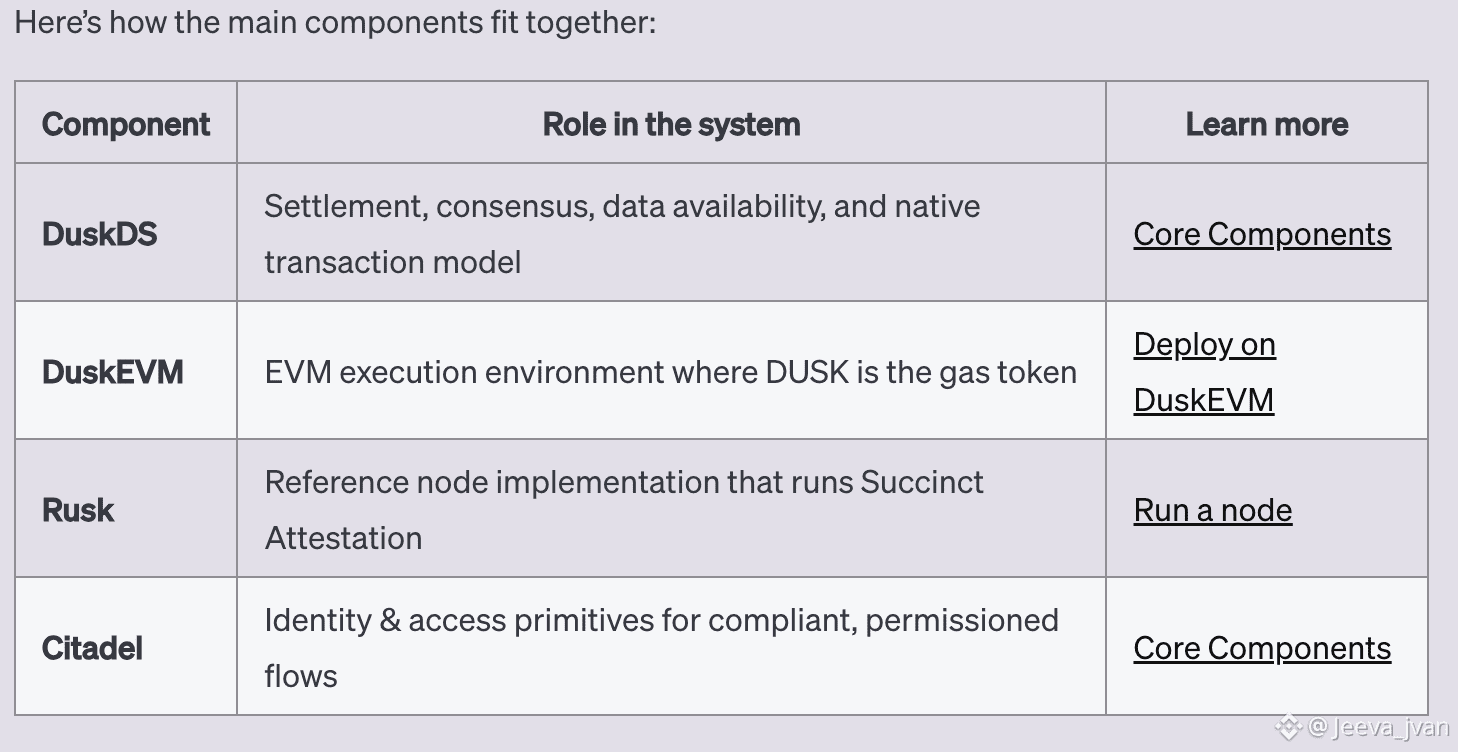
Architecture at a Glance
Component
Role
DuskDS
Settlement, consensus, privacy, data availability
DuskEVM
EVM execution environment
Rusk
Reference node implementation
Citadel
Identity and access primitives
Each component is designed to work together while remaining modular and upgradeable.
Getting Started with Dusk
Whether you’re a user, developer, or node operator, Dusk offers multiple ways to participate:
Use Dusk – Interact via the Web Wallet
Stake DUSK – Secure the network and earn rewards
Build on Dusk – Develop on DuskDS or DuskEVM
Join the Community – Collaborate and get support
For deeper technical exploration, developers can dive into the Core Components, Cryptography docs, or the Dusk Whitepaper.
Final Thoughts
Dusk is not trying to replace public blockchains—it complements them by solving what they cannot: regulated, private, on-chain finance at scale.
By combining privacy, compliance, fast settlement, and EVM compatibility, Dusk positions itself as the blockchain layer where institutional finance can finally operate without compromise.
As regulation tightens and institutions move on-chain, Dusk is built for what comes next. @Dusk #dusk $DUSK
