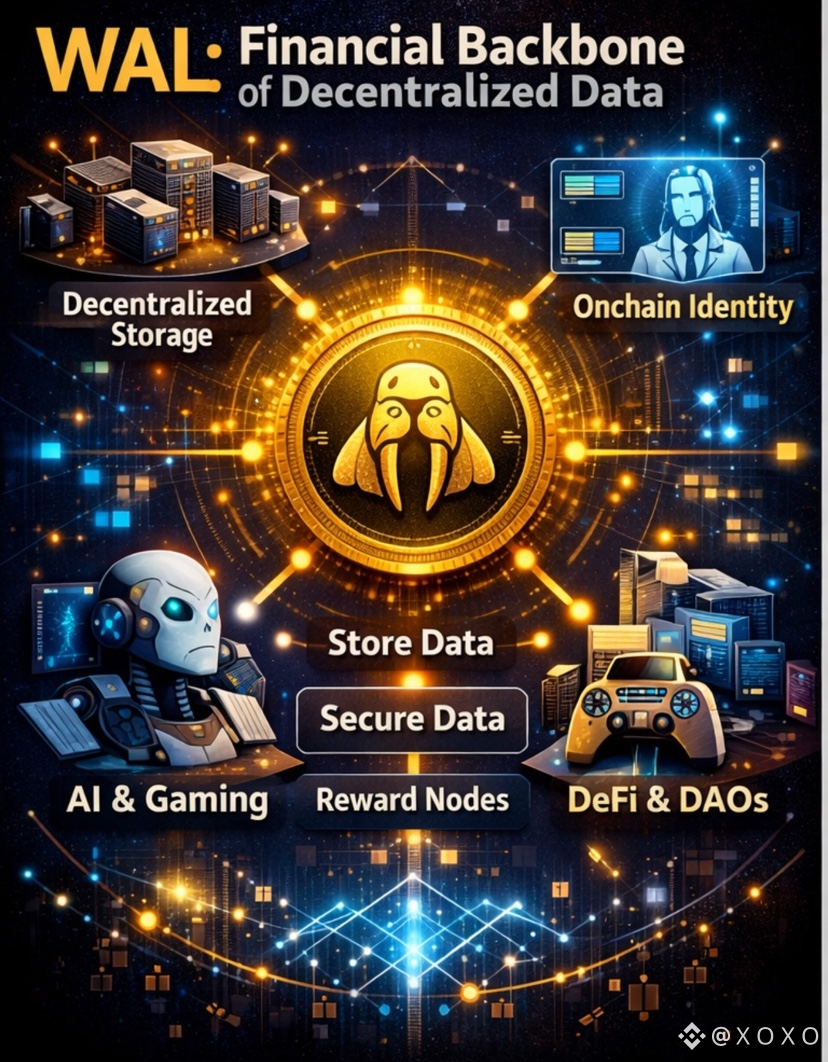
When people talk about Web3, they usually start with blockchains, tokens, or smart contracts. They talk about transactions, gas fees, and speculation. But underneath everything, there is a quieter layer that almost never gets the attention it deserves: data. Every NFT, every DAO vote, every AI agent, every DeFi position and every onchain identity is not just a transaction. It is a piece of data that must exist, remain available, and stay verifiable long after the block it was created in is forgotten. In traditional systems, this job is done by centralized servers owned by corporations. In decentralized systems, this job is much harder, because nobody owns the database. And that is exactly where @Walrus 🦭/acc and its token WAL step in.
Walrus is not trying to be another blockchain. It is not competing with Ethereum, Sui, or Solana. It is solving a different problem, the one that every decentralised application quietly depends on but rarely talks about: how to store, retrieve, and verify large amounts of data in a way that is trustless, persistent, and economically sustainable. WAL is the economic engine that makes that system work. Without WAL, Walrus would just be a clever technical idea. With WAL, it becomes an actual economy around data.
To understand why this matters, it helps to think about how Web2 works. When you upload a photo, a document, or a piece of code to a Web2 platform, that data lives on a server controlled by a company. You do not really own it. You are renting space on someone else’s machine. If the company goes bankrupt, changes its terms, or simply decides to delete your data, you have no recourse. In Web3, we claim to want something better. We want applications that cannot censor users, identities that cannot be erased, and financial systems that do not depend on a single gatekeeper. But all of that collapses if the underlying data is still stored in fragile or centralized ways.
Most blockchains are very bad at storing large data. They are optimized for consensus, not for storage. Putting large files directly on a blockchain is expensive and inefficient. That is why so many dApps quietly rely on centralized storage or semi decentralized solutions. The result is a huge gap between the promise of decentralization and the reality of how data is handled. Walrus is designed to close that gap by creating a decentralized storage and data availability network that is tightly integrated with economic incentives.
WAL is the token that ties this system together. At the most basic level, WAL is used to pay for storage. When someone wants to store data on Walrus, they pay in WAL. That data is then distributed across a network of storage nodes, which are run by independent operators. These operators are not just hosting files for free. They are being paid in WAL to store data, keep it available, and prove that they are doing so honestly.
This is where Walrus becomes much more than just decentralized Dropbox. Storage nodes are required to continuously prove that they still hold the data they are responsible for. These proofs are verified by the network. If a node fails to provide valid proofs, it can lose its rewards or even be penalized. This creates a direct financial incentive to behave honestly. WAL is not just a payment token. It is a mechanism that enforces reliability.
In traditional storage systems, reliability comes from legal contracts and corporate reputation. In Walrus, reliability comes from cryptography and economics. The token creates a situation where it is more profitable to store data correctly than to cheat. That is the foundation of decentralized data.
What makes this especially powerful is how it interacts with the rest of Web3. Imagine an AI agent that makes trading decisions. It relies on historical data, model weights, and execution logs. If any of that data disappears or is tampered with, the agent’s behavior becomes unverifiable. Or think about an onchain identity system that stores credentials and reputation. If old records vanish, people can rewrite their past. Governance systems face the same problem. Votes, proposals, and execution results must remain accessible forever if they are to be trusted.
Walrus provides the memory layer for all of this. WAL turns that memory into something that can be funded, maintained, and scaled. Instead of hoping that someone somewhere will keep the data alive, the network pays for it to stay alive.
There is also a deeper financial dimension here. Data is not just something that needs to be stored. It is becoming an asset. In Web3 and AI, high quality data is valuable. Training sets, onchain histories, game states, user behavior logs, and model outputs all have economic value. Walrus makes it possible to store and reference this data in a way that is neutral and verifiable. WAL becomes the currency that prices this data economy.
Think about what happens when data is priced properly. Right now, most decentralized applications underprice data because they do not directly pay for long term storage. They rely on IPFS pinning services, cloud providers, or best effort hosting. That works until it does not. With Walrus, developers can build applications that know exactly how much it costs to store and keep data available for years. That makes business models more realistic and more sustainable.
For users, this means something important as well. When you upload something to a Walrus powered application, you are not just trusting a company. You are paying into a network that is economically designed to keep your data safe. WAL aligns the interests of users, developers, and node operators around one goal: persistence.
One of the most interesting aspects of WAL is that it connects storage with staking and security. Storage providers typically have to stake WAL to participate. That stake acts as collateral. If they behave badly, they can lose it. This creates a form of economic security similar to what blockchains use to secure consensus. Instead of securing blocks, WAL secures data.
Over time, this can create a very large and very stable economy. As more data is stored, more WAL is locked into storage contracts and stakes. This reduces circulating supply and ties the token’s value to the real usage of the network. In other words, WAL is not just a speculative asset. It is a working asset that reflects how much the world is relying on Walrus for data.
This is where the idea of WAL as a financial backbone becomes very real. Just as ETH is the fuel for Ethereum and SOL is the fuel for Solana, WAL is the fuel for decentralized data. But data is arguably even more fundamental than transactions. Every blockchain, every AI system, and every decentralized application ultimately depends on data being available and trustworthy.
As Web3 moves beyond simple tokens and into areas like real world assets, gaming, identity, and autonomous agents, the amount of data that needs to be stored explodes. A single game can generate millions of state updates. A single AI agent can produce huge logs and models. A single RWA platform can require long term records for compliance and auditing. None of this fits well on a blockchain alone.
Walrus is built for this reality. It does not try to squeeze data into blocks. It builds a separate but connected network that is optimized for storing and proving data at scale. WAL is the economic glue that holds this network together.
There is also a strategic dimension here. Most storage networks focus on being cheap. Walrus focuses on being reliable and verifiable. That is a subtle but important difference. In a decentralized world, the biggest risk is not just cost. It is silent failure. Data that looks available but is not, or data that has been subtly altered. By requiring ongoing proofs and tying them to WAL incentives, Walrus reduces that risk.
For developers building on Sui and other chains, this is especially attractive. They get a storage layer that feels like part of the chain, even though it is not limited by block size or gas. WAL makes this integration possible by providing a simple and consistent way to pay for and secure data.
Over time, this could reshape how we think about onchain applications. Instead of designing around the limitations of block storage, developers can assume that large, persistent, verifiable data is available. That opens the door to much richer applications, from fully onchain games to complex AI driven systems.
From an investment and ecosystem perspective, WAL sits in a very interesting position. It is not competing with layer ones or layer twos. It is complementing them. Every successful chain and every successful application needs data. As usage grows, the demand for reliable storage grows with it. WAL captures that demand.
This also means that WAL has a kind of diversification built in. It is not tied to one specific narrative like DeFi or NFTs. It benefits from all of them. If gaming grows, WAL benefits. If AI agents grow, WAL benefits. If onchain governance and identity grow, WAL benefits. All of these trends increase the need for decentralized data.
Of course, no system is perfect. Decentralized storage is hard. It requires strong cryptography, good networking, and carefully designed incentives. Walrus is still early, and it will have to prove itself at scale. But the direction is clear. The industry is moving toward more data heavy applications, not fewer. And centralized storage is a weak point in an otherwise decentralized stack.
WAL gives that stack a financial foundation. It turns data from a hidden dependency into a first class economic layer. It makes persistence something you can pay for, secure, and rely on.
When people look back at this period of Web3, they might realize that the biggest breakthroughs were not just in faster chains or cheaper transactions, but in making data truly decentralized. Walrus and WAL are aiming to be at the center of that shift.
My take is that WAL is one of those tokens that makes more sense the more you think about what Web3 is really trying to become. If decentralized applications are going to replace centralized ones, they need decentralized memory. WAL is not just a token for storage. It is a token for trust in data. And in a world of AI, autonomous agents and onchain economies, that might turn out to be one of the most valuable things you can own.