
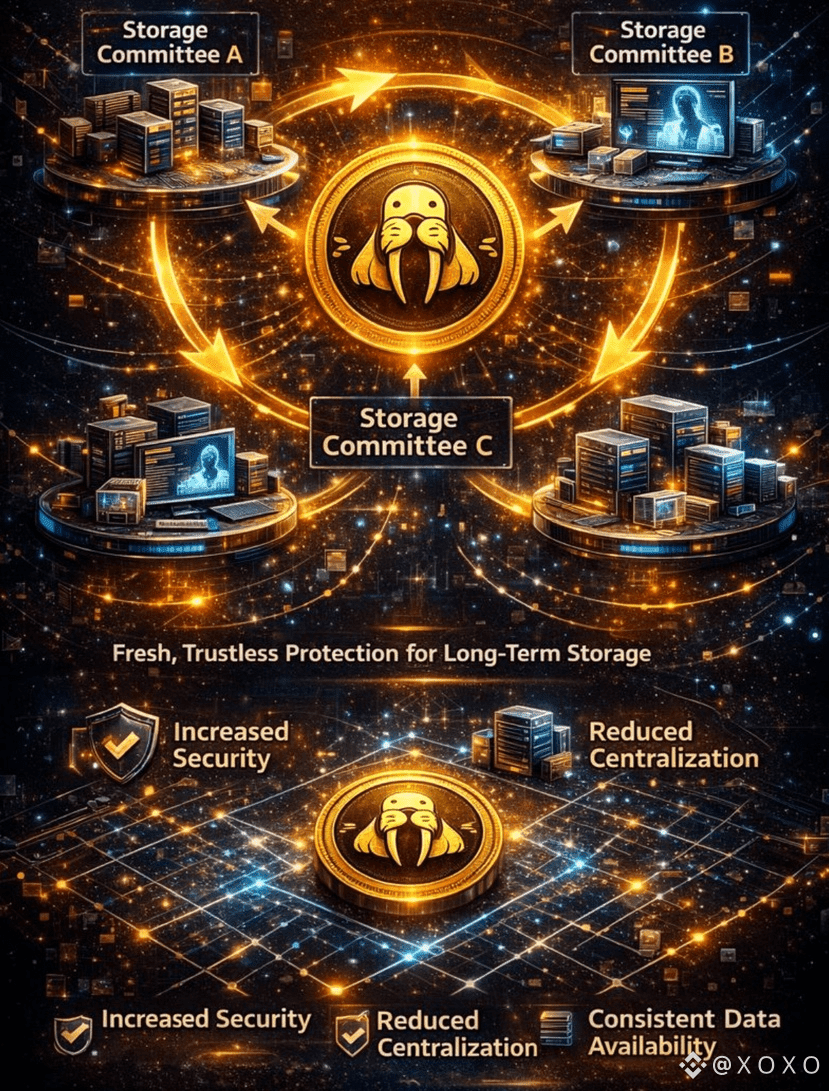


One of the easiest mistakes to make when thinking about decentralized storage is to imagine it like a static cloud. You picture a set of servers somewhere holding data and you assume that as long as they stay online everything is fine. But Walrus was never designed to work like that. It was built with a much deeper understanding of what happens when real money, real data, and real adversaries are involved. That is why one of its most important and least talked about features is the rotation of storage committees.
To understand why this matters, we have to start with what a storage committee actually is in Walrus. When data is stored on the network, it is not just scattered randomly. It is assigned to a specific group of nodes that are responsible for holding it, serving it, and continuously proving that they still have it. That group is the committee for that piece of data. These nodes are economically bonded through WAL, meaning they have something to lose if they fail or cheat.
In a naive system, you might think that once a committee is chosen, it can just keep that data forever. After all, stability sounds good. The same nodes keep the same data and everything is predictable. But in adversarial systems, predictability is a weakness. If attackers know exactly which nodes are holding which data, they can target them. If operators know they will keep the same data forever, they might slowly become lazy, underinvest in hardware, or collude. Over time, the system drifts away from the ideal of decentralised.
@Walrus 🦭/acc avoids this trap by rotating its storage committees. That means the responsibility for holding a given piece of data moves over time from one set of nodes to another. The data itself does not disappear or get re uploaded by users. The network orchestrates the handoff, verifying that the new committee has the data before the old one is released from its obligations. This might sound like an implementation detail, but it is actually a core security and economic design choice.
Rotation turns data storage from a static assignment into a continuous process. Nodes cannot just be good once and then coast forever. They have to repeatedly prove that they are capable, online, and honest. Every rotation is a kind of test. Did the old committee keep the data intact. Did it serve it correctly. Did the new committee receive and verify it properly. Each step is enforced by cryptographic proofs and WAL backed incentives.
From a security perspective, this is extremely powerful. In a static system, an attacker only needs to compromise or collude with the nodes holding a piece of data once. After that, they can quietly degrade availability or try to manipulate it. In a rotating system, the attacker would need to repeatedly control a majority of every committee that ever holds that data. That is orders of magnitude harder, especially when committee membership is randomized and influenced by stake.
Rotation also protects against a more subtle threat: slow decay. Storage is not just about whether a file exists today. It is about whether it will exist and be retrievable years from now. Hardware fails. Operators leave. Incentives change. A static committee that was healthy in year one might be unreliable in year three. By forcing data to move, Walrus continuously refreshes the set of machines and operators responsible for it. Old hardware is replaced by new. Underperforming nodes are naturally filtered out because they lose rewards or get slashed.
There is also an important economic angle. WAL is used to stake, earn, and be penalized. If committees never rotated, large operators could accumulate massive portions of the network and lock in their position. They would have stable income streams from the same data forever. That creates centralization pressure. Rotation prevents that by making access to storage revenue more dynamic. Nodes have to keep competing for committee assignments by providing good service and staking WAL. This keeps the storage market healthier and more decentralized.
For users and developers, rotation means something even more important: long term reliability without trust. You do not have to know who is storing your data. You do not have to trust that they will still be around in five years. The network itself takes on that responsibility. By moving data through many independent operators over time, Walrus reduces the risk that any single failure or group can erase or corrupt history.
This is especially critical for the kinds of applications Walrus is targeting. Onchain identity systems need decades of persistence. Governance records need to be immutable and accessible. AI agents need to keep logs and models that can be audited. Games need to preserve state. All of these use cases fail if data quietly disappears or becomes unverifiable. Committee rotation makes it much harder for that to happen.
It is also worth noting that rotation interacts deeply with Walrus’s proof of storage system. Nodes are not just asked to say they have data. They have to produce cryptographic proofs that are checked by the network. During a rotation, these proofs become even more important because they verify that the data was correctly transferred. WAL backs this whole process. If a node lies, it risks losing its stake. If it behaves well, it earns rewards.
This creates a kind of virtuous cycle. Honest behavior is continuously reinforced. Dishonest or lazy behavior is continuously punished. Over time, the network evolves toward a set of operators that are actually good at doing the job.
There is also a philosophical layer here. Walrus is treating data not as something static, but as something alive. It moves. It is checked. It is re validated. That is much closer to how trust works in human systems. We do not trust someone once and forever. We trust them because they keep showing up and doing what they said they would do. Committee rotation applies that same idea to machines and networks.
From a scaling perspective, rotation helps as well. As the network grows and more nodes join, data can be spread across a larger and more diverse set of participants. This improves geographic distribution, hardware diversity, and resilience against correlated failures. A static system tends to ossify. A rotating system stays flexible.
Some people worry that moving data around introduces complexity and risk. That is true. It is harder to build. But Walrus is choosing the harder path because the alternative is a system that looks decentralized but slowly becomes fragile. By designing rotation into the core of the protocol, Walrus is saying that long term trust is more important than short term convenience.
Over time, as more applications rely on Walrus, this design choice becomes even more important. The more valuable the data, the more attractive it is to attack. Rotation makes those attacks more expensive and less likely to succeed. It turns data storage into a moving target.
My take is that storage committee rotation is one of those features that only reveals its importance when you think in years instead of weeks. It is easy to build something that works today. It is much harder to build something that will still work when it holds the collective memory of decentralized economies. Walrus is trying to do the latter. By constantly reshuffling who holds the data and by backing that process with WAL incentives and cryptographic proofs, it is building a storage layer that does not just exist, but endures.