The digital world was supposed to give us freedom, but over time it quietly took something away. Our data. Our work. Our history. Everything we create online today lives at the mercy of centralized systems that can fail, censor, or disappear without warning. Accounts get locked. Platforms shut down. Years of effort can vanish in a moment. Walrus exists because this reality is no longer acceptable.
Walrus is a decentralized data storage and availability protocol built on the Sui blockchain, designed to give data permanence, independence, and resilience. It is not simply another crypto project or a temporary trend. It is infrastructure, built for a future where data must survive beyond companies, platforms, and shifting policies. At its core, Walrus is about one idea: data should belong to the people who create it, not the systems that host it.
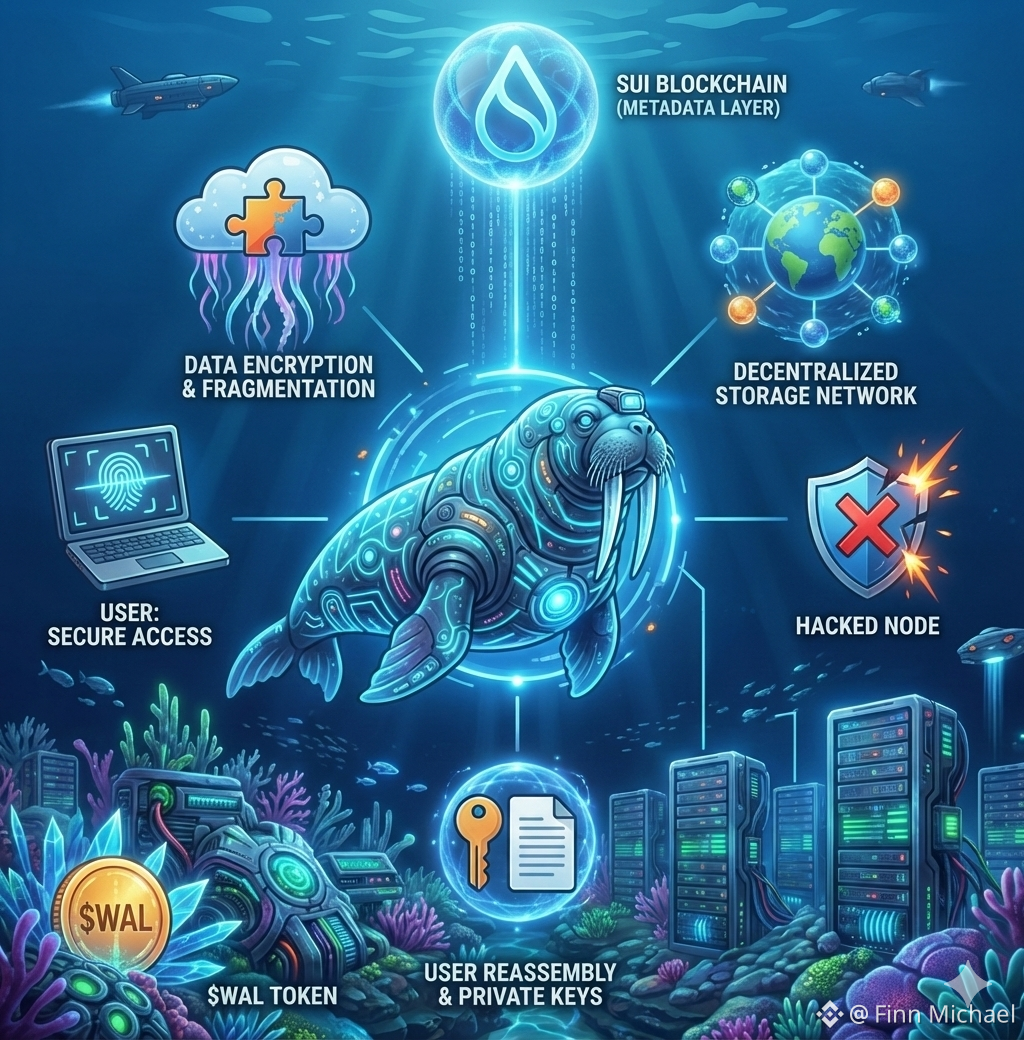
Instead of storing files in a single location or endlessly copying them across servers, Walrus takes a fundamentally different approach. Data is converted into immutable blobs and mathematically encoded into smaller fragments. These fragments are then distributed across a decentralized network of independent storage providers. No single node controls the data. No single failure can destroy it. Even if parts of the network go offline, the original file can still be reconstructed. This design makes data resilient by default, not as an afterthought.
What makes Walrus especially powerful is its efficiency. Traditional decentralized storage often relies on heavy duplication, which increases costs and limits scalability. Walrus uses advanced erasure coding to protect data without waste. Only a portion of the stored fragments is needed to recover the original file, allowing Walrus to maintain strong availability guarantees while keeping storage costs predictable and sustainable. This balance is what allows decentralized storage to move from theory into real-world use.
The Sui blockchain serves as the coordination layer that makes this system trustworthy and programmable. Sui does not store the data itself. Instead, it records ownership, manages payments, enforces storage rules, and verifies that data remains available. Storage on Walrus becomes a programmable on-chain object, meaning developers can build applications that interact with stored data through smart contracts. This separation of data and coordination allows Walrus to scale without sacrificing transparency or security.
The WAL token is the economic backbone of the protocol. Users pay in WAL to store data, and those payments flow directly to the operators who maintain it. Storage providers must stake WAL as collateral, creating real consequences for failure or dishonesty. If a provider does not meet availability requirements, they risk losing their stake. This system replaces blind trust with measurable accountability. Every participant has something at stake, aligning incentives across the entire network.
WAL also represents participation and ownership. Token holders take part in governance decisions that shape the future of the protocol. Changes to economic parameters, upgrades, and long-term direction are decided collectively. This ensures Walrus evolves through community consensus rather than centralized control, keeping the network aligned with its original mission.
The impact of Walrus reaches far beyond storage alone. AI development depends on massive datasets and large models, yet most of this data remains locked behind centralized infrastructure. Walrus opens the door to transparent, decentralized AI by providing a reliable place for datasets and models to live and be verified. NFTs gain real permanence when their media and metadata are stored in a system designed to last. Decentralized websites can exist without fear of takedowns. Blockchain networks can archive their own history without overloading their chains.
What truly sets Walrus apart is not just what it does, but what it represents. It challenges the idea that digital work is disposable. It rejects the notion that access should depend on permission. It offers a future where data does not disappear because it becomes inconvenient or unprofitable.
Walrus is not promising shortcuts or instant adoption. Decentralized infrastructure takes time, trust, and real usage to prove itself. But every meaningful technological shift begins with a refusal to accept the status quo. Walrus is built for those who believe that the digital world should be resilient, open, and fair by design.
In a time when data defines identity, creativity, and value, Walrus stands for something fundamental: the right to create without fear, to store without surrender, and to remember without permission.