
Let’s be real most blockchains are still trying to be everything to everyone and failing spectacularly when it comes to actual regulated finance. Dusk from day one took a different path. Its goal wasn’t to chase hype or become another general-purpose chain. It was to make privacy compliance and speed work together in a way institutions can actually rely on. To understand why Dusk feels different you need to look under the hood at how the system is built and why those decisions actually matter.
At a high level Dusk combines a carefully designed peer to peer network a fast deterministic consensus mechanism flexible transaction models and a virtual machine built for privacy and compliance. Each piece solves a real pain point that traditional blockchains stumble on when handling regulated assets.
Kadcast Networking That Actually Works
Everything starts with moving data. If your network is slow or unpredictable nothing else matters. Dusk solves this with Kadcast its peer-to-peer protocol built for reliability at scale. Unlike naive gossip networks where every node talks to everyone else Kadcast structures message propagation along efficient paths. That reduces wasted bandwidth and ensures transactions reach the right parties predictably which is a big deal when milliseconds matter in finance.
It’s also resilient. Nodes can fail go offline or act maliciously and Kadcast keeps messages flowing. No centralized relays. No fragile assumptions. For a bank issuing tokenized bonds or an investment firm trading regulated securities that kind of network reliability isn’t optional it’s essential. Kadcast is the plumbing that makes the rest of the stack actually usable.
Succinct Attestation Fast Finality Without the Drama
Consensus is usually where blockchains get slow or unpredictable. Waiting ten minutes for a transaction to confirm or worrying about chain reorganizations is a nonstarter for institutions. Dusk solves this with Succinct Attestation SA
SA isn’t just another consensus protocol it’s a design that delivers deterministic finality in seconds. Compact cryptographic attestations prove agreement across the network without requiring every node to vote or mine endlessly. Transactions are settled fast and predictably which is exactly what a regulated exchange or institutional asset platform needs.
The neat part SA works hand in hand with privacy. Attestations do not reveal transaction details so you get speed and finality without compromising confidentiality. It’s like combining the predictability of traditional finance with the decentralization of blockchain.
Moonlight and Phoenix Pick Your Privacy
Dusk does not force a single transaction model. It offers Moonlight and Phoenix two approaches that cover very different needs.
Moonlight is for confidential transactions. Amounts and participants are hidden while still allowing correctness verification. Transparent transactions are cheaper and easier to process ideal for operations where confidentiality is not needed or throughput is the priority.
The takeaway Dusk is flexible. Some operations need privacy some do not. Instead of shoehorning everyone into one model it gives developers tools to make trade-offs intelligently.
Energy Efficiency Because Waste Matters
Blockchains are notorious for being wasteful. Dusk takes energy seriously. SA avoids mining style inefficiency.Transaction models avoid bloated proofs.
This is not just about being green. Lower resource use reduces validator costs and makes the network more accessible. If institutions are evaluating blockchain infrastructure energy efficiency becomes a financial consideration as much as an environmental one. Dusk tackles it head-on.
The Dusk VM and Genesis Contracts
At the execution layer Dusk’s virtual machine is built for privacy from day one. Smart contracts can enforce compliance rules automatically. Ownership limits jurisdictional restrictions and transfer rules are encoded at the protocol level. Assets behave correctly by default instead of relying on off-chain enforcement.
They anchor everything transparently from day one. The VM also seamlessly supports Moonlight and Phoenix transactions letting developers work within a single execution environment while still taking advantage of Dusk’s privacy and performance features.
A Real World Use Case
To make this concrete imagine a midsized European investment firm issuing tokenized corporate bonds. On Ethereum every trade every holder and every movement would be visible to competitors. On a pure privacy chain regulators would never sign off.
With Dusk the firm uses the Confidential Security Token standard. Compliance rules are baked into smart contracts. Only whitelisted investors can participate transfers are jurisdiction aware and dividends are automatically processed. Transactions remain confidential but auditors can verify them selectively. Settlement is instant thanks to SA consensus and the network can integrate with licensed exchanges for regulated trading. The firm cuts out intermediaries reduces settlement time from days to seconds and regulators sleep easy.
This is not sci-fi. It is happening now. Dusk is built for situations like this where speed privacy and compliance are all required simultaneously.
Why Dusk Matters
Most chains retrofit privacy or bolt compliance on after the fact. Dusk builds it from the ground up. Its architecture is not flashy it is deliberate. It aligns with the realities of regulated finance rather than assuming institutions will adapt to blockchain quirks.
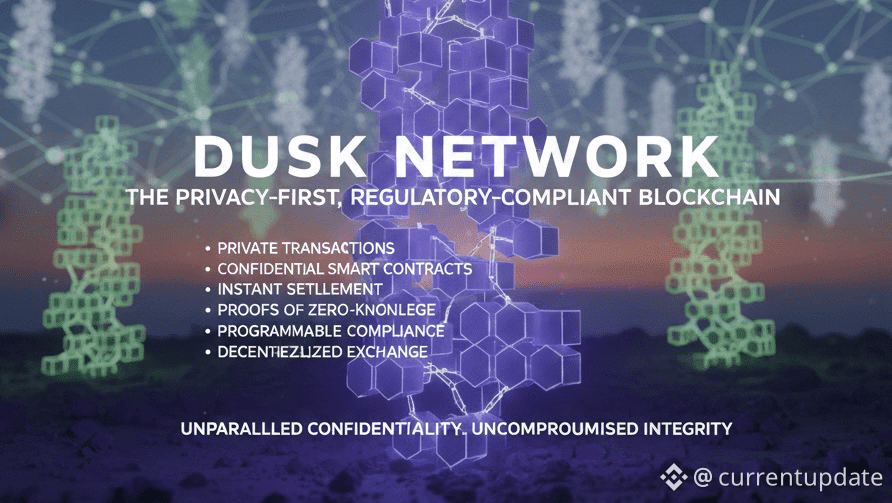
Kadcast keeps communication reliable. SA delivers deterministic fast consensus. Moonlight and Phoenix give flexible privacy. Energy efficient design makes it sustainable. The virtual machine ensures assets behave correctly by default. Together this stack is not just functional it is cohesive predictable and trustworthy.
For anyone building regulated financial applications Dusk feels like the first blockchain designed with their actual needs in mind rather than forcing them to bend to an experimental system.
Conclusion
Understanding Dusk’s technical foundations makes one thing clear. This is not an experiment. It is infrastructure. Every layer from networking to consensus to execution has been shaped by real world constraints. It is privacy first without ignoring compliance fast without sacrificing security and flexible without compromising simplicity.
In 2026 and beyond as tokenized assets and regulated financial applications grow networks like Dusk are likely to be the backbone. It is the uncomfortable middle ground between public transparency and private confidentiality. And as far as institutional grade blockchain infrastructure goes Dusk is quietly setting the standard.
