
When I first started diving into the Sui network nearly a year ago one thing struck me almost immediately the network was not just another collection of DeFi darlings and NFT playgrounds. There was a thoughtful stack emerging and at its heart was a protocol most crypto traders barely talk about Walrus. In my assessment this under the radar project is quietly building what could become the backbone of next generation decentralized applications and its implications go far beyond typical storage projects like IPFS Filecoin or Arweave.
Walrus did not just appear overnight. It was launched on the Sui mainnet in 2025 after raising $140 million in private funding led by Standard Crypto and Franklin Templeton Digital Assets among others which signaled early institutional confidence in its design and mission.
While most narratives about Sui center around its super fast parallelized transaction execution. Walrus is engineered to solve one of Web3’s absurdly persistent challenges verifiable scalable decentralized data storage. In plain terms think of Walrus as the layer that lets applications store actual data videos. AI training sets backups media assets in a trustless programmable way while retaining cryptographic guarantees of integrity and availability something earlier decentralized storage layers struggled to deliver at scale.
The trick Walrus pulls off is subtle but profound. Instead of pushing all data into the Sui chain which would be prohibitively expensive and slow. It uses an efficient erasure coding scheme called RedStuff to fragment and disperse large files across a network of independent nodes. This allows a file to be reconstructed even if many nodes go offline much like RAID storage systems do for hard drives and lowers storage overhead compared to traditional replication strategies. I analyzed projects like Arweave and Filecoin back to back with Walrus, and the difference is that those earlier networks were built with archival use in mind whereas Walrus is designed from the ground up for real time access programmability and on-chain composability.
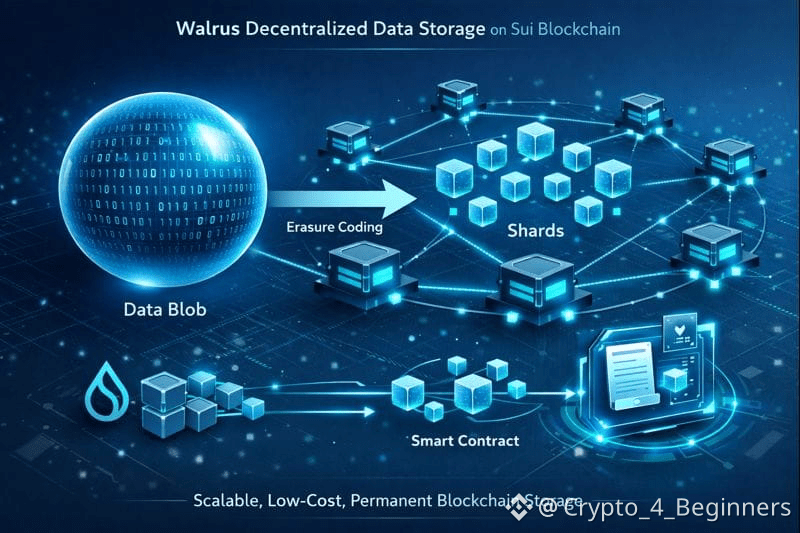
Let’s talk about use cases because this is where Walrus stops being theoretical and becomes strategic in practice. One of the earliest and most striking partnerships Walrus announced was with Humanity Protocol, which migrated over 10 million verifiable identity credentials onto Walrus.
That is not just a catchy PR bullet. It's a real world stress test for how Walrus handles large sensitive datasets that must remain both tamper evident and accessible. This alone challenges the notion that decentralized data layers are too slow or too expensive for serious workloads.
But Walrus's reach goes further. It's powering privacy preserving AI training infrastructures like FLock where encrypted model parameters and federated learning gradients are stored and retrieved on a decentralized basis. A purely centralized data store like AWS or GCP simply can't offer the same data ownership guarantees and that matters in an era where AI models are only as credible as the datasets they are trained on. Even generative AI platforms like Everlyn are tapping Walrus to manage thousands of user generated videos and associated training caches. In my research nothing signals real product market fit faster than data intensive apps willing to anchor their infrastructure on a decentralized network.
I like to frame Walrus's role in Web3 as analogous to SQL databases in Web2. Early web apps could store small text fields and user profiles but once multimedia sessions analytics and large assets became central solid storage engines like MySQL and later Cassandra became indispensable. Walrus in this view is Web3's native trust minimized database but with cryptographic proofs instead of access control lists. Of course no analysis is complete without confronting the challenges. Decentralized storage is notoriously hard to get right and while Walrus architecture is elegant. It's not immune to hazards. For one incentivizing storage nodes via staking and delegated proof of stake mechanisms raises decentralization concerns in the case of early node heavy concentration among early investors or institutional validators some observers have pointed out.
A network that is too centralized in its physical or economic distribution may undermine the very trustless guarantees that it promises.
The economic model also relies on steady demand for storage. While data needs are exploding in AI and decentralized applications, there is still uncertainty about how much ongoing revenue the WAL token can generate relative to capacity. Will developers and enterprises be willing to store multi terabyte datasets on Walrus at the same cost efficiency as cloud providers? Time will tell and in my assessment this is where real competitive pressure could expose limitations.
Then there is the broader market structure. Storage tokens have not traditionally captured speculative market exuberance as well as DeFi or L2 tokens meaning that volumes and liquidity are likely to lag and price action in WAL could remain muted even if adoption grows. That is something traders need to account for actively.
Comparing Walrus to more established storage nets like Arweave, Filecoin, or even L2 data availability layers Celestia EigenDA is useful to contextualize its niche. Filecoin and Arweave excel at long term archival storage with Filecoin's market cap often oscillating independently of broader crypto trends. Walrus on the other hand is purpose built for smart contract connected storage meaning stored data is natively addressable and manipulable within the Sui Move framework. That fundamentally changes what developers can build. You can write a smart contract that knows which blobs to fetch or update something harder to do with traditional storage networks that treat data as external references.
On the other end of the spectrum data availability solutions like Celestia focus on proving that data exists and can be retrieved for rollups and L2 proofs. Walrus does not compete directly there it hosts and serves data in a decentralized manner with programmability as a first class concern instead of just commitment proofs.
Now let's talk strategy since you will want specific levels and actions. Based on circulating supply data I’ve seen circa late 2025 WAL's market cap was hovering around ~$600 million with price levels near ~$0.41. My research shows this has made the token reasonably range bound and that creates clear technical thresholds to watch. For directional exposure consider scaling entries on strong demand signals For example a breakout accompanied by rising on-chain WAL staking and rising blobs stored on Walrus. Always use stop levels under $0.30 to protect against macro sell offs and consider a rebalancing point if WAL approaches its prior all time highs from 2025 about $1.20 billion market cap equivalent range. A prudent trader might keep no more than 5 to 7 percent of portfolio exposure in Walrus given its tech promise but inherent volatility.
To help put this analysis in context visualize a time series chart plotting three series the WAL price daily WAL staking volume and the total bytes of data stored on Walrus. A second potential chart could be a stacked area graph showing data distribution among key use cases AI datasets identity credentials and media content over time.
For deeper insight a conceptual table comparing decentralized storage primitives can consider metrics such as programmability on-chain composability replication efficiency and network integrations across Filecoin Arweave and Walrus. Another table could detail token use cases like governance payment for storage and staking rewards to show where on-chain economic activity emanates from.
To close let me ask this if Web3 is going to truly decentralize the internet and power real world data intensive apps is not the data layer just as important as execution and consensus? Sui delivers speed and low cost computation. Walrus delivers trustworthy programmable data at scale. Together they form a stack that finally lets developers treat data not as an afterthought but as a first class citizen. That is not hype that is a foundational shift. In my assessment the next 12 to 18 months will determine whether Walrus stays an underrated gem or becomes a recognized core primitive of Web3's infrastructure but for now if you are mining for layers that matter. Walrus deserves serious attention.
