

🧠 The Phase Every Serious Protocol Must Survive
There is a phase in crypto that rarely gets celebrated.
It’s not the launch.
It’s not the rally.
It’s not the marketing wave.
It’s the quiet middle — where theory meets reality.
This is exactly where Dusk Foundation spent a significant part of its journey.
🧪 When Ideas Leave Paper, Reality Pushes Back
On paper, privacy-preserving finance sounds elegant.
In reality, it collides with:
• Edge cases
• Adversarial behavior
• Regulatory ambiguity
• Performance constraints
Every core component of Dusk had to survive this collision:
• Consensus
• Privacy
• Execution
• Compliance logic
And none of these are forgiving domains .
🧱 Why Progress Looked “Slow” From the Outside
Observers often confuse visibility with velocity.
Dusk’s development involved:
• Formal cryptography
• Consensus safety proofs
• Zero-knowledge correctness
• State model guarantees
These things do not produce flashy demos.
They produce absence of failure.
And absence of failure rarely trends.
🔍 The Early Skepticism Phase
Initial reactions often followed a pattern:
• “Too academic”
• “Overengineered”
• “Why not just fork something?”
These questions usually come from a good place — speed bias.
But speed bias breaks down when systems must:
• Handle value at scale
• Survive adversarial environments
• Withstand regulatory pressure
Dusk chose resilience over acceleration.
😄 A Light Reality Check
Fast code ships bugs.
Fast finance ships disasters.
Dusk picked the slower lesson.
🧠 Internal Challenges That Rarely Get Mentioned
Designing privacy systems introduces paradoxes:
• Make things hidden — but verifiable
• Make systems flexible — but bounded
• Make contracts expressive — but safe
Solving one constraint often breaks another.
Phoenix, Zedger, SBA, and Rusk VM had to evolve together, not independently .
That coordination is brutally complex.
🧩 The “Invisible Wins” Phase
Some wins don’t announce themselves.
For Dusk, these included:
• Eliminating probabilistic finality risk
• Preventing validator identity leakage
• Avoiding compliance bolt-ons
• Designing audit-friendly privacy
Each of these removed future failure modes.
Markets rarely price that in early.
📉 Market Sentiment Then: Curiosity Without Conviction
During earlier stages:
• Attention was intermittent
• Narratives were unclear
• Progress felt abstract
This is normal for infrastructure projects.
Conviction usually arrives after reliability is demonstrated — not before.
🧠 Why Silence Was Not Neglect
Silence often signals one of two things:
• Lack of progress
• Focused execution
Dusk belonged to the second category.
Instead of promising timelines, it reduced uncertainty.
That trade-off is invisible — until suddenly it isn’t.
🔮 Setting the Stage for the Shift
This slow, resistant phase created:
• Technical maturity
• Conceptual clarity
• A smaller but aligned audience
Which is exactly what infrastructure needs before adoption begins.
🧠 Market Psychology Is Not Static — It Evolves
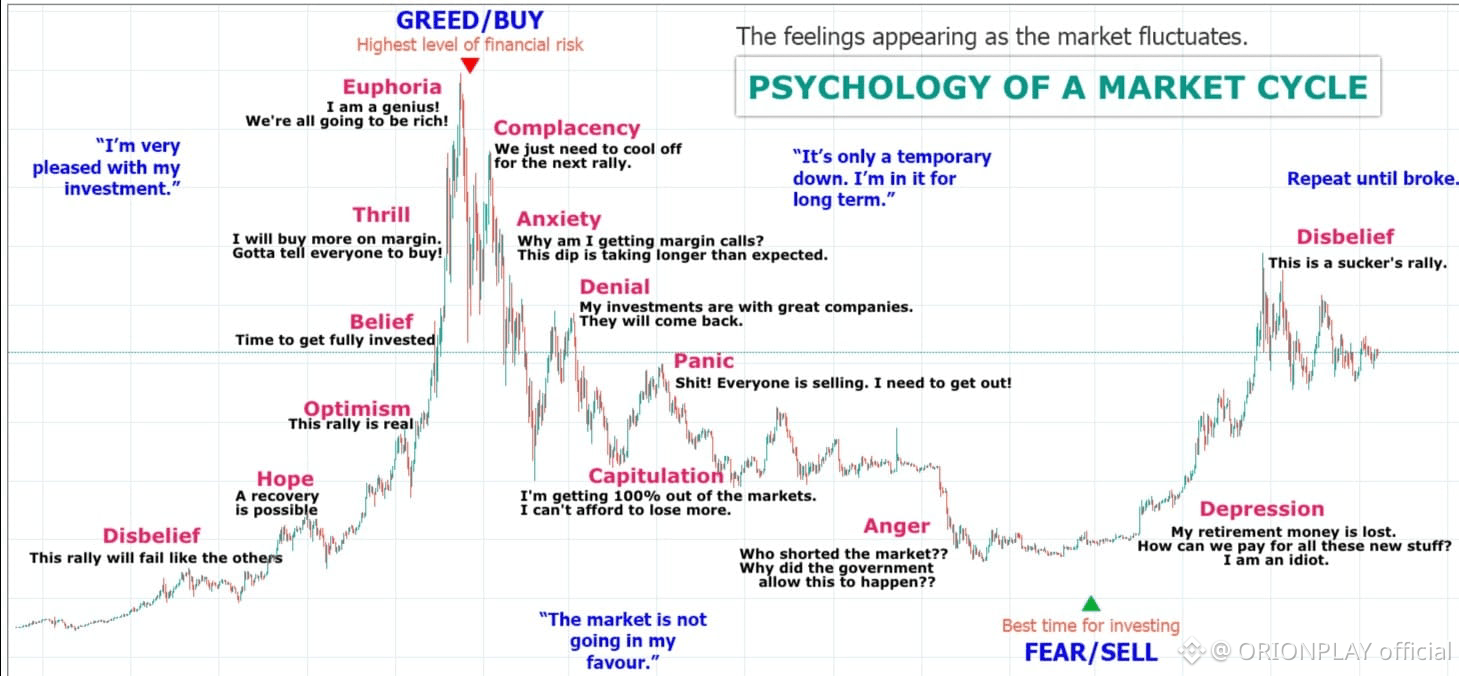
Crypto sentiment moves in phases.
Early phase thinking usually sounds like:
• “What’s the next catalyst?”
• “Where’s the hype?”
• “Why isn’t this everywhere yet?”
That mindset dominated much of Dusk’s early perception.
But infrastructure projects rarely thrive under early-phase psychology.
📉 “Then”: Attention Without Understanding
Earlier sentiment around Dusk could be summarized as:
• Interest, but shallow
• Respect, but cautious
• Curiosity, but impatient
The technology was acknowledged —
the implications were not fully absorbed.
This is common when a project solves problems that haven’t become urgent yet.
🧠 Why Urgency Was Missing
At the time:
• Regulation felt distant
• Privacy concerns felt optional
• Institutions were “experimenting”
So a protocol designed for:
• Compliance
• Confidential execution
• Formal guarantees
felt premature.
Premature ideas often look unnecessary — until conditions change.
😄 A Small Analogy
Wearing a seatbelt feels excessive
until the first sudden stop.
Dusk was a seatbelt design in a world still cruising.
📈 “Now”: Subtle Signals Replace Noise
As the market matured:
• Regulation discussions intensified
• Institutional pilots slowed but deepened
• Data privacy risks became visible
Suddenly, the questions shifted:
• “Can this survive scrutiny?”
• “Can this scale without leaking?”
• “Can this be audited without exposure?”
These are Dusk-native questions.
🔍 Why Confidence Builds Quietly
Confidence doesn’t spike — it accumulates.
In Dusk’s case:
• Architectural consistency stayed intact
• Core assumptions didn’t collapse
• Design decisions aged well
That consistency slowly rewires perception.
🧠 Traders vs Builders: A Perception Gap
Short-term traders evaluate:
• Momentum
• Liquidity
• Visibility
Builders and institutions evaluate:
• Failure modes
• Edge cases
• Regulatory survivability
As attention gradually shifts from speculation to infrastructure,
Dusk’s relevance increases without shouting.
🔐 Privacy Reframed: From Feature to Requirement
Earlier framing:
• “Privacy is optional”
Current framing:
• “Privacy breaches are existential risks”
Transaction graph analysis, data permanence, and retroactive exposure have changed the conversation.
Dusk’s selective disclosure model fits this new framing naturally .
📉 Why This Shift Is Easy to Miss
There was no single event.
No dramatic announcement.
No viral narrative.
Instead:
• Old assumptions weakened
• New constraints emerged
• Design choices gained meaning
That’s how structural relevance grows.
🧠 The Role of Patience (Often Underestimated)
Patience in crypto is rare.
But systems built without it:
• Accumulate shortcuts
• Accumulate risk
• Accumulate technical debt
Dusk accumulated:
• Proofs
• Guarantees
• Coherence
Which compounds slower — but breaks less.
🔮 What This Phase Sets Up
This psychological shift prepares the ground for:
• Institutional trust
• Serious integrations
• Use cases that don’t tolerate failure
Not explosive adoption —
but stable integration.
🧠 Every Cycle Separates Experiments From Infrastructure
Crypto cycles are noisy.
They reward:
• Speed
• Visibility
• Narrative dominance
But when cycles cool, a different filter appears.
Projects are no longer asked:
“How fast can you grow?”
They are asked:
“How hard are you to break?”
This is the phase where Dusk Foundation begins to make sense.
🏗️ What Dusk’s Journey Actually Teaches
The Dusk story is not about hype missed.
It’s about failure avoided.
Lessons embedded in the design:
• Privacy must be provable
• Finality must be explicit
• Compliance must be native
• Execution must be bounded
Each of these removes an entire class of future problems .
😄 Why “Boring” Is a Compliment
In finance:
• Boring means predictable
• Predictable means safe
• Safe means usable
Nobody wants surprise behavior in:
• Settlement
• Ownership
• Accounting
Dusk optimizes for unexciting correctness.
That’s rare — and valuable.
🧠 The Quiet Advantage of Design Integrity
Many projects pivot as narratives shift.
Dusk didn’t.
Its early assumptions still hold:
• Regulation is real
• Privacy is non-negotiable
• Cryptography is the mediator
When assumptions survive time, trust compounds.
🔍 Why Infrastructure Wins Slowly — Then Permanently
Infrastructure doesn’t dominate conversations.
It dominates outcomes.
Once integrated:
• It’s expensive to replace
• It’s risky to remove
• It becomes invisible
That invisibility is success.
🔐 Privacy as Future-Proofing
Data exposure cannot be undone.
Dusk’s design assumes:
• Future adversaries
• Better analytics
• Stricter rules
By minimizing data today, it protects tomorrow’s users — even from unknown threats.
🧠 The Role Dusk Is Positioning For
Not:
• A universal chain
• A social playground
• A speculative magnet
But:
• A settlement layer
• A confidential execution environment
• A regulated asset backbone
That role doesn’t need loud adoption.
It needs correct adoption.
📈 The Long View (Where Dusk Fits)
As crypto integrates with:
• Law
• Institutions
• Real capital
Designs that ignored constraints will retrofit.
Designs that anticipated constraints will lead.
Dusk belongs to the second category.
🧠 Final Reflection
Dusk Foundation never optimized for applause.
It optimized for survival under scrutiny.
And in systems that handle real value,
survival is the highest form of success.
