
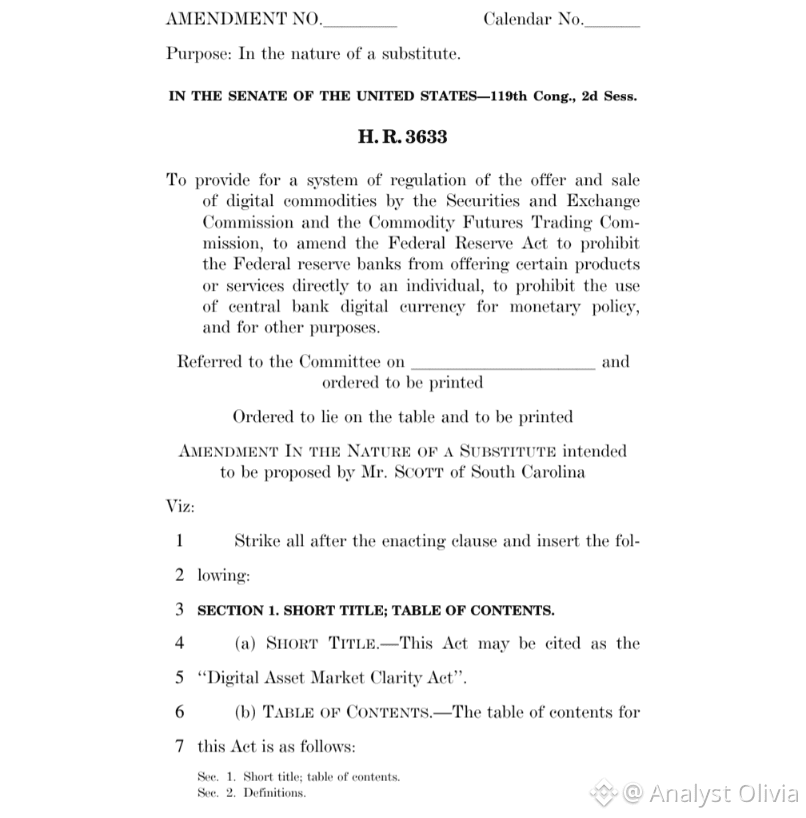
The US Senate’s new crypto market structure draft is a serious attempt to replace enforcement-by-lawsuit with an actual legal framework. Instead of forcing crypto into decades-old securities law, the bill tries to define what crypto is and how it should be regulated.
At the core of the problem is regulatory overlap. Today, the U.S. Securities and Exchange Commission broadly treats most tokens as securities, while the Commodity Futures Trading Commission views many as commodities. This bill draws a hard line: securities fall under the SEC, commodities under the CFTC. That clarity alone removes years of uncertainty for builders and investors.
The most important innovation is the creation of a new category called ancillary assets. These are tokens that do not represent ownership or profit rights in a company, but instead provide access or utility within a network. By recognizing this distinction, the bill avoids forcing network tokens into IPO-style compliance, while still requiring baseline transparency.
Rather than vague whitepapers, the bill mandates standardized disclosures. Projects must clearly explain who controls development, how tokens are issued and distributed, how governance works, and what risks users face. For large raises above $25 million, this extends to audited financials and verifiable treasury data, reducing the ability to fabricate numbers or mislead investors.
The draft also addresses a major chilling effect in crypto: developer liability. Builders are explicitly allowed to discuss roadmaps and features without every statement being treated as investment solicitation, as long as disclosures are truthful. This reduces the fear that normal development communication could trigger enforcement.
Decentralization is treated as a process, not a binary state. Projects may begin centralized and gradually decentralize. Once a network reaches sufficient decentralization, regulatory obligations are reduced and the asset can exit securities-style oversight. This reflects how major networks actually evolve, rather than imposing unrealistic launch standards.
On the market side, exchanges face tighter, clearer rules. Registration, segregation of user funds, custody standards, surveillance requirements, and strict bans on wash trading, spoofing, and front-running aim to align crypto markets with traditional financial protections. Mandatory proof-of-reserves directly targets failures like exchange insolvencies and hidden leverage.
Finally, the bill formally acknowledges DeFi as part of the financial system. It brings decentralized protocols into broader discussions around cybersecurity, financial stability, and systemic risk, signaling that crypto is no longer treated as a fringe experiment.
Overall, this draft represents a shift from ambiguity and retroactive punishment toward defined categories, predictable rules, and enforceable protections. Whether it passes unchanged or not, it sets a clear direction: crypto regulation in the US is moving from chaos toward structure.