

There is a small moment of relief when an upload finishes. The progress bar disappears. The tab can be closed. For most of us, that feels like the end of the story.
But storage is never only about finishing an upload. It is about what happens later. A week from now. A year from now. After a server gets replaced. After a service changes its rules. After the original caretaker is gone.
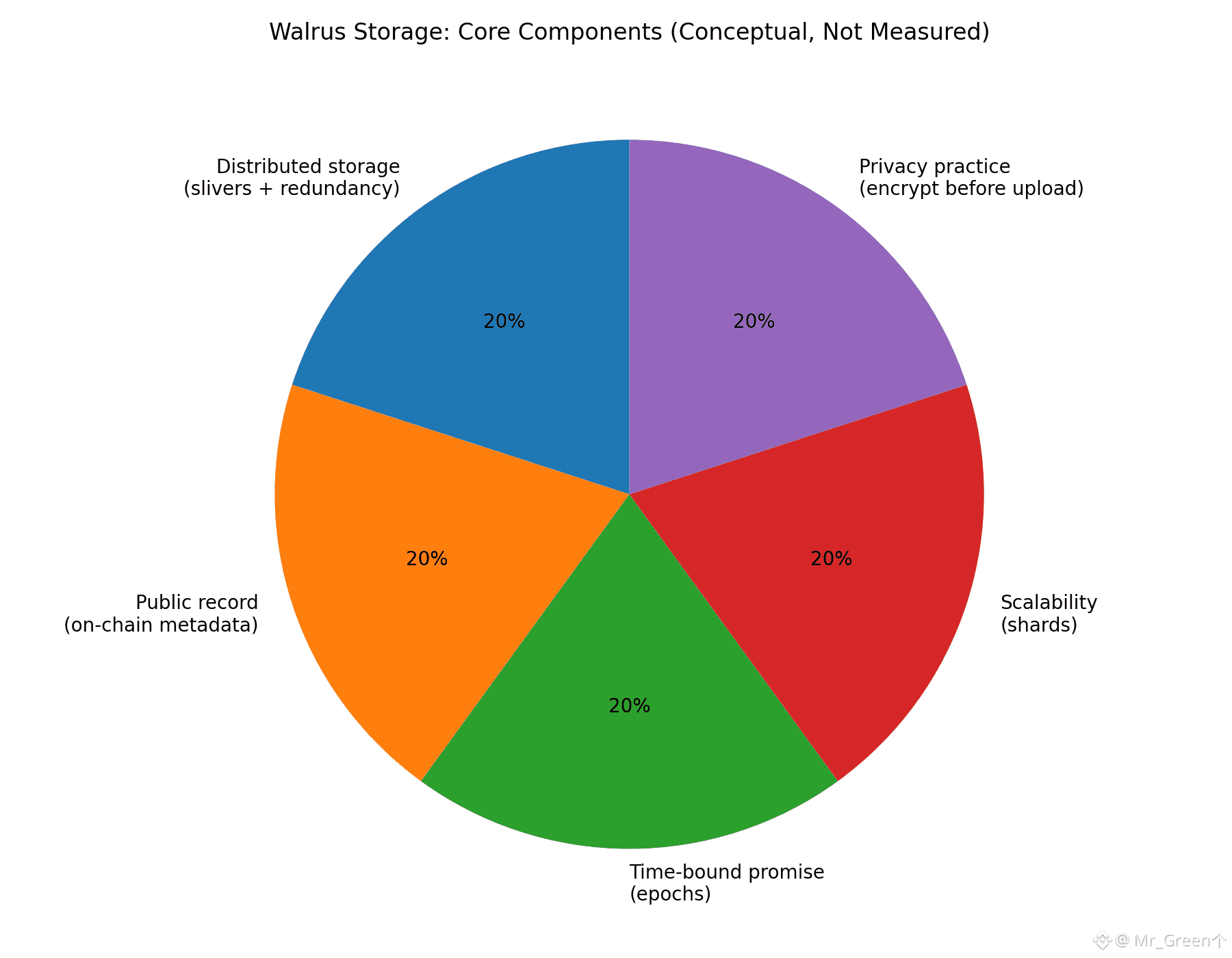
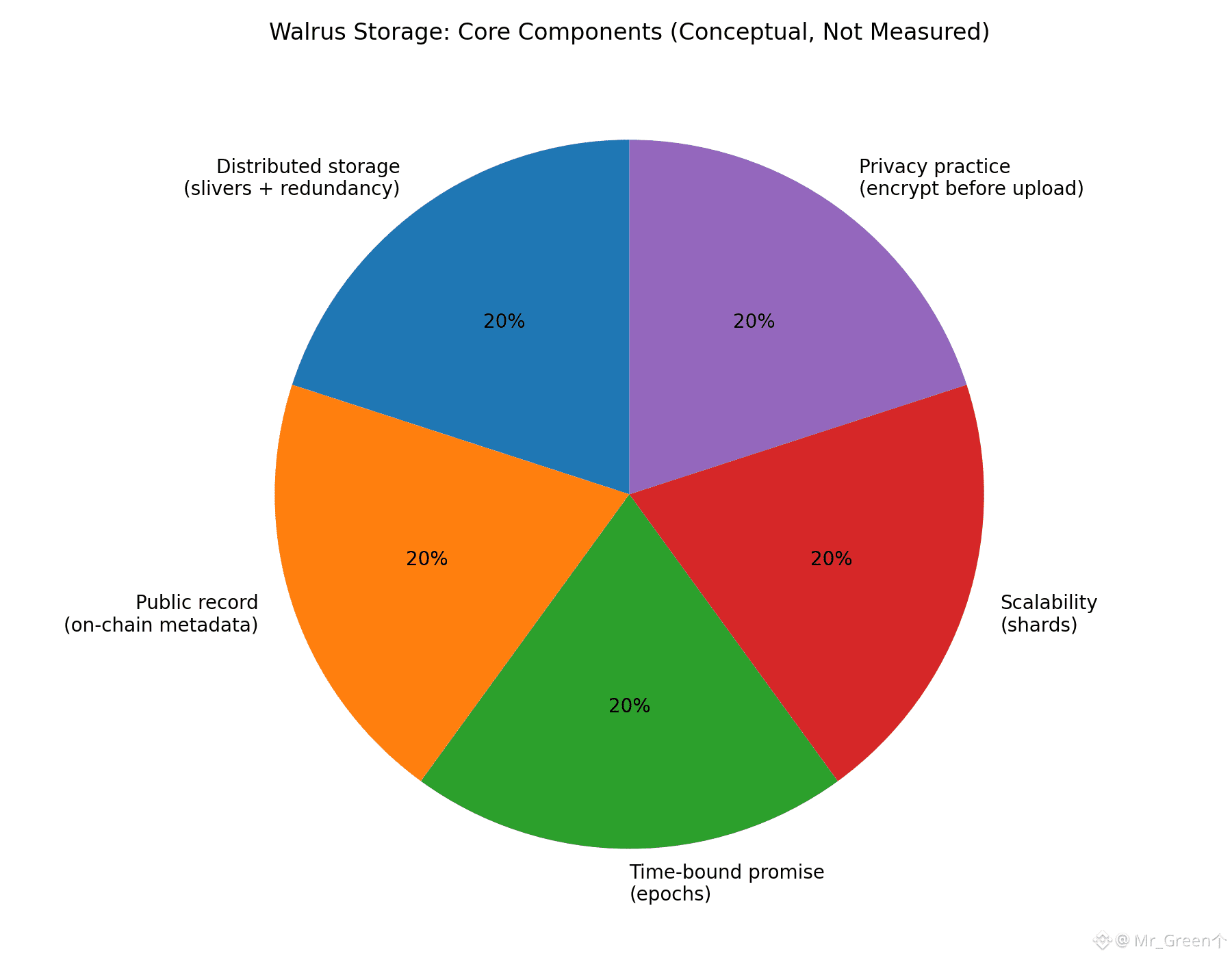
Walrus is built for the part of the story that comes after “done.”
It is designed for large files, images, videos, archives, datasets, the kind of data people often call “blobs.” A blob is not a special new thing. It is just a big chunk of data that does not belong in a tidy table. Walrus is meant to store those blobs on a network, not on a single machine.
The basic idea is simple to say, and harder to do well: spread responsibility across many storage nodes. A storage node is a computer that takes on the job of holding data and serving it back when asked. The challenge is that “many computers” can also mean “many ways to fail.” Machines go offline. Networks stutter. Operators come and go.
Walrus answers this with a practical trick. It does not hand a whole file to one node and hope that node stays healthy. Instead, it encodes the file and splits it into smaller pieces. Walrus calls these pieces slivers. The system is built so a blob can be recovered even if some slivers are missing. That is the point of redundancy. Not perfection. Survival.
Now comes the harder question: how do you know the network really accepted the job?
In a normal cloud service, you trust a provider’s internal logs. In a decentralized system, that kind of private bookkeeping is not enough. So Walrus leans on the Sui blockchain, not as a place to store the big data, but as a place to store the shared truth about it.
Think of Sui as the public ledger for the storage agreement. The heavy file stays off-chain, spread across storage nodes. The on-chain record keeps the key facts that apps can check: that a blob was registered, that storage was purchased, that the blob was certified as available, and how long the promise lasts.
Walrus describes this availability step using a Proof of Availability certificate. The name sounds formal, but the meaning is straightforward. The system wants a public marker that says: enough storage nodes acknowledged their part, and the network is now on the hook for keeping the blob available for the agreed time. That certificate is submitted to Sui smart contracts, so it leaves a verifiable trail instead of a private claim.
Time, in Walrus, is not a vague promise. It is measured.
Walrus uses epochs, which are fixed time windows. On Mainnet, an epoch is listed as two weeks. Storage is purchased for a number of epochs, and there is a maximum amount you can buy in advance: 53 epochs. In human terms, this is Walrus saying, “We can promise you a bounded stretch of time. Past that, renew.” That limit is not a weakness. It is a way to keep the system predictable, because large networks do not handle constant surprise well.
The system also divides work using shards. A shard is just a partition. It is one of the ways a big network avoids becoming one giant bottleneck where everyone has to track everything. Walrus lists 1,000 shards as a fixed parameter on both Mainnet and Testnet.
Walrus is also clear about network environments. It distinguishes between Mainnet, meant for production use on Sui Mainnet, and Testnet, used for trying new features on Sui Testnet. If you have ever built software, you know why that matters. Testing is where you learn. Production is where you keep your promises.
Limits show a system’s character, too. Walrus states a maximum blob size and even tells you how to work around it. The docs say the maximum blob size is currently 13.3 GB, and if you need to store something larger, you split it into smaller chunks. That is a quiet kind of honesty. Not “infinite,” not “just trust us,” but “here is the boundary, and here is the workaround.”
Then there is the truth people most often miss when they hear the word “decentralized”: decentralized does not automatically mean private.
Walrus says this plainly. It does not provide native encryption, and blobs stored in Walrus are public and discoverable by default. That can feel counter-intuitive if you associate storage with private folders and hidden links. But the clarity is useful. If your file must be confidential, you protect it before you upload it.
Encryption is the everyday name for that protection. It turns readable data into unreadable data unless you have the right key. Walrus also points to Seal for on-chain access control, for builders who want programmable rules about who can open what. The message is consistent: durability is one job. privacy is another. Use the right tools for each.
So what is Walrus, in the most human sense?
It is a storage system that tries to make big-file persistence less like a personal favor from a single provider, and more like a public commitment with receipts. It spreads data across many nodes so failures do not erase it. It uses a blockchain ledger so “stored” can be checked, not merely believed. It measures time in epochs so the promise has a clear start and end. And it tells you, without drama, what is public by default, so you do not confuse availability with secrecy.
That is not poetry. But it is the kind of design that ages well.


