
For most of human history memory was fragile People carved stories into stone painted them on cave walls wrote them on paper and hoped they would survive fire water and time Even our most important knowledge wars treaties inventions and art could vanish if the medium holding it failed In the digital age we made memory easier to create but not more permanent We produce oceans of data but almost all of it lives on servers owned by companies that can change policies go bankrupt get censored or simply shut down What we call the internet is not an archive it is a marketplace of rented shelves.
@Walrus 🦭/acc enters this story at the exact moment when digital civilization realizes how temporary its memory really is NFTs lose their images social networks delete histories blockchains forget data rollups depend on centralized storage and entire communities disappear when a cloud account is closed We act as if digital equals permanent but in reality digital has become the most fragile form of memory humans have ever created Walrus was designed to fix that not by making things faster or cheaper but by making them last.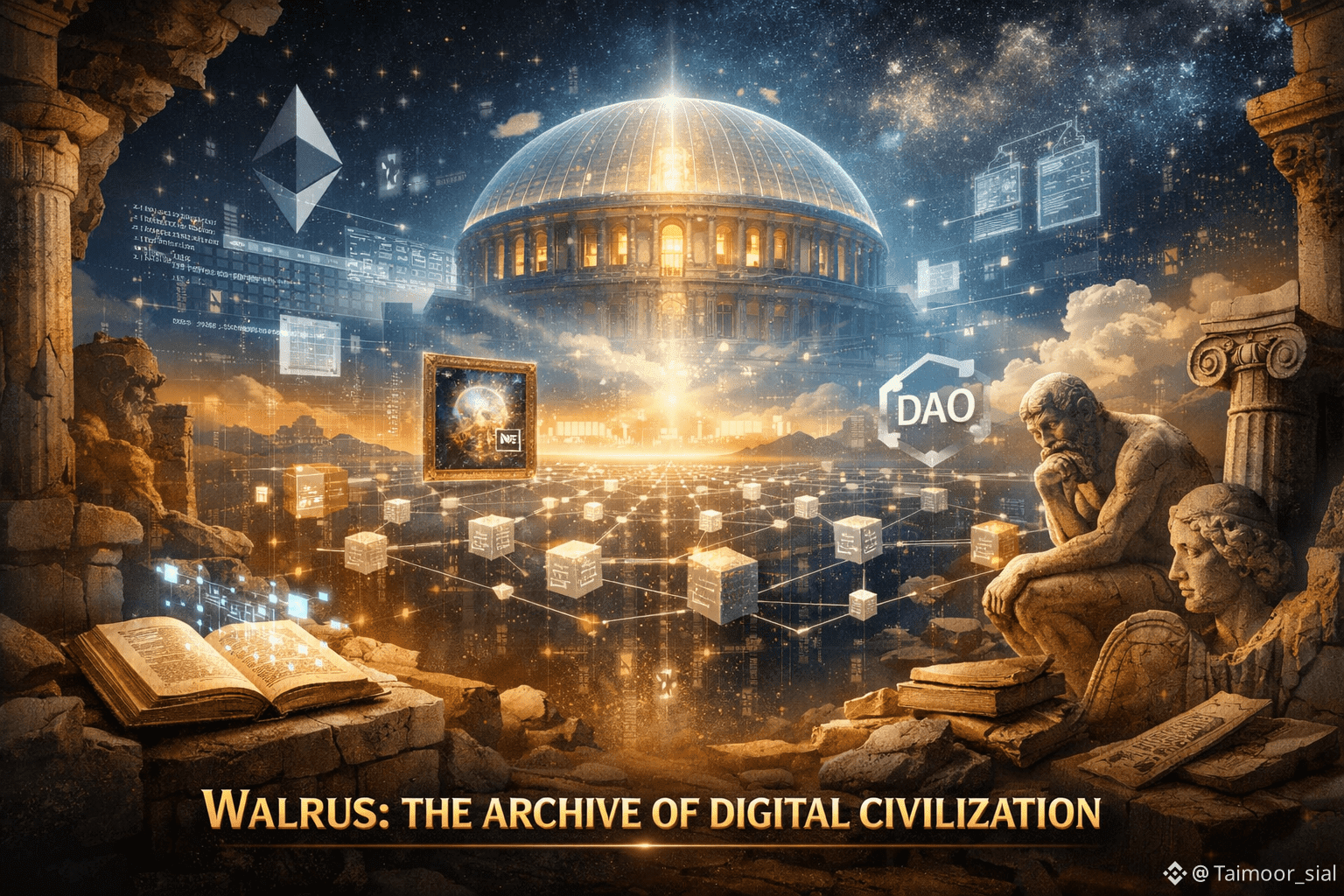
The idea behind Walrus is simple but radical Data should not depend on institutions It should depend on mathematics economics and distributed trust When a civilization writes something down it should not matter which company is hosting it or which country is running the servers It should live as long as people are willing to pay for its existence and as long as the network can agree on what is true That is what Walrus builds a global record room for the digital age.
In ancient times archives were physical buildings guarded by priests kings and later by states They were centralized because they had to be Paper had to be stored somewhere Stone tablets had to be protected But that centralization made memory political Whoever controlled the archive controlled history The same thing happened again with the internet Our emails our posts our images our code our financial records all live on platforms that can edit erase or reinterpret them at will The archive became corporate.
Walrus breaks this pattern by turning storage into a decentralized public good Data is not kept by one institution but by a market of independent nodes spread across the world These nodes do not store files because they are trusted They store files because they are economically and cryptographically forced to Walrus does not ask anyone to be honest It makes dishonesty expensive.
What makes Walrus different from previous decentralized storage attempts is not just that it distributes data It is how it keeps that data alive through time In most systems when a node disappears a piece of memory disappears with it Over time these small losses accumulate until the record becomes incomplete or corrupted Walrus was built to resist that kind of slow decay Its two dimensional encoding creates a web of redundancy where every piece of data is protected in more than one direction If one part of the web breaks the rest of the web repairs it.
This is why #walrus feels less like a database and more like an organism It is always checking itself always healing small wounds before they become fatal The archive does not wait for someone to notice something is wrong It fixes itself automatically The data is not static it is alive inside the network.
For a digital civilization this matters more than almost any other technical feature We are moving into a world where identities property art governance and even history itself live on chains and networks If the storage behind those systems is fragile then the civilization built on top of them is fragile Walrus provides the missing layer that makes all of this durable.
Think about what it means to have a permanent archive of human activity NFTs are no longer just tokens pointing to disappearing images They become genuine digital artifacts DAOs are no longer just chats and spreadsheets They become historical institutions whose decisions can be studied centuries later Open source software becomes a permanent record of how civilization learned to build machines even financial records become part of a public memory rather than something locked inside banks.
Walrus makes this possible because it treats data as something that must survive not just be served Fast storage is easy Permanent storage is hard It requires assuming that hardware will fail that networks will lie and that people will cheat Walrus starts from those assumptions and builds upward.
Every file stored in Walrus is broken into encoded pieces spread across many independent nodes No single machine holds the full truth but the network as a whole does And because each piece is tied to the others through mathematics the system can detect when something is missing or wrong It can prove that a node is lying It can prove that data still exists And it can rebuild what is lost without asking anyone to upload it again.
This is what turns Walrus into an archive instead of a warehouse Warehouses just store things Archives preserve meaning They ensure that what was written remains what was written even as time passes and the world changes Walrus provides cryptographic commitments and proofs of availability that let anyone verify that the data they are reading is the same data that was written years ago.
Over time this creates something extraordinary A shared digital memory that no government no company and no individual can quietly rewrite History becomes verifiable Culture becomes durable Knowledge becomes cumulative Instead of every generation rebuilding from fragments we get a continuous record.
We can already see why this matters in the crypto world Blockchains are supposed to be immutable but most of their important data lives off chain Rollups depend on external data availability layers NFTs depend on external image hosts DAOs depend on centralized tools Walrus closes that gap It brings memory back into the trustless domain.
But the vision goes far beyond crypto Imagine legal systems built on top of permanent digital records where contracts cannot be lost Imagine scientific research stored in a global archive that cannot be altered by political pressure Imagine journalism that cannot be erased Imagine personal histories preserved beyond the lifespan of any platform.
Walrus does not need to know what data it is storing That is the beauty of it It just provides the memory substrate Civilization builds on top of it.
The economics of Walrus also reinforce this archival role Storage providers are paid to keep data alive over time Cheating is punished Long term reliability is rewarded This creates a natural incentive to preserve history rather than delete it In centralized systems deletion is often profitable In Walrus deletion is costly.
This flips the usual logic of the internet Today companies are paid to keep data only as long as it is useful to them In Walrus the network is paid to keep data as long as someone values it Even a single person paying for a file is enough to keep it alive as long as the system exists.
That is how archives have always worked Libraries survive because societies value books Walrus extends that model into the digital realm with cryptography instead of librarians and with markets instead of governments.
As decades pass the network grows The amount of stored data grows The redundancy grows The archive becomes harder to erase Every new node adds not just capacity but resilience The memory of digital civilization becomes more secure over time not less.
This is a profound shift In the physical world things decay In Walrus memory strengthens.
When historians in the future look back at our era they will not rely on screenshots and broken links They will be able to read the original records The transactions The art The conversations The code The decisions of early digital societies will still be there preserved in a global archive that no single power ever controlled.
Walrus does not try to be flashy It does not chase trends It does not promise infinite speed or infinite scale It promises something more important endurance.
Digital civilization does not need another platform It needs a memory.
Walrus is building that memory. $WAL

