In the development of decentralized systems, the primary focus has historically remained on execution and consensus. However, as these systems mature, the structural deficit in data management has become a critical bottleneck. Blockchains are inherently optimized for state transitions and the validation of small metadata packets; they are not designed for the long-term preservation of high-volume data context.
The Walrus Protocol emerges not as a speculative venture, but as a specialized infrastructure layer designed to address the engineering challenges of data durability and programmability in a decentralized environment.
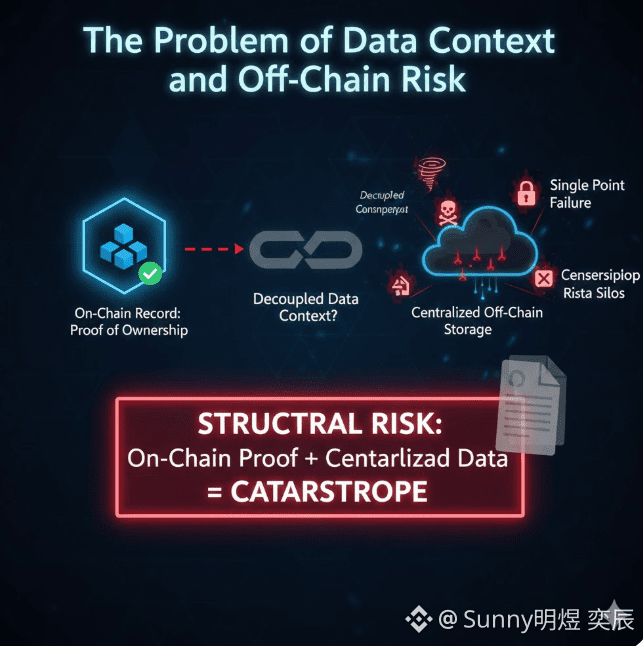
The Problem of Data Context and Off-Chain Risk
Blockchains excel at maintaining a ledger of "who owns what," yet they are fundamentally incapable of storing the "what" itself when the data exceeds a few kilobytes. This limitation forces developers to rely on off-chain storage. When Web3 systems utilize centralized cloud providers for this purpose, they introduce a catastrophic structural risk: the decoupling of a decentralized proof of ownership from a centralized point of failure. If the off-chain data is deleted or censored, the on-chain record loses its context and, consequently, its utility.
Existing decentralized alternatives often struggle with the trade-off between availability and cost. Traditional replication—copying a full file across multiple nodes—is economically unsustainable at scale. Conversely, protocols that rely on voluntary participation often lack the rigorous cryptographic guarantees required for enterprise-grade durability.
Red Stuff: Erasure Coding as Resilience
The Walrus Protocol addresses these inefficiencies through its core encoding primitive, "Red Stuff." Rather than full replication, Walrus utilizes erasure-coded, fragment-based storage. In this model, a data blob is transformed into a set of slivers (fragments) distributed across a global committee of independent storage nodes.
This design is rooted in mathematical redundancy rather than simple duplication. The system is engineered to survive Byzantine faults, meaning the original data remains fully reconstructable even if up to one-third of the storage nodes fail or act maliciously. This approach prioritizes data durability—the mathematical certainty that data will exist over time—over the immediate speed of a centralized cache. By shifting the burden from the individual node to the collective properties of the network, Walrus creates a storage medium that is resistant to node churn and network decay.
From Passive Storage to Programmable Data
A significant shift in the Walrus architecture is the transition from passive file storage to programmable data. In legacy systems, storage is a "black box"; data is uploaded, and a hash is returned. In Walrus, data blobs are treated as first-class objects on the Sui blockchain.
Because the metadata and availability proofs are integrated into the Sui execution layer, storage becomes an active participant in smart contract logic. This allows for:
Dynamic Lifecycle Management: Data can be programmed to exist for specific epochs or be extended programmatically based on on-chain events.
Tokenized Capacity: Storage resources can be traded, wrapped, or used as collateral within the decentralized economy.
Automated Maintenance: Contracts can trigger the re-encoding or migration of data without manual intervention.
Protocol-Level Access Control and the Seal Extension
For real-world and enterprise adoption, decentralization cannot mean total transparency. Organizations require precise control over who can retrieve and interact with sensitive information. The Seal extension introduces protocol-level access control, enabling on-chain encryption and permissioning.
By embedding access logic directly into the protocol, Walrus ensures that the rules governing data are as immutable and verifiable as the data itself. This is a prerequisite for use cases such as private AI model weights, medical records, or proprietary corporate datasets, where the risk of unauthorized access is as significant as the risk of data loss.
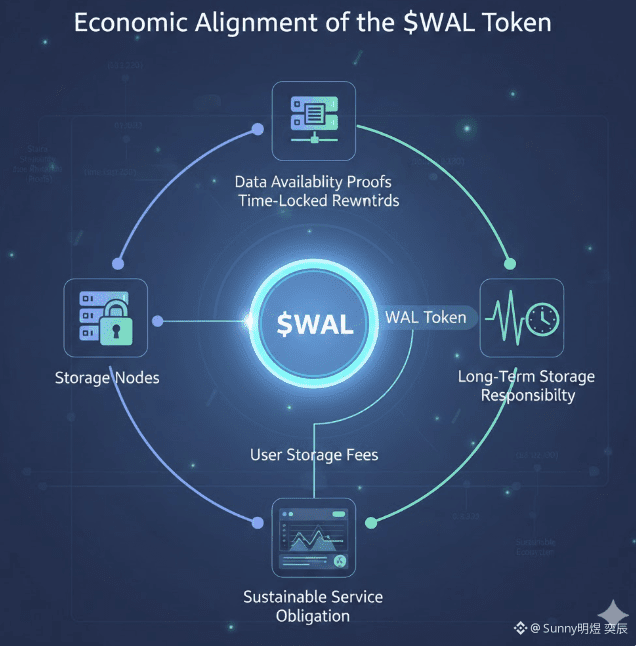
The Economic Alignment of the $WAL Token
The WAL token is the fundamental incentive mechanism that bridges the gap between software and hardware responsibility. Unlike tokens designed for mere circulation, WAL is tied to the long-term storage responsibility of node operators.
Storage nodes must stake WAL to participate in the committee, providing "skin in the game" that discourages negligence. The protocol employs a stake-weighted percentile pricing mechanism to ensure that storage costs remain competitive yet sustainable for operators. When a user pays for storage, the $WAL is distributed over the requested duration, ensuring that nodes are continuously incentivized to prove data availability throughout the entire lifecycle of the blob. This economic model transforms storage from a one-time transaction into a sustained service obligation.
The Walrus Protocol represents a move away from the ephemeral nature of the current web. It is infrastructure designed to endure after the initial waves of attention fade—a system where the integrity of data is tested not by marketing claims, but by the rigorous passage of time and the mathematical laws of erasure coding.