
Most digital systems are designed with an unspoken assumption: if something is important, it will be copied, mirrored, or saved somewhere else. This belief has shaped how data moves across the internet for years. It works when information is short-lived or easily recreated. It fails when data becomes history, proof, or coordination itself. In those moments, losing access is not an inconvenience—it is a break in trust. This is the problem space Walrus is built for.
Rather than treating storage as a one-time interaction, Walrus Protocol is designed around continuity. When data enters the network, the system does not assume the job is finished. The real challenge begins after the upload, during the long stretch where data must remain available despite changing conditions. Nodes rotate, hardware ages, incentives fluctuate, and attention moves elsewhere. Walrus assumes all of this will happen and builds its structure around surviving it.
A key part of this design is how Walrus handles responsibility. Data is not stored as a single object held by one party. It is encoded, divided into fragments, and distributed across many independent operators. Each operator checks what it received and confirms that it matches what it was supposed to store. This verification step is not cosmetic. It creates a system where storage is measurable and accountable, rather than based on trust or vague participation.
This matters because most failures in decentralized storage are slow and quiet. Files do not vanish instantly. They become harder to retrieve as fragments disappear, nodes leave, or incentives weaken. Weeks later, systems discover that what they relied on is no longer complete. Walrus is designed for this slow erosion. Its reward structure favors operators who remain reliable over time, not those who appear briefly during moments of high activity.
The economic layer reinforces this philosophy. WAL is not positioned as a token that exists only to capture attention. It is used to price durability. Users pay for data to remain accessible for defined periods, and operators earn by honoring that commitment consistently. At present, WAL trades around $0.160, with a market capitalization near $253 million. About 1.58 billion WAL are circulating out of a 5 billion WAL total supply. These numbers are less about market excitement and more about scale—how much long-term storage responsibility the network is currently carrying.
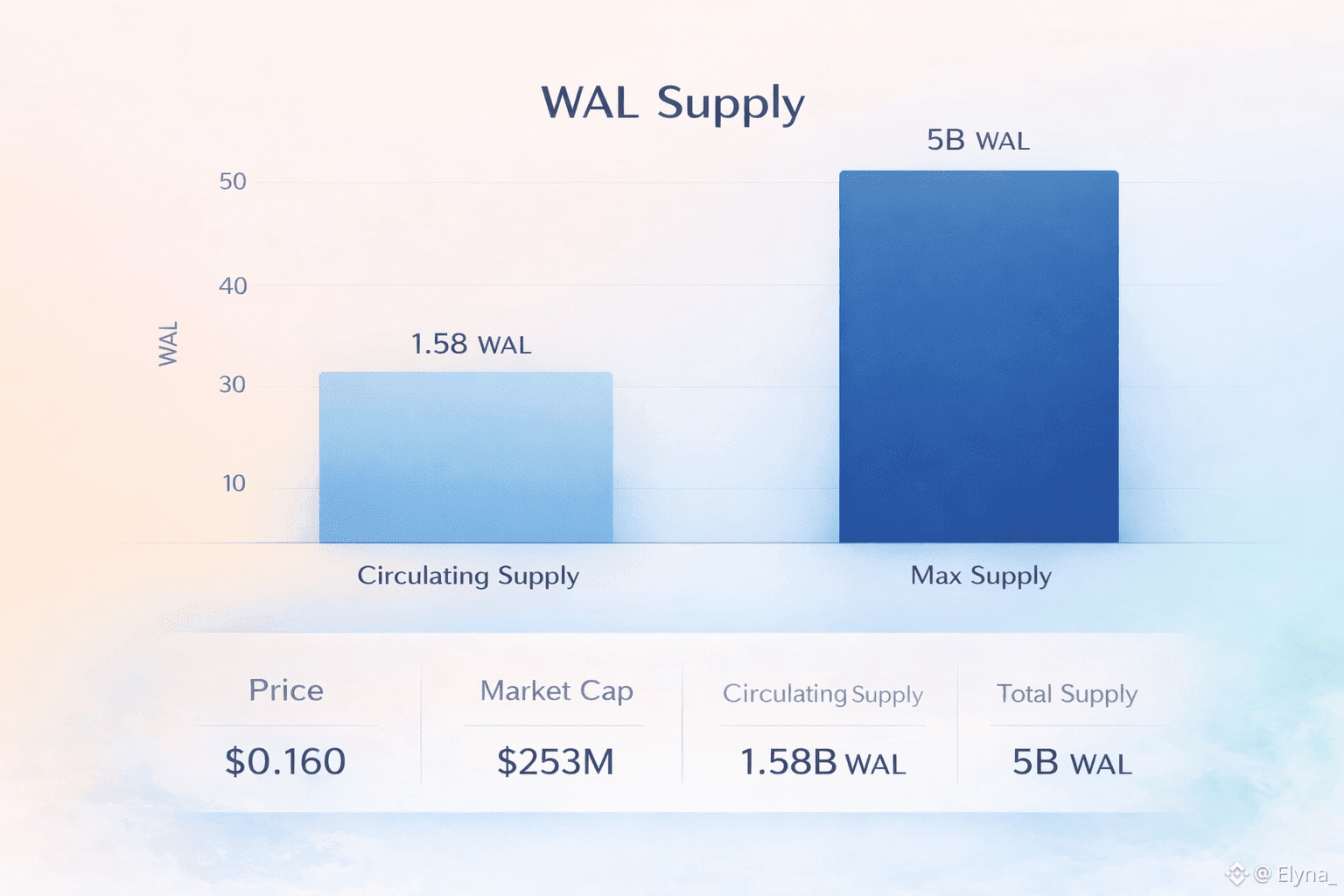


The difference between circulating and total supply also reflects how Walrus thinks about time. Storage is not consumed instantly. It represents future work that must be performed day after day. WAL functions as the unit through which that future obligation is priced. This creates a clearer relationship between value and service: the network earns because it continues to remember, not because it briefly attracts attention.
Walrus also benefits from a clear separation of roles within the Sui ecosystem. Coordination, governance, and execution live on Sui, where speed and finality are essential. Large-scale data storage lives on Walrus, where recovery and durability matter more. This separation avoids forcing a single layer to solve incompatible problems and makes the system easier to reason about for developers building serious applications.
As decentralized systems mature, this kind of infrastructure becomes increasingly important. Governance platforms need records that can be referenced years later. Financial applications rely on documents that may face audits long after creation. AI systems depend on datasets that must remain intact and verifiable. In all these cases, losing data damages credibility more than any temporary outage. Walrus is positioned for these environments, where forgetting is costly and reliability is non-negotiable.
The real measure of Walrus will not appear in daily headlines. It will appear quietly, over time. When applications retain their history. When references still resolve. When data remains accessible long after the original teams have moved on. In a market driven by speed and noise, Walrus focuses on something less visible but more durable: making sure that what matters today still exists tomorrow.