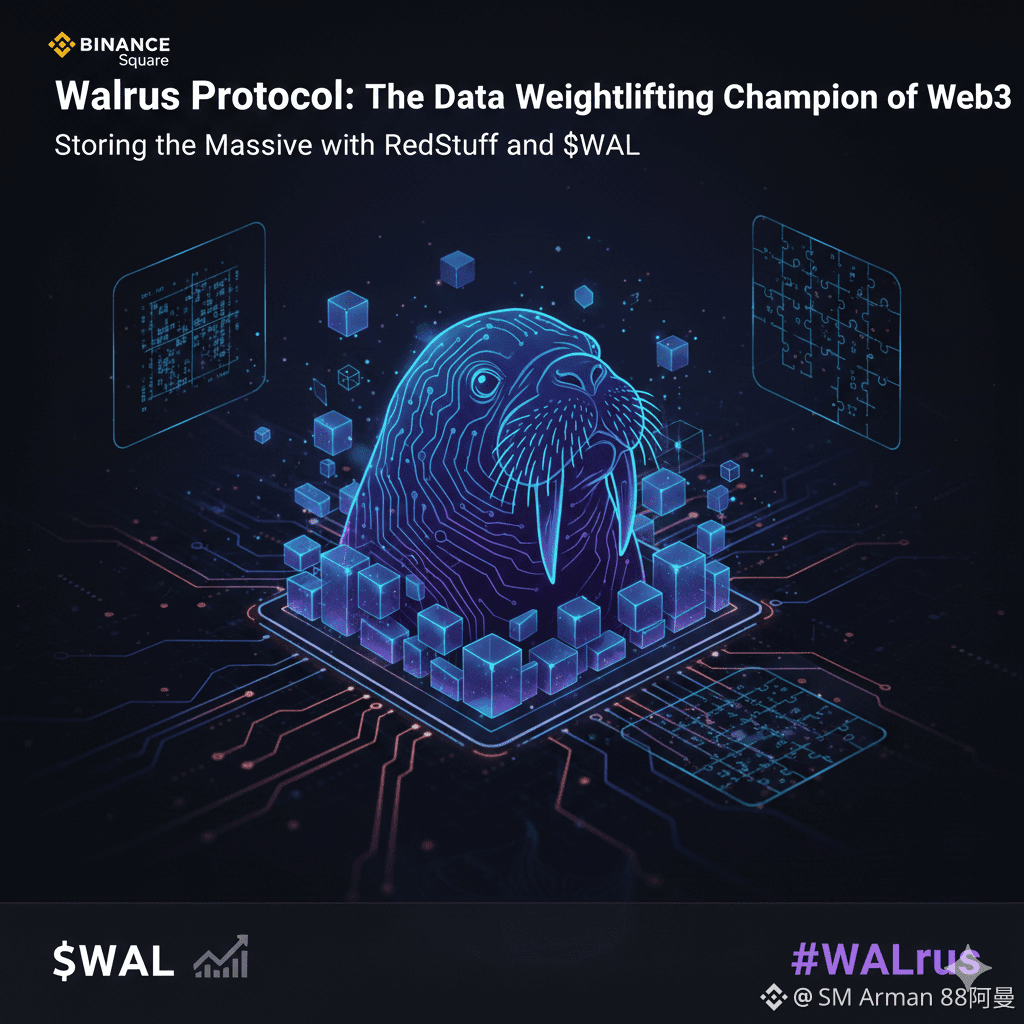
In the rapidly evolving world of decentralized infrastructure, one project is quietly solving the most "massive" problem in the space: how to store the heavy stuff. While blockchains are excellent at processing transactions, they are notoriously inefficient and expensive for storing large files like 4K videos, AI datasets, or high-fidelity gaming assets. This is where @walrusprotocol steps in.
What Makes Walrus Different?
Unlike traditional cloud storage or even some older decentralized storage models that rely on full file replication (making multiple 1:1 copies), Walrus utilizes a revolutionary 2D erasure-coding algorithm called "RedStuff." Think of it like a digital puzzle. Instead of making ten copies of a book, Walrus breaks the book into tiny shards and scatters them across a decentralized network. The magic? You only need a fraction of those shards to reconstruct the entire book. This reduces storage costs by up to 80% compared to legacy decentralized protocols, bringing performance closer to centralized giants like AWS while maintaining total decentralization.
The Role of $WAL in the Ecosystem
The native token, $WAL, is far more than just a ticker symbol; it is the lifeblood of the network:
Storage Payments: Users pay in $WAL to store their "blobs" (binary large objects).
Security & Staking: Node operators must stake $WAL to participate, ensuring they have skin in the game.
Governance: Holders influence the protocol's future, from pricing models to technical upgrades.
As we move through 2026, the roadmap for @walrusprotocol is looking incredibly ambitious. Key milestones to watch include:
Support for XL Blobs: Optimized handling for even larger data sets, perfect for the growing AI industry.
Stable Pricing: A shift toward USD-denominated pricing to help enterprises predict costs without crypto volatility.
Sui Integration: Deepening its synergy with the Sui blockchain to provide seamless, programmable data availability.#walrus @Walrus 🦭/acc