Another evening reviewing Sui updates like the verifiable AI framework from January 13 2026 and it underscores how blockchains excel at momentary computations yet overlook the quiet erosion of data over time. Walrus brings this tension to light serving as the persistent memory layer that has been absent forcing reliance on centralized silos or inefficient onchain methods. This revelation feels like tracing back why so many decentralized visions falter not from logic flaws but from assuming information simply persists without deliberate safeguards.
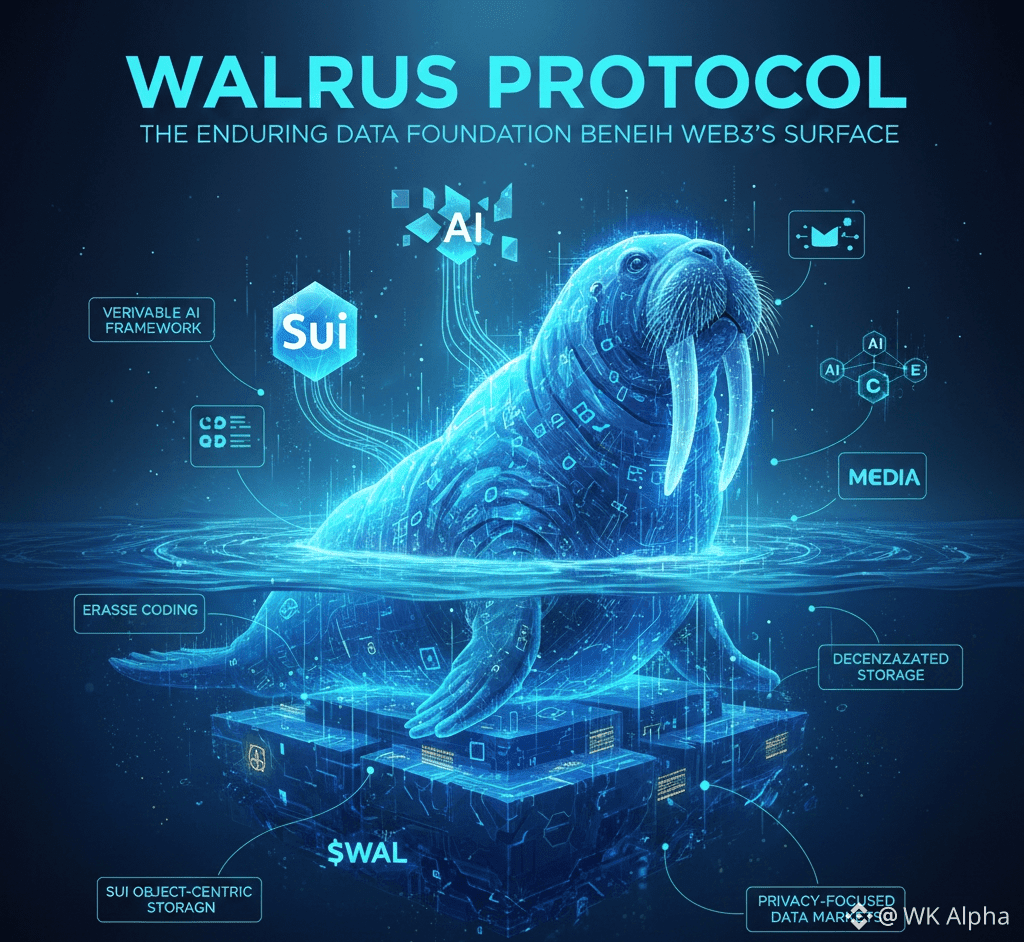
THE REAL PROBLEM
Web3 prioritizes execution efficiency with layers optimizing state transitions and consensus but neglects scalable storage for unstructured blobs such as AI datasets or media files. Full replication across validators inflates costs exponentially while offchain alternatives reintroduce central points of vulnerability and trust dependencies. This technical shortfall undermines applications requiring verifiable long term access leaving ecosystems fragmented and prone to data loss.
WHAT WALRUS IS
Walrus provides a decentralized storage and availability solution employing erasure coding to shard blobs across nodes with redundancy factors typically four to five times for optimized efficiency. It ensures durability through cryptographic proofs and node challenges confirming presence without full data retrievals. Developed by Mysten Labs its engineering aim centers on verifiable persistence as demonstrated in the Tusky migration extension to March 19 2026 preserving decentralized media.
WHY SUI MAKES SENSE
Suis object centric design aligns with Walrus by modeling storage as composable programmable entities within Move contracts. Sui manages metadata attestations and governance while Walrus handles offchain distribution avoiding execution layer congestion. This integration as seen in Suis January 13 2026 AI infrastructure launch enables seamless verifiable data flows complementing each other for agent driven applications.
DATA AS INFRASTRUCTURE
Data endurance warrants protocol level integration akin to how security underpins transactions. Walrus instills this via epoch based commitments staking models and incentives rewarding sustained uptime. With over one billion WAL staked by early January 2026 it cultivates reliability as a core feature supporting ecosystems like AI where provenance must endure.
ROLE OF $WAL
$WAL functions as the networks foundational token enabling storage fees node staking and governance adjustments on parameters. It facilitates epoch distributed payments aligning participants with long term viability through usage tied burns. This structural role avoids speculation tying value to actual demand and security as evidenced by the Binance campaign ending January 6 2026 distributing 300000 tokens.
WHAT WALRUS IS BECOMING
Walrus eschews competition with clouds or general blockchains emerging instead as the memory backbone for privacy focused data markets in AI and beyond. Integrations within the Sui Stack including Seal for encryption position it for cross chain utility beyond Ethereum or Solana. Reflecting in these late hours WalrusProtocol may well anchor the shift toward truly resilient decentralized information.