A Deep, Human Exploration of Decentralized Storage and Digital Ownership. When Infrastructure Starts to Matter Again
Blockchain has never lacked ideas. Every cycle introduces new narratives, new acronyms, and new promises of transformation. Yet beneath all the innovation, there is one uncomfortable truth: much of our digital world still depends on centralized infrastructure. Our data, our creations, our memories, and even the datasets powering artificial intelligence largely live on servers controlled by a small number of corporations.
Walrus Protocol emerges from this quiet contradiction.
Rather than chasing novelty, Walrus focuses on something foundational: how data is stored, preserved, and accessed over time. It does not try to be everything. It tries to be reliable. In an industry often driven by speed and speculation, Walrus feels deliberate—almost patient. And that patience is what makes it worth examining closely.
This article explores Walrus not just as a protocol or token, but as an idea rooted in digital dignity, resilience, and long-term thinking.
Why Data Storage Is No Longer Just a Technical Issue
Data is deeply human.
Photos are memories. Videos are stories. Research datasets represent years of work. AI models are built on carefully curated information. When data disappears, access is revoked, or rules change overnight, the loss is not abstract it is personal.
Today, most of the world’s data is stored in centralized systems. These platforms are efficient, but they are also fragile in subtle ways:
Access can be restricted without negotiation
Pricing models can change unexpectedly
Content can be removed or deprioritized
Entire services can shut down
For individuals and developers alike, this creates a quiet dependency. You may “own” your content, but you do not control the infrastructure it lives on.
Walrus exists because this dependency has reached a breaking point. Decentralized finance, decentralized identity, and decentralized computation cannot function honestly if storage remains centralized. Data is the base layer and base layers must be neutral, resilient, and permissionless.
The Philosophy Behind Walrus
Walrus Protocol is built on a simple but powerful belief:
Data should outlive platforms, companies, and trends.
Instead of optimizing for short-term growth or attention, Walrus optimizes for durability. The goal is not to replace cloud storage overnight, but to create an alternative that is:
Censorship resistant
Fault tolerant
Economically sustainable
Accessible at scale
This philosophy influences every technical and economic decision within the protocol.
Built on Sui: A Strategic Foundation
Walrus is built on the Sui blockchain, and this choice is not incidental.
Sui is designed for high throughput, low latency, and object-based data management. These qualities make it particularly suitable for coordinating complex systems like decentralized storage without turning every interaction into an expensive bottleneck.
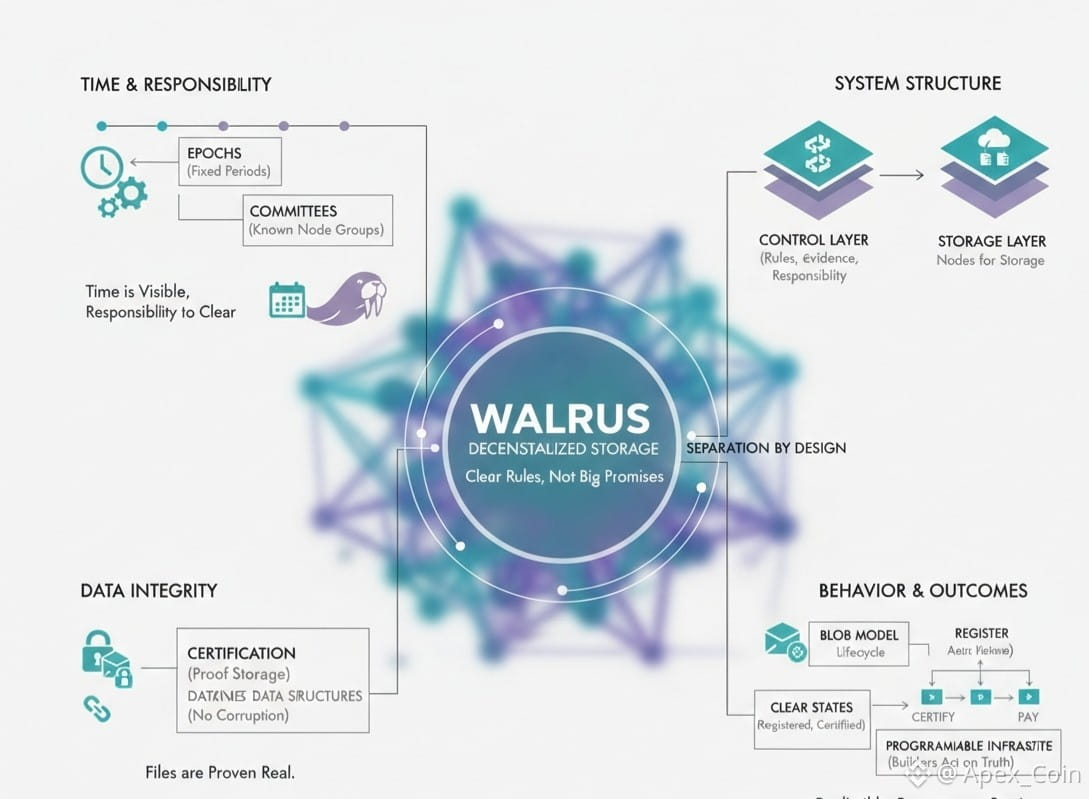
In Walrus, Sui acts as the coordination and verification layer, while the actual data storage happens off-chain. This separation is critical. It allows Walrus to scale efficiently without sacrificing trust or transparency.
How Walrus Stores Data: A Practical Explanation
Traditional storage systems rely on replication copying the same file multiple times and storing it in different locations. While effective, this approach is expensive and inefficient at scale.
Walrus uses erasure coding, a more advanced and thoughtful method.
Step by step overview:
A file is uploaded to the Walrus network
The file is mathematically divided into many fragments
These fragments are distributed across independent storage nodes
Only a subset of fragments is required to reconstruct the original file
This means:
The network remains functional even if many nodes go offline
Storage costs are reduced compared to full replication
Reliability increases without unnecessary redundancy
The result is a system that feels calm under pressure designed to fail gracefully rather than collapse.
On Chain Coordination, Off Chain Data
Walrus deliberately separates control from content.
On chain (via Sui):
Metadata
Ownership rules
Storage proofs
Payments and permissions
Off chain (Walrus network):
The actual data itself
This hybrid design keeps costs low and performance high while maintaining verifiable trust. It reflects a mature understanding that not everything belongs on chain but what does belong there must be immutable and transparent.
The WAL Token: More Than a Utility Coin
The WAL token is the economic backbone of the Walrus ecosystem. Its design emphasizes alignment rather than speculation.
WAL is used for:
Paying for data storage
Staking to support storage providers
Participating in governance decisions
When users pay for storage, that value flows directly to the operators maintaining the network. There are no hidden intermediaries. Incentives are clear and visible.
Staking and Network Security
Staking WAL is not passive decoration it is a security mechanism.
Token holders can stake WAL to support storage providers who behave reliably and honestly. In return, they earn rewards for contributing to network stability.
This creates a system where:
Good behavior is rewarded
Poor performance is economically discouraged
Trust is enforced by incentives, not promises
It is a quiet but powerful form of decentralization.
Governance: Evolution Without Central Control
Walrus governance is designed to evolve gradually rather than abruptly.
WAL holders can participate in decisions regarding:
Protocol upgrades
Incentive structures
Parameter adjustments
Long-term roadmap changes
No single entity dictates the future. Change happens through consensus, which encourages thoughtful iteration rather than rushed experimentation.
Supply Discipline and Long-Term Thinking
The total supply of WAL is capped.
This matters because it ties value to real usage, not perpetual inflation. Storage demand, network growth, and adoption become the primary drivers of economic value.
In a space where many tokens exist mainly as incentives, WAL is structured to reflect actual utility.
Mainnet Launch: From Theory to Reality
Walrus did not rush to market.
The team spent significant time on research, testing, and economic modeling before launching mainnet in March 2025. This transition marked a shift from conceptual design to operational reality.
The launch was not accompanied by excessive noise. Instead, the focus remained on:
Network stability
Performance under load
Operator reliability
Developer experience
This restraint speaks volumes.
Backing and Credibility
Before launch, Walrus attracted backing from respected participants in the blockchain ecosystem. While funding numbers matter less than alignment, this support signaled confidence in the project’s technical depth and long-term relevance.
Decentralized storage is not optional infrastructure it is inevitable. Walrus positions itself accordingly.
Real-World Use Cases That Matter
Walrus is designed for large, unstructured data, which opens the door to meaningful applications:
Developers
Store application assets without centralized dependencies
Build resilient dApps with permanent availability
Creators
Host high-resolution media without fear of silent removal
Preserve ownership over digital work
Researchers and AI Builders
Store datasets with verifiable integrity
Ensure long-term accessibility for training and validation
Walrus does not compete for attention. It quietly becomes infrastructure and infrastructure is where lasting value is created.
Cost Efficiency Without Compromise
One of Walrus’s most thoughtful design choices is its balance between cost and trust.
Erasure coding reduces waste. Off-chain storage lowers fees. On chain verification maintains integrity. Each decision reflects the same philosophy: decentralization should be practical, not performative.
This makes Walrus not just idealistic, but viable.
The Broader Significance of Walrus
Walrus is not trying to dominate headlines or define a trend. It is positioning itself as a foundational layer the kind of protocol that becomes invisible because it simply works.
As Web3 matures, storage will no longer be optional or secondary. Applications that manage identity, AI, media, and financial records require storage that is permanent, neutral, and censorship resistant.
Walrus fits naturally into that future.
Final Thoughts: Data With Dignity
Walrus Protocol represents something rare in crypto: restraint.
It does not shout. It does not overpromise. It builds carefully, with respect for the role it plays. In doing so, it reminds us that decentralization is not just about permissionless finance it is about ownership, continuity, and trust.
Walrus is not merely a project.
It is a commitment to data dignity.
And in a world increasingly defined by information, that commitment matters more than ever.