Most Layer 1 blockchains still feel like they’re competing for attention inside Crypto Twitter rather than competing for real users. Faster TPS, louder narratives, bigger incentive programs yet the same question keeps coming back: why hasn’t Web3 broken into mainstream entertainment?
Vanar Chain approaches that question from a different angle. Instead of asking how to onboard users into crypto, it asks how to make crypto invisible to users who just want to play, create, or interact. That single design choice quietly changes everything.
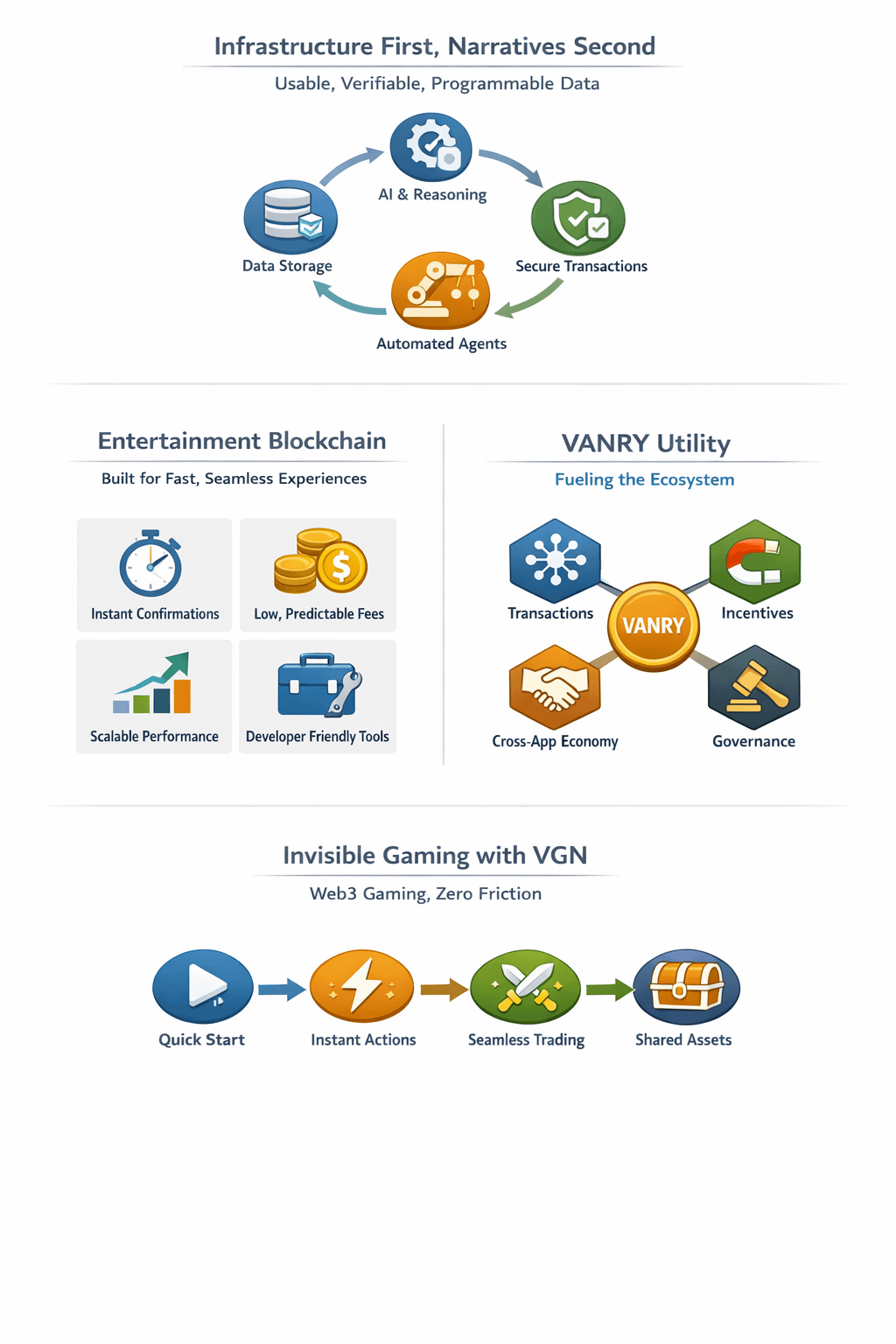
Infrastructure First, Narratives Second
Vanar doesn’t market itself as an “AI chain” or a “gaming chain” in the usual buzzword-heavy way. Instead, it treats AI and data as infrastructurebsomething that must work reliably before it’s ever promoted.
The Neutron and Kayon architecture introduces an important idea:
data shouldn’t just be stored it should be usable, verifiable, and programmable.
That matters in an AI agent economy where actions don’t pause:
➣ Automated transactions
➣ In game economies running 24/7
➣ Content pipelines driven by agents
➣ Adaptive worlds responding in real time
Without predictable fees and fast settlement, that vision collapses. Vanar’s fixed-fee mindset and low-latency execution are clearly designed for nonstop activity, not occasional speculation.
Why Entertainment Demands a Different Blockchain
Gaming and entertainment are unforgiving environments. A two-second delay is enough to break immersion. A confusing wallet prompt can end a session entirely. That’s why so many Web3 games failed—not because ownership wasn’t interesting, but because friction killed the fun.
Vanar builds around this reality:
fast confirmations so gameplay doesn’t pause
predictable costs for micro-actions
stability during peak demand
tooling studios can ship with, not fight against
This is not “good enough” performance. It’s infrastructure designed to feel instant, every time.
VANRY’s Role: Utility Before Hype
Vanar takes a quieter approach to its token. Instead of treating VANRY as the product, it treats the ecosystem as the product—and the token as the engine underneath.
VANRY powers:
➣ network execution and transactions
➣ incentives that attract builders and users
➣ shared economic activity across apps
➣ governance as the ecosystem matures
The bet here is simple but demanding: if real usage grows, the token’s relevance grows naturally. No constant narrative rotation required.
VGN and the “Invisible Blockchain” Thesis
Vanar Gaming Network (VGN) pushes the idea further: blockchain gaming that feels like regular gaming.
The ideal outcome isn’t players learning about decentralization, it’s players never needing to think about it at all.
Fast starts. Instant actions. Item trading that feels native. Ownership that exists quietly in the background.
If assets move across games inside the same ecosystem, value stops being trapped in single titles. That’s when isolated game economies start becoming a connected network.
AI Without the Hype Cycle
AI in entertainment isn’t about flashy demos—it’s about personalization, adaptive systems, and continuous interaction. Those workloads demand infrastructure that stays cheap, fast, and stable under constant use.
Vanar’s real test is whether AI-driven apps can run without performance degradation or cost spikes. If they can, Vanar stops being “a gaming chain” and becomes infrastructure for real-time digital experiences.
The Only Metric That Matters: Execution
This thesis won’t be rewarded forever without proof.
Vanar has to show:
studios shipping real products.
➣ Games launching and retaining users
➣ Organic transaction growth
➣ Stability under real load
Consumer-focused chains don’t win with theory. They win by shipping and shipping consistently.
Final Take
Vanar feels less like a blockchain project and more like an infrastructure company quietly positioning itself for where entertainment and AI are heading.
If the tech stays invisible, the experiences stay smooth, and real usage keeps growing, VANRY stops being a narrative and starts becoming fuel.
And those are the networks worth watching.