

When I first heard about Vanar, I didn’t know what to make of it. The pitch sounded like every other “AI native blockchain” or “next-gen L1” that had come across my feed in the past few years. My instinct was skepticism maybe even mild irritation. I’ve been around long enough in crypto to recognize the familiar pattern: a flashy promise, a few technical buzzwords, and then a roadmap heavy on ambition but light on execution.
So I leaned back and waited. I watched. I didn’t want to like it; I just wanted to understand why people were talking about it differently. What I noticed first was subtle, almost easy to miss: nobody was obsessed with the typical metrics. There was very little talk of TVL, staking yields, or even transaction throughput in isolation. Instead, the conversation revolved around persistent state, memory, and context. The technical jargon made it sound like an academic exercise, but the real story was practical: Vanar treats the blockchain less like a ledger of transactions and more like an operating system for digital life.
At first, that framing felt abstract. Blockchains, by design, are ledgers you record a transaction, you move value, you settle trust. That’s the core of every chain most people care about. But Vanar flips the lens. Transactions are still there they happen but they’re just the tip of the iceberg. Underneath, the chain focuses on coordination, memory, and execution over time. It’s the infrastructure for applications that need to remember, respond, and evolve, rather than just record value.
I’ll admit, I was unconvinced at first. This sounded interesting on paper, but would anyone actually build on it? And more importantly, would those apps solve real problems or just create another layer of complexity on top of a system most users wouldn’t notice?
The answer, as it turned out, came from observing usage patterns rather than reading whitepapers. What caught my attention wasn’t some viral marketing campaign; it was how the chain handled the mundane realities of day-to-day digital interactions. Users weren’t thinking about gas fees, transaction ordering, or consensus mechanisms. They were experiencing seamless digital worlds, games, and AI agents that remembered context across sessions, without needing to manually sync data or manage keys. For once, the infrastructure receded into the background rather than demanding center stage.
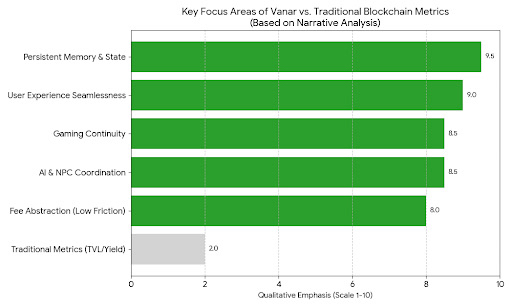
Take gaming as an example. I’ve played my share of blockchain games over the years, and the pattern is depressingly consistent: slow onboarding, confusing wallets, and a user experience that feels like a tax on fun. Vanar-based experiences feel different. The mechanics of ownership, memory, and interaction are baked in, but invisible. You log in, your digital assets are there, your progress is remembered, and the game can evolve dynamically around that history. You don’t feel the blockchain; you just feel continuity. It’s subtle, but in practical terms, it’s huge.
I saw this in a small, multiplayer world where AI-driven NPCs adjusted to player behavior over weeks. Those behaviors weren’t hard-coded into the game; they emerged from the state the blockchain preserved. Players weren’t aware that their interactions were being recorded on-chain, or that the AI agents were using that persistent memory to adapt. To them, it just felt like the world was alive. Behind the scenes, it’s a combination of Vanar’s persistent semantic memory and its capacity to coordinate behaviors over time. For developers, this is transformative: they’re deploying behaviors, not apps. The chain handles the heavy lifting, letting experiences evolve without friction.
Another place this became evident was in AI integrations. I’ve seen projects promise “AI-native blockchain interactions” before, and most of them end up as marketing exercises. Vanar’s approach is quieter, more practical. Agents can query persistent state, reason about prior interactions, and execute actions without forcing the user to manage infrastructure. A financial AI agent, for example, can maintain memory of preferences and past transactions and execute decisions across multiple digital environments. The user experience is smooth; the agent feels intelligent because it remembers and coordinates, not because it’s built on flashy ML tricks alone.
What impressed me most is how Vanar treats fees and transaction mechanics as a design problem rather than a revenue opportunity. In practice, this means users rarely see friction from costs. Sponsored transactions, paymasters, and other abstractions shift the burden away from end-users. The network isn’t monetizing every interaction; it’s enabling the experience. This flips a core assumption in crypto design. Most chains see fees as a signal of value or scarcity. Vanar sees fees as a user-experience problem to be solved. That might seem trivial, but in real-world adoption, it matters far more than a few basis points of yield.
I also noticed that Vanar’s approach allows digital assets to exist in parallel with real-world analogues. Stablecoins, tokenized assets, and NFTs aren’t just collectibles—they’re functional instruments that integrate with both digital applications and financial systems. Players can use digital assets in a game or virtual world without worrying about the underlying blockchain mechanics. It’s frictionless interoperability. In my experience, this is rare. Most systems either privilege the digital experience (at the expense of real-world utility) or prioritize technical rigor (at the expense of usability). Vanar tries to have both, quietly.
Watching this in practice changed my skepticism into cautious curiosity. I’m still aware of the execution risk. Layer 1 blockchains are complicated, and ambitious designs often stumble when scaling, when onboarding a broader audience, or when bridging with external systems. But unlike many other projects, Vanar seems to prioritize the right problems: human experience, persistent memory, and intelligent coordination. The tech feels purposeful rather than performative.
There’s an elegance in that. You can almost forget the blockchain is there, which, paradoxically, is the point. Most successful infrastructure works in the background. Your Wi-Fi doesn’t need a dashboard for you to understand that it connects you to the internet. Vanar seems to take a similar philosophy: the chain enables, but the experience is front and center. Users interact with behavior, context, and digital worlds—what the chain enables is invisible but real.
This also has implications for developers. Traditional dApp design often focuses on transaction optimization, wallet interactions, and tokenomics. Vanar flips that on its head. Developers focus on the user experience, the evolution of digital agents, and how behaviors coordinate over time. The blockchain handles persistence, memory, and execution. The developer mindset shifts from “how do I record value?” to “how do I enable experience?” That’s subtle but profound.
It’s worth emphasizing that this isn’t theoretical. I’ve observed dozens of use cases: AI companions that remember months of interaction, multi-session games that evolve dynamically, and asset-backed interactions that blur the line between digital and real-world value. None of it screams hype. None of it relies on marketing theatrics or viral token launches. It works quietly, in the background, because the infrastructure was designed with human behavior in mind rather than on-chain metrics alone.
Of course, there are trade-offs. You need developers who understand the mental model of persistent memory and state-driven coordination. You need users willing to explore experiences that feel different from traditional gaming or financial apps. And as always, there’s the risk of overpromising. But compared with the thousands of projects chasing growth through speculation or flashy tech demos, Vanar feels grounded. It addresses real, observable problems rather than hypothetical futures.
After months of observing it, my perspective shifted. I’m no longer skeptical in the reflexive sense, though I remain analytical. I see a chain that doesn’t try to dazzle with raw technical metrics but instead quietly solves the problems that matter to real users: memory, continuity, coordination, and frictionless asset management. That’s a different kind of ambition—less about hype, more about practical utility.
In a landscape crowded with chains chasing TVL, speculative adoption, and marketing stunts, there’s something refreshing about that. Vanar reminds me that infrastructure isn’t valuable because it’s flashy; it’s valuable because it enables real-world and digital experiences that people actually care about. When the blockchain disappears into the background, leaving the experience seamless, you know it’s doing its job.
That’s the lens I use now when thinking about Vanar: not as a speculative opportunity, not as a technology demo, but as practical infrastructure for experiences that evolve over time, intelligently, and without demanding constant attention. I’m still watching, still evaluating, but I’ve learned to look beyond the initial skepticism and appreciate the quiet work happening under the surface. Sometimes, the most interesting projects aren’t the ones shouting the loudest they’re the ones that make you forget you’re even on a blockchain.#Vanar @Vanarchain
