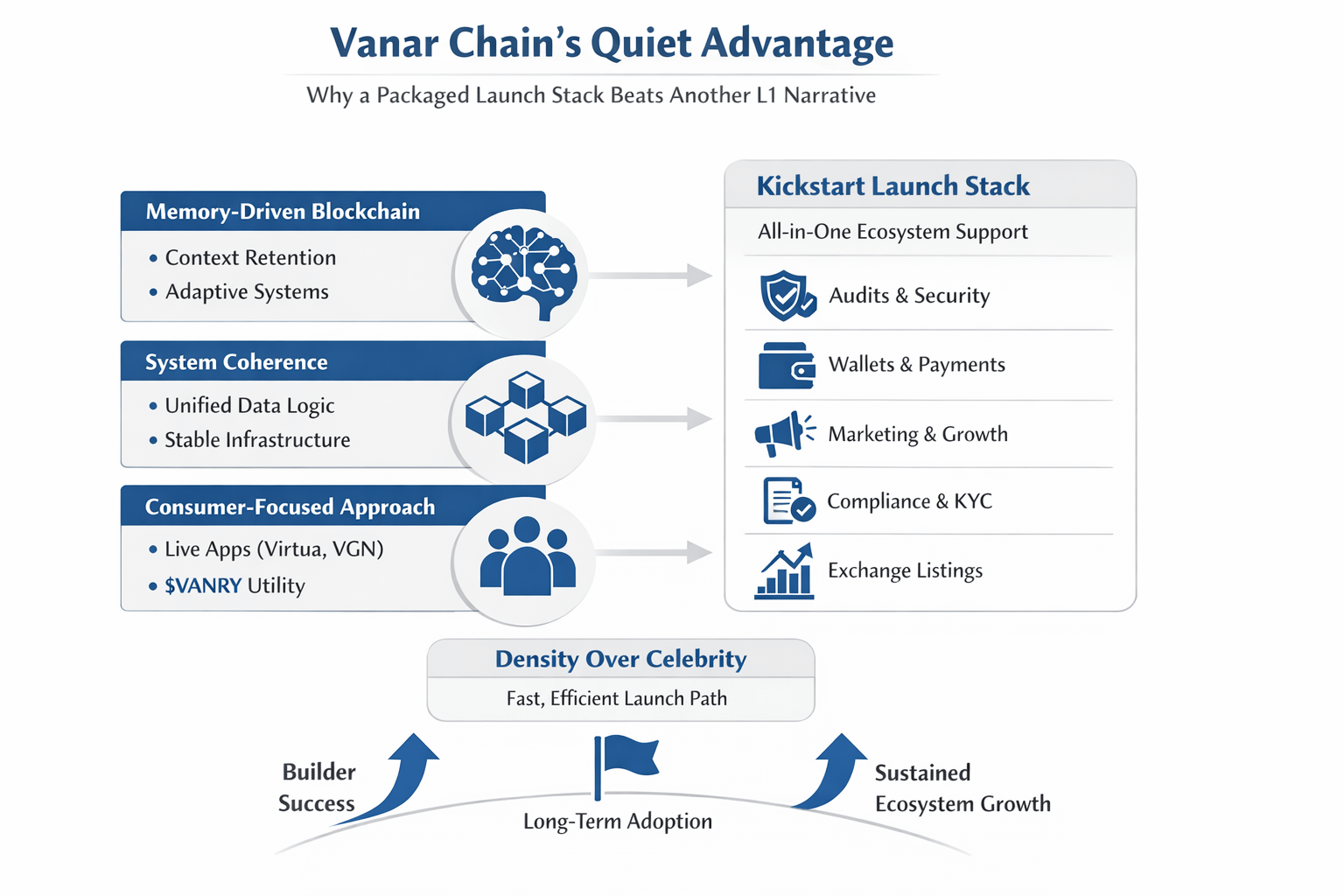
In an overcrowded Layer 1 landscape, most chains compete on the same axes: speed, throughput, and feature count. Vanar Chain is taking a different path one that prioritizes coherence, memory, and distribution over raw technical bravado. It’s a strategy aimed not at short-term attention, but at long-term adoption.
At its core, Vanar is a consumer-first L1 designed for real users, not just builders. With live products like Virtua and VGN already serving gaming, entertainment, and brand-driven experiences, the network is proving its thesis in production. Powered by $VANRY, participation isn’t abstract—it’s tied directly to usage, access, and operational activity across the ecosystem.
From Storage to Memory
Most blockchains are excellent at storing data. Vanar argues that storage alone is insufficient. Modern applications—especially those involving AI, automation, and persistent digital identities—require memory: structured context that preserves relationships over time. Instead of forcing developers to rebuild context off-chain through indexes and middleware, Vanar organizes meaningful data at the protocol level.
This distinction matters as applications scale. Memory-driven systems reduce recomputation, lower technical debt, and enable adaptive behavior. For users, that translates into consistency. For builders, it means fewer brittle integrations and a system that evolves without collapsing under its own complexity.
System Coherence Over Feature Sprawl
Rather than stacking disconnected tools, Vanar emphasizes how data, logic, and applications interact as a single system. Predictable fees, stable infrastructure, and consistent behavior take precedence over chasing the latest feature trend. This approach aligns with how real products are built: reliability first, iteration second.
$VANRY plays a central role here. Its utility supports participation, governance, and interaction within a memory-driven environment, aligning token demand with actual system usage rather than speculative narratives.
Kickstart: Treating Distribution as Infrastructure
Vanar’s most underappreciated differentiator isn’t technical—it’s operational. The Kickstart program reframes “ecosystem building” as a packaged launch stack. Instead of sending teams on a scavenger hunt for audits, wallets, compliance, analytics, listings, and growth partners, Vanar bundles these needs into a single go-to-market system.
Kickstart operates less like a grant program and more like an accelerator menu. Partners provide tangible incentives discounts, free tiers, priority support, co marketing while Vanar acts as the distributor. This reduces burn rate, shortens time to launch, and shifts partnerships from logos to actual leverage.
The insight is simple but rare: the real bottleneck in Web3 isn’t building it’s assembling. Teams don’t fail because they can’t write code; they fail because they can’t ship before time and money run out.
A Bet on Density, Not Celebrity
Vanar’s strategy favors many small, surviving teams over a few headline applications. By investing in talent pipelines, regional builder communities, and structured launch support, it’s betting that ecosystem density beats hype. Distribution becomes infrastructure, not marketing.
Final Take
Vanar Chain isn’t trying to be the loudest L1. It’s positioning itself as the easiest chain to ship on and stay on. If Kickstart continues to produce visible launches, retention, and revenue, Vanar’s “packaged launch stack” could become one of the most pragmatic wedges in Web3. In a market saturated with narratives, the chain that helps builders survive may ultimately be the one that grows.