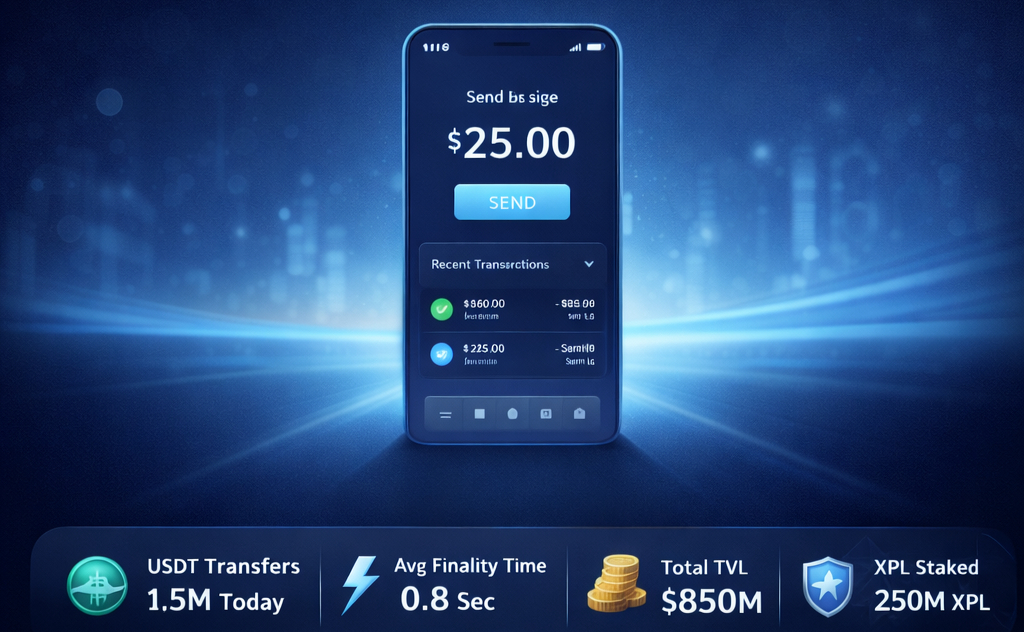
I’m thinking about how strange it is that sending stablecoins is supposed to feel like using money, yet it often feels like operating a machine. There is always an extra step, an extra token, an extra reminder that you are inside a system built for experts instead of ordinary people. Plasma’s story starts with the uncomfortable honesty that most blockchain activity already revolves around stable value. If that is true, the infrastructure should stop treating stablecoins like a side feature and start treating them as the center of the experience. Plasma is not trying to invent new money. It is trying to remove the emotional friction around the money people already trust.
They’re building Plasma with full EVM compatibility through Reth, and that choice feels grounded in reality. Developers already live inside Ethereum tools and habits. If a chain wants adoption, it cannot force everyone to relearn how to think. Plasma quietly keeps the developer world familiar while changing what users feel. The difference appears in speed and finality. Sub second confirmation is not just a technical detail. It is psychological. Waiting creates doubt. Waiting makes people wonder if something broke. PlasmaBFT is designed to shrink that gap so settlement feels immediate enough that the brain relaxes.
We’re seeing an architecture that treats payments as a reliability problem rather than a novelty problem. PlasmaBFT pushes deterministic finality because stablecoin transfers cannot live in uncertainty. When people move value tied to salaries or savings, they are not interested in theoretical debates about block timing. They want certainty. The combination of Reth execution and a Rust built consensus engine reflects an assumption that heavy usage is normal, not an exception. The system is shaped around the idea that stablecoin volume will be constant and demanding.
The most human design choice appears in fees. If a person holds digital dollars but must buy a volatile token just to send them, the system quietly admits it has not solved usability. Plasma’s stablecoin first gas model tries to erase that contradiction. Users can pay fees in assets they already hold, and in some flows fees can disappear from the visible experience. This is not about pretending transactions are free. It is about moving complexity away from the emotional moment of payment. If someone tries to send money and gets interrupted by token requirements, trust drains out of the experience. Plasma treats that interruption as a flaw that needs fixing.
Bitcoin anchoring adds a deeper layer to the story. Plasma does not claim Bitcoin runs the network. Instead it uses Bitcoin as a long term reference for truth, a way to stamp history with a neutral settlement anchor. Payments need more than speed. They need a story about permanence. Anchoring to Bitcoin is Plasma’s way of saying fast local finality and deep historical security can exist together. Everyday responsiveness does not have to sacrifice long term credibility.
The native token sits quietly beneath the surface. XPL is not designed to dominate the user experience. It exists as the economic backbone that secures Proof of Stake, aligns validators, and keeps incentives honest. If Plasma succeeds, many users may barely notice the token directly. That sounds unusual in a market obsessed with visibility, but it fits the philosophy. Infrastructure works best when it fades into the background. Electricity is powerful because nobody has to think about it. Plasma’s token utility follows that same logic.
The ecosystem strategy mirrors this practical tone. Plasma is not waiting for adoption to appear slowly. It starts with stablecoin liquidity, DeFi integrations, and payment flows as immediate priorities. The chain assumes stablecoins are already a global layer in progress and the winning infrastructure will support that reality from day one. Retail users in high adoption regions and institutions moving large value are treated as part of the same system. Both groups need reliability more than spectacle.
The roadmap reads like a product plan instead of a promise of hype. Milestones focus on usability, integration depth, and liquidity access. If it becomes the rail Plasma imagines, progress will look quiet. More applications hiding complexity. More liquidity reinforcing stability. More integrations making the chain invisible to the end user. Success here does not look dramatic. It looks ordinary. That is the paradox. The better it works, the less people talk about it.
Risks remain unavoidable. A chain built around stablecoins inherits regulatory and political gravity. Issuers, compliance frameworks, and jurisdictional pressure become structural forces. If stablecoin policy shifts or liquidity concentrates in fragile areas, Plasma feels the impact immediately. Fee abstraction also carries centralization risk. Systems that manage gas behind the scenes can create hidden control points. If those controls tighten, users may discover their simple experience depends on governance they never saw.
Technical dangers exist as well. Sub second finality must survive congestion, validator conflict, and hostile network conditions. BFT systems can face liveness challenges under stress. High throughput environments attract sophisticated extraction behavior, and unmanaged MEV can distort outcomes for ordinary users. Bridges and anchoring mechanisms expand the security surface. Any promise of gradual decentralization must eventually survive real economic pressure, not just elegant design.
Still, the reason Plasma stands out is its emotional target. It is not chasing spectacle. It is chasing normalcy. If it becomes what it aims to be, sending digital dollars stops feeling like interacting with crypto and starts feeling like interacting with money. The system fades into the background. Payments become expected instead of impressive. And that quiet disappearance may be the strongest signal of success. When people stop thinking about the technology and simply trust the result, the infrastructure has finally done its job.