
As blockchain technology continues to evolve, scalability remains one of the biggest challenges facing developers and ecosystem builders. High transaction fees, network congestion, and limited throughput have slowed down mass adoption. While solutions like rollups and Layer 2 networks have made progress, Plasma stands out as a powerful and underexplored scaling framework that blockchain builders should not ignore.
Plasma is a Layer 2 scaling solution originally proposed to help Ethereum process massive transaction volumes without compromising decentralization or security. It works by creating child chains that handle the majority of transactions off the Ethereum main chain, while still anchoring security to Ethereum’s base layer. This allows developers to build high-performance decentralized applications capable of serving millions — or even billions — of users.

For blockchain builders, Plasma offers a compelling opportunity to design faster, cheaper, and more scalable applications. Instead of competing for limited block space on Layer 1, Plasma enables developers to offload transaction processing to specialized child chains. This dramatically reduces gas fees, improves transaction speed, and enhances the overall user experience — a critical factor for mainstream adoption.
One of Plasma’s strongest advantages lies in its security model. Even though transactions occur off-chain, users retain the ability to exit back to Ethereum if malicious behavior occurs on a child chain. This ensures that funds remain protected under Ethereum’s robust consensus mechanism. For builders, this means they can scale applications without sacrificing trust, decentralization, or user sovereignty.
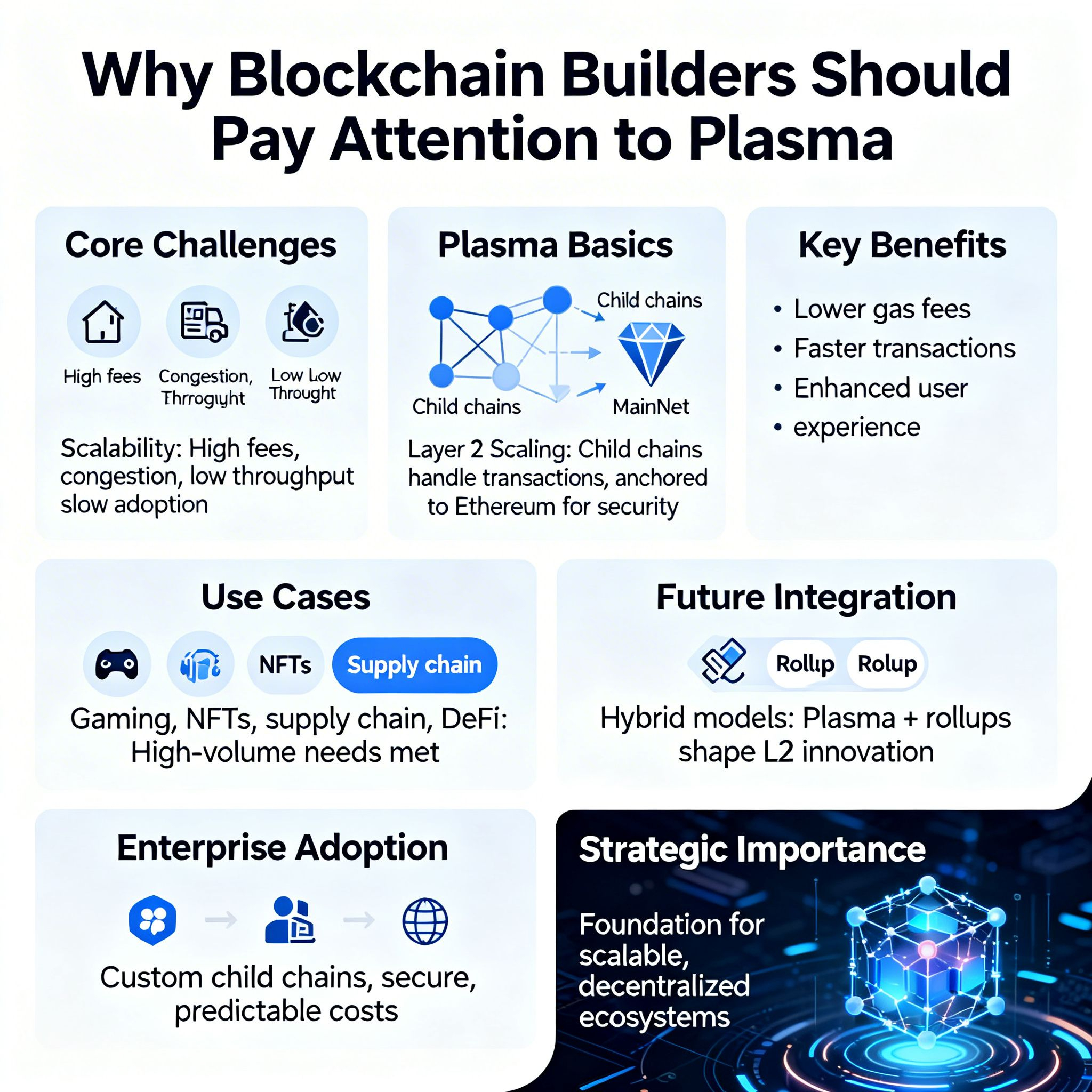
Plasma is especially well-suited for high-volume use cases such as gaming, micropayments, NFT marketplaces, supply chain tracking, decentralized exchanges, and cross-border payment systems. These industries require fast finality, low transaction costs, and scalable infrastructure — all of which Plasma is designed to support. By integrating Plasma-based architectures, developers can unlock new product possibilities that were previously limited by Layer 1 constraints.
Another major reason builders should pay attention to Plasma is its growing relevance alongside rollups and modern Layer 2 solutions. As the blockchain ecosystem matures, hybrid scaling models are emerging that combine Plasma-inspired designs with optimistic or zero-knowledge rollups. This convergence suggests that Plasma’s core concepts will continue to influence the future of blockchain scalability — making it a strategic long-term investment for developers to understand and adopt.
Plasma also opens doors for enterprise-level blockchain adoption. Businesses require predictable costs, high throughput, and secure transaction environments. Plasma’s architecture allows enterprises to deploy custom child chains optimized for specific operational needs while still benefiting from Ethereum’s security. This creates opportunities for blockchain builders to collaborate with corporate partners and develop scalable Web3 infrastructure for real-world industries.
For Web3 founders and protocol designers, Plasma presents a chance to build next-generation decentralized platforms that are more user-friendly and economically viable. Lower fees and faster transactions reduce friction, improve retention, and make decentralized apps more competitive with traditional Web2 platforms. Builders who leverage Plasma early can gain a first-mover advantage in creating scalable, mass-market blockchain solutions.
In a world where blockchain adoption is accelerating, the ability to scale securely and efficiently will define the next wave of successful projects. Plasma is not just a historical scaling experiment — it is a foundational technology that continues to shape modern Layer 2 innovation. Blockchain builders who understand Plasma today will be better positioned to architect the scalable, decentralized ecosystems of tomorrow.
@Plasma $XPL #Plasma