

Execution demand across on-chain markets is no longer expanding linearly. It’s clustering. Liquidity events, coordinated trading flows, and automated strategies now generate bursts of transaction density that expose structural bottlenecks far faster than organic growth ever did. This shift is quietly reframing how infrastructure risk is priced.
Throughput ceilings are only one side of the equation. What increasingly matters is how networks behave when computation, consensus, and propagation loads collide simultaneously. Under these conditions, latency variance widens, confirmation windows stretch, and execution determinism weakens. For capital operating at speed, those inefficiencies translate directly into cost.
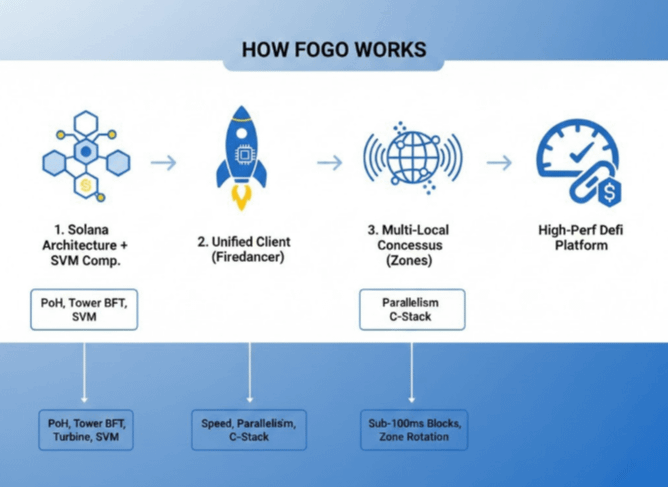
As a result, infrastructure design is starting to influence market positioning. Parallel execution environments are gaining relevance not because they are faster in isolation, but because they distribute computational pressure before it concentrates into systemic drag. The ability to fragment workload at the runtime layer reduces the probability of congestion cascading upward into settlement delays.
This is where architectural alignment becomes critical. The system stack surrounding @Fogo Official combines SVM-based parallel execution with segmented consensus coordination and high-performance client propagation. Rather than scaling vertically through blockspace expansion, validation load is distributed laterally across multi-local zones, reducing synchronization strain during demand spikes.
Block interval compression further tightens execution feedback loops. Faster production cycles don’t just improve speed metrics; they stabilize confirmation predictability when transaction clustering intensifies. Infrastructure resilience, in this model, comes from synchronized scaling across execution, validation, and communication layers.
As markets begin pricing infrastructure durability alongside throughput capacity, networks engineered to absorb coordinated load may capture disproportionate attention. The performance thesis surrounding $FOGO reflects that transition, with #fogo positioned within a segment of Layer 1 design focused less on peak speed and more on sustained execution reliability.