


On February 9, 2026, Vanar quietly released myNeutron v1.4. At first glance, it looked like a usability update — Telegram bot integration, mobile optimization, credit tracking, file-to-Seed automation, cleaner billing. But the real shift wasn’t in the interface. It was in distribution.
Vanar moved its AI memory layer out of the developer console and into Telegram.
That matters more than it sounds.
For months, Neutron has positioned itself as persistent semantic memory for agents — compressing inputs into verifiable Seeds, enabling retrieval across sessions, and allowing Kayon to reason over accumulated context. The infrastructure was there. But infrastructure only compounds when usage becomes habitual.
v1.4 changes where that habit forms.
Telegram is where Web3 actually lives — builders, researchers, communities, traders, founders. Decisions, ideas, drafts, screenshots, whiteboard thoughts — they happen in chats, not dashboards. By letting users forward messages, documents, and files directly into myNeutron via a Telegram bot, Vanar closes the gap between “thinking” and “recording.”
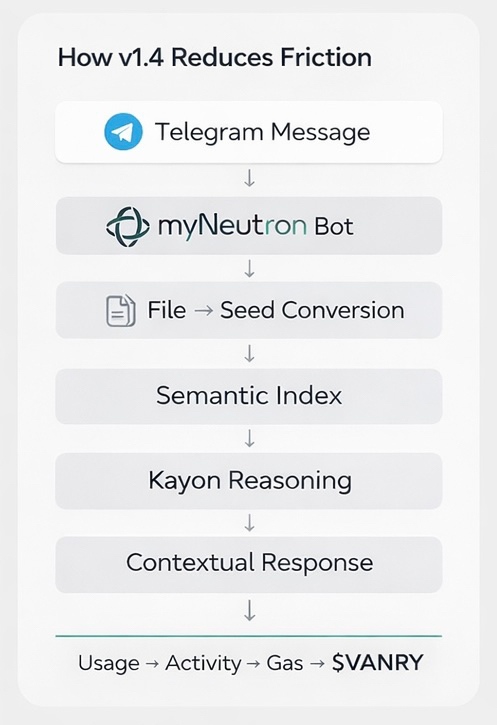
A message becomes a Seed.
A file becomes indexed memory.
A discussion becomes retrievable context.
That flow — Telegram → myNeutron → Seed → semantic search → AI response — reduces friction dramatically. And friction is what usually kills daily AI usage.
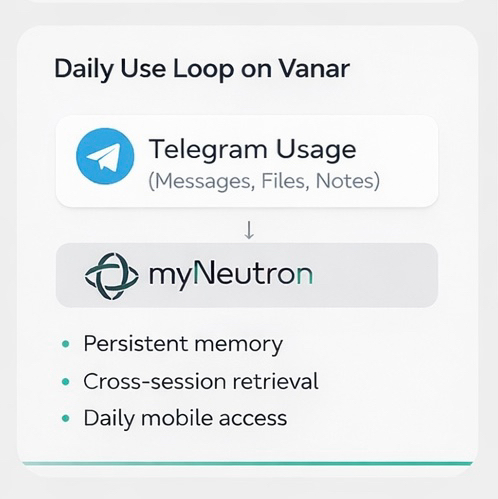
I tested it in real conditions, not in a polished demo. Forwarded long chat threads, uploaded research PDFs, saved voice notes. The system auto-converted files into Seeds without requiring manual formatting. Later, I queried that information from mobile. Retrieval felt instant and contextual. Not a re-upload. Not a reconstruction. Just continuation.
This is where the upgrade stops being cosmetic.
Vanar isn’t just improving UX. It’s increasing daily interaction with its memory layer. More files saved. More Seeds created. More queries run. That translates directly into operational activity on Vanar’s stack.
If AI memory stays locked in dev consoles, it remains niche. If it lives in Telegram, it becomes routine.
There’s also a behavioral layer hidden in the update. Credit tracking and streak logic in v1.4 introduce subtle usage incentives. Not loud token emissions. Not farming. Just habit loops. The more users store and retrieve knowledge, the more embedded the tool becomes in daily workflows.
That’s retention, not speculation.
And retention is what turns infrastructure into default.
From an ecosystem perspective, the impact compounds. When knowledge workers, creators, and builders start using myNeutron daily, they indirectly increase activity on Neutron and Kayon. Every file converted into a Seed, every semantic query, every structured retrieval connects back to Vanar’s AI-native architecture.
Usage drives gas.
Gas ties back to $VANRY.
Demand grows from behavior, not campaigns.
It’s subtle, but powerful.
The risk, of course, is overcapture. If users indiscriminately push every message into persistent memory, signal can drown in noise. Privacy expectations in Telegram also require clear boundaries. Long-term retention needs thoughtful controls, not blind storage. How Vanar manages filtering, permissions, and context hygiene will matter.
But directionally, this update signals something important.
Vanar isn’t marketing AI.
It’s embedding it into everyday tools.
In Web3, adoption rarely comes from whitepapers. It comes from presence in the tools people already use. By placing its memory layer directly inside Telegram, Vanar reduces switching cost and increases daily surface area.
This is what AI leaving “developer mode” looks like.
Not a flashy announcement.
Not a throughput claim.
Just memory becoming portable, mobile, and habitual.
If AI infrastructure is going to matter in 2026, it won’t be because it’s powerful in theory. It will matter because people use it every day without thinking about it.
With v1.4, Vanar took a quiet step in that direction.
Would you trust Telegram as the entry point to your second brain? And what type of information would you actually store as a Seed?