
When I first looked at VANAR, I expected the usual Layer-1 story.
You know the pattern: faster blocks, cheaper fees, and the hope that developers will eventually build something meaningful on top. That’s still how most people frame new chains.
But the longer I spent studying what VANAR has actually shipped — and more importantly, how they describe what comes next — the more that framing started to feel incomplete.
VANAR does not read like an ecosystem waiting for use cases.
It reads like a product stack that happens to settle on its own chain.
And that difference matters more than most people realize.
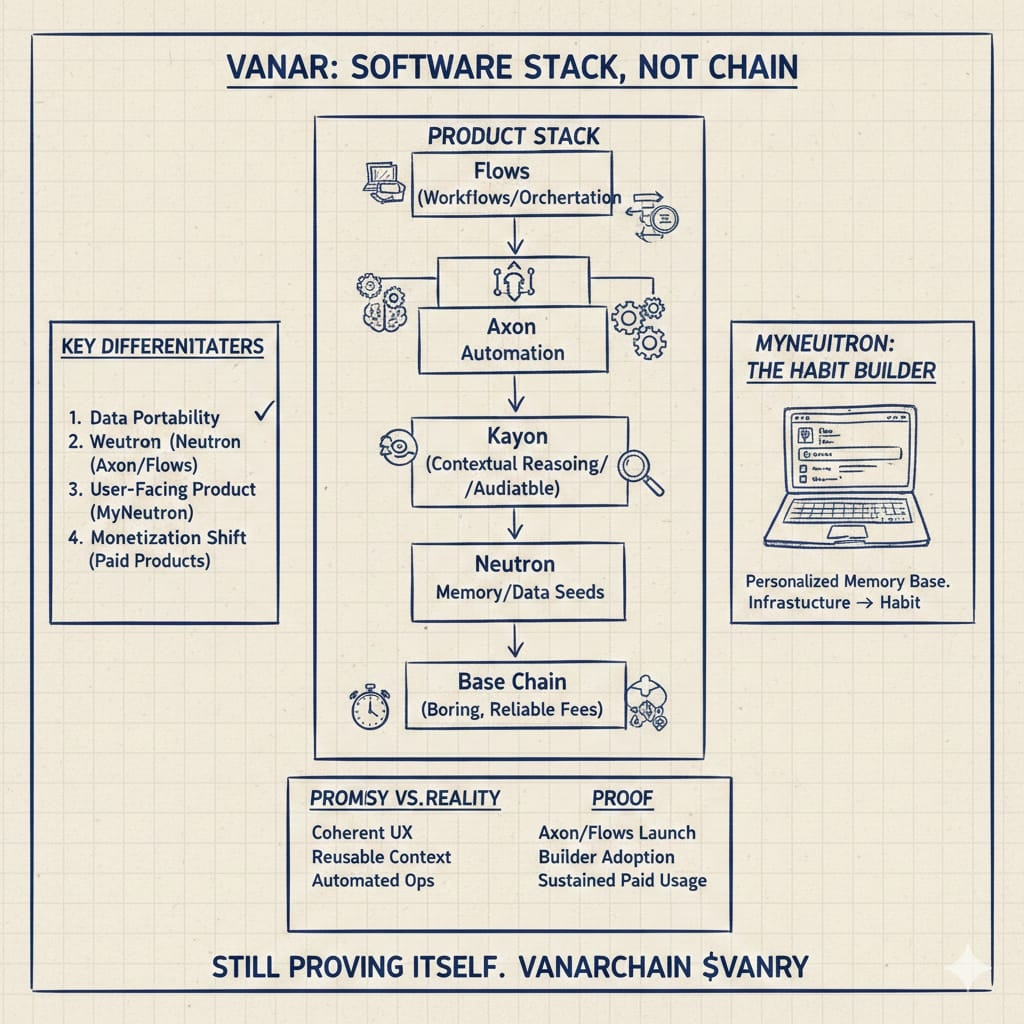
It’s structured like software, not like a token pitch
The cleanest signal is how VANAR lays out its own architecture:
Base Chain → Neutron → Kayon → Axon → Flows
That looks much closer to a software suite roadmap than a typical crypto narrative.
In Web2, nobody sells you “a database” and calls it a day. They sell systems that make data actually useful — searchable, portable, and able to power workflows. VANAR appears to be chasing something structurally similar, except they want the storage and trust layer to live on-chain instead of inside private infrastructure.
You can absolutely debate whether a blockchain is necessary for this. That’s a fair question.
But the shape of the strategy is clearly different from the usual Layer-1 playbook.
The base chain: trying to make crypto feel boring (in a good way)
VANAR’s base layer messaging is pretty straightforward. They emphasize predictable fees and smooth performance so applications don’t feel clunky or expensive to use.
That may sound simple, but it targets a real friction point.
Most blockchains work fine for occasional transactions. They start to feel awkward when you try to build something interactive — something where users click frequently and expect the experience to feel instant and normal.
VANAR’s approach suggests they understand this problem. The goal is not just raw speed. The goal is to make the layers above behave like ordinary software where users don’t have to think about costs every few seconds.
If they succeed here, it gives the rest of the stack a much better foundation.
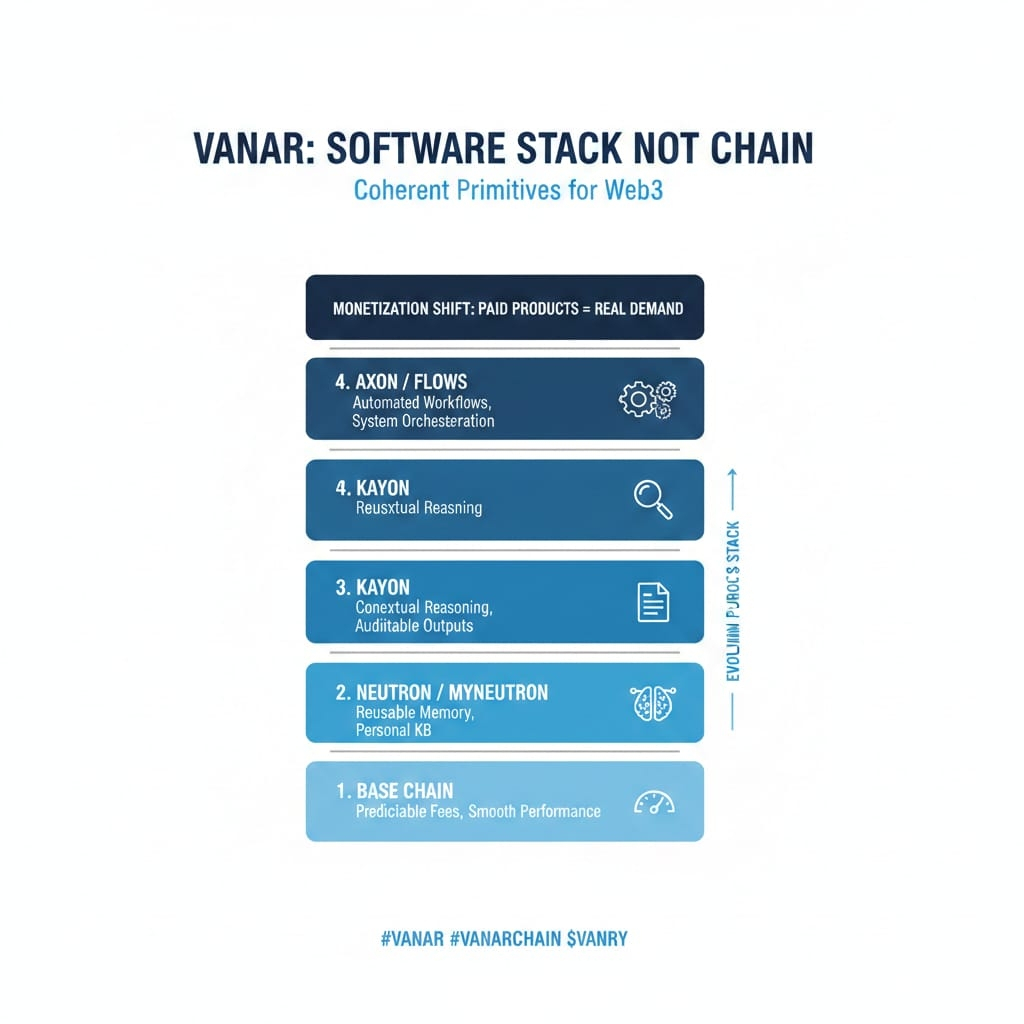
Neutron: where things actually get interesting
Neutron is the first place where VANAR starts to look genuinely different.
Instead of positioning it as simple storage, they describe it as a system that transforms raw data into compact “Seeds” that can live on-chain and be queried later like active memory.
In plain terms, they are trying to turn data into something reusable across applications, not just something archived and forgotten.
That’s an important distinction.
Most blockchain storage solutions still behave like cold storage. Neutron’s pitch is closer to a portable memory layer — something applications can reference and build on repeatedly.
Now, the compression claims they make are ambitious. Any serious researcher should treat those numbers as something to test, not something to accept blindly.
But even with healthy skepticism, the direction is clear: VANAR is trying to make data more fluid and reusable inside the ecosystem.
myNeutron: the quiet but important piece
If you ask me what part of the stack could matter most for real adoption, it might actually be myNeutron.
Because this is not just infrastructure. It is a user-facing product.
It’s framed as a personal knowledge base where users can capture pages, files, notes, and prior work — then reuse that context later instead of rebuilding everything from scratch.
Why does this matter?
Because infrastructure only becomes valuable when it sits underneath a habit.
If people start using a memory tool daily, the blockchain beneath it stops being theoretical. It becomes part of a workflow that repeats over and over.
That is the kind of usage that tends to stick.

Kayon: powerful idea, but this is where I’d be strict
Once you accept Neutron as the memory layer, Kayon is easier to understand. VANAR positions it as the reasoning layer that can analyze stored context and produce traceable outputs.
Conceptually, that makes sense. Strong software systems often evolve in layers:
stabilize the data
then make the data useful
then automate workflows around it
But Kayon is also where I would apply the most scrutiny.
Because the word “auditable” gets used very loosely across the industry. Sometimes it just means good logging. Other times it means independent parties can actually verify what happened and why.
Those are very different standards.
VANAR’s messaging leans toward the stronger interpretation. The real test will be whether outside builders can rely on it without heavy customization or handholding.
Axon and Flows: the make-or-break layer
Right now, Axon and Flows are still framed as upcoming pieces of the stack.
In my view, this is where the entire thesis either becomes real or stalls.
Because the jump from “we store data” to “teams run real operations on this” always comes down to workflow.
Automation. Orchestration. The boring glue that turns tools into systems.
If VANAR delivers Flows in a way that lets teams reliably define multi-step processes, then the earlier layers start to compound in value.
If they don’t — if the developer experience is clumsy or delayed — then the story shrinks.
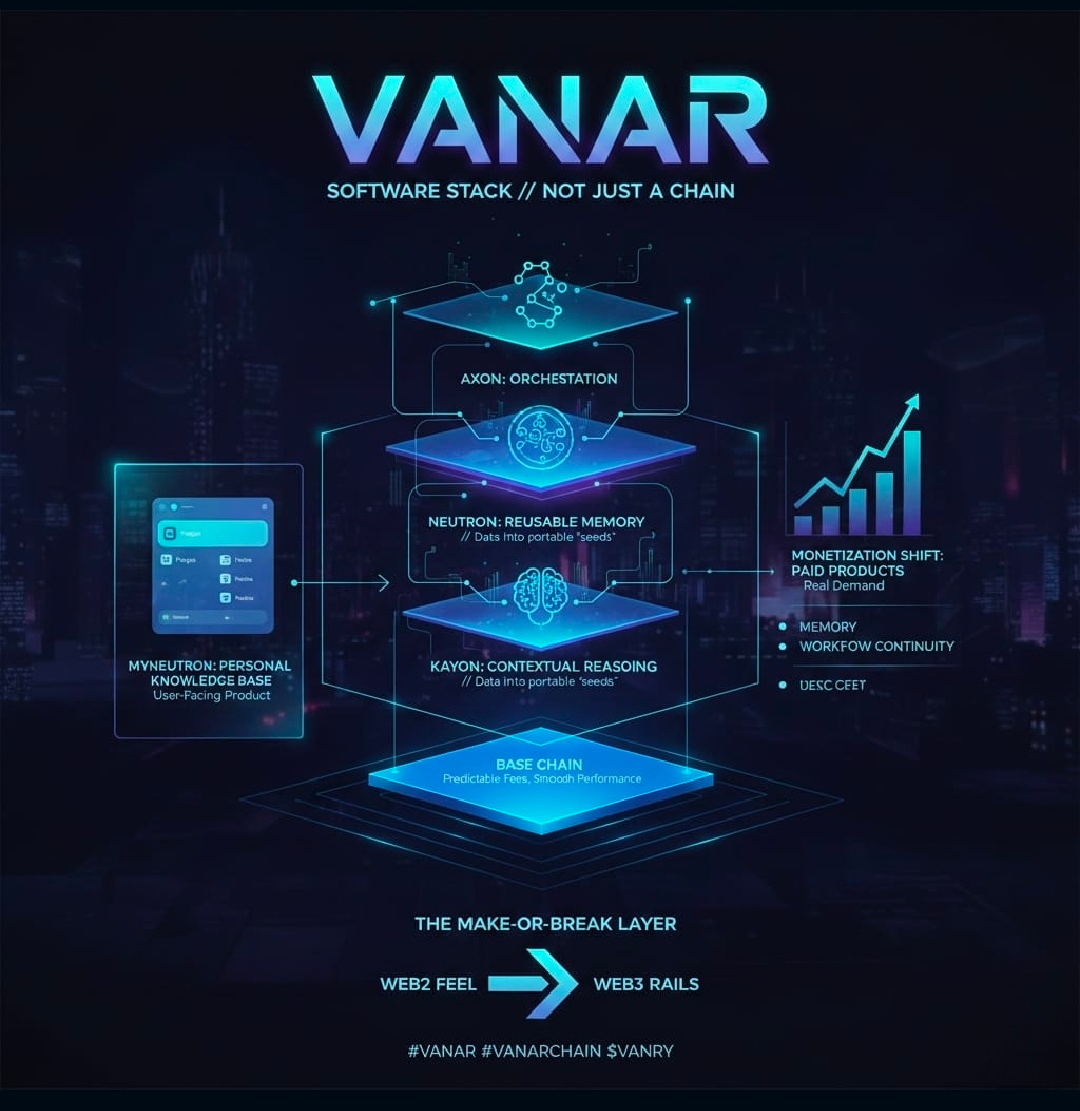
The monetization shift is quietly important
One detail I am watching closely is the move toward paid products.
Crypto is full of ecosystems that rely on incentives forever. That can drive activity, but it rarely proves real demand.
Charging users is uncomfortable. It also forces honesty.
If tools like myNeutron actually transition into subscription-based products and users still stick around, that becomes one of the strongest signals that the stack is solving a real problem.
Why VANAR matters (without the hype)
The real bet VANAR is making is not about launching more dApps.
It is betting that the next wave of crypto adoption will come from better primitives for:
memory
context
and workflow continuity
In other words, software that feels coherent over time, not just transactional in the moment.
If they execute well — especially on the workflow layer — the “Web2 feel on Web3 rails” idea starts to become tangible.
If the upper layers slip, or Neutron ends up being more branding than substance, then the outcome is smaller.
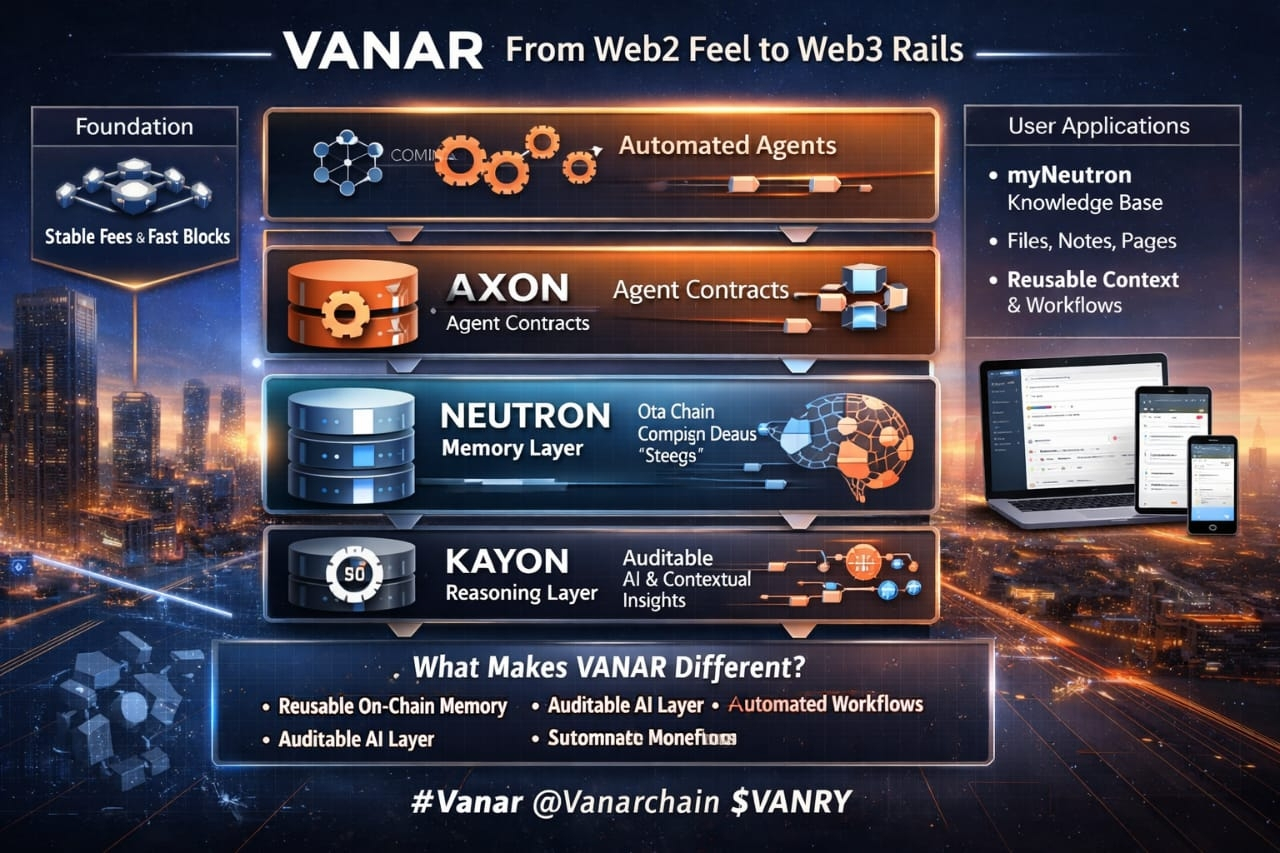
My honest read
I don’t find VANAR interesting because of buzzwords.
I find it interesting because the structure of the build actually makes sense.
It follows a logical progression:
predictable base → reusable memory → contextual reasoning → automated workflows
That is how durable software platforms usually evolve.
But the final proof is still ahead.
If Axon and Flows land cleanly and builders start using the stack for boring, repeated workflows, VANAR could carve out a meaningful position.
If not, it risks becoming another well-designed system that never fully converts promise into sustained demand.
For now, it stays on my watchlist — not as hype, but as a thesis that still needs to finish proving itself.