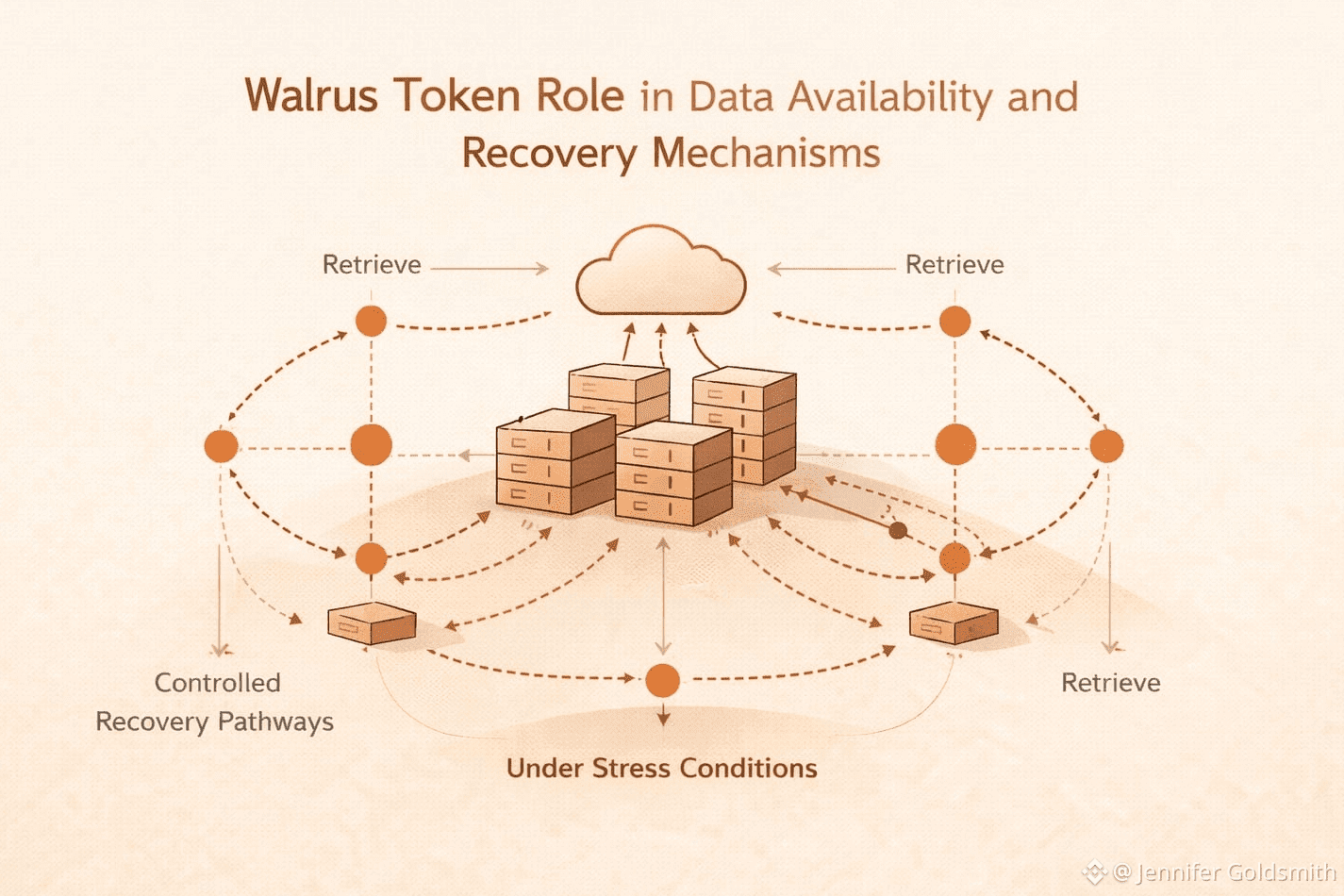
Data availability is one of the most underestimated pressure points in decentralized storage systems. As networks scale, the challenge shifts from simply storing data to ensuring reliable retrieval under stress conditions, including node failures and partial outages.
Recent technical progress within the Walrus Protocol highlights how recovery-oriented design choices directly impact trust at the infrastructure layer. Rather than maximizing redundancy at any cost, Walrus emphasizes controlled recovery pathways that balance cost efficiency, retrieval latency, and long-term resilience.
Within this architecture, the WAL token serves a functional role, not a symbolic one. Token-based incentives are used to coordinate storage providers around availability and recovery guarantees, even when retrieval conditions degrade. This reduces reliance on brute-force replication and redirects incentives toward predictable, performance-based recovery behavior.
By aligning economic incentives with recovery outcomes, the network encourages participants to prioritize data integrity and accessibility over raw capacity expansion. Over time, this approach strengthens Walrus’s reliability profile, as availability is measured not by how much data is stored, but by how consistently it can be retrieved when systems are under pressure.
As Walrus continues to refine its recovery mechanisms, the WAL token becomes embedded in an infrastructure model that rewards reliability under adverse conditions, reinforcing long-term confidence rather than short-term throughput metrics.