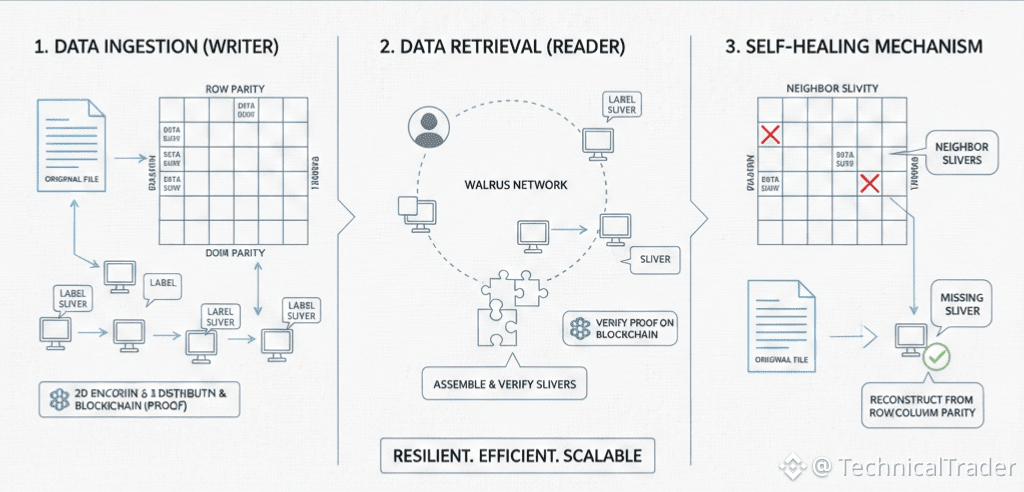
Have you ever stopped to think about where your digital life actually lives? Whether it is your favorite photos or important work documents, we usually trust "the cloud" to keep them safe. But most clouds are just big warehouses owned by one company. Today, I want to talk to you about a different way of doing things called Walrus. This is a decentralized storage network, which means instead of trusting one big company, we trust a wide community of computers working together. Let’s walk through how Walrus makes sure your data stays safe, even if some of those computers disappear.
The Simple Way We Share in Walrus
Imagine I have a secret recipe that I want to make sure is never lost. The easiest thing I could do is print out a hundred copies and give one to every single person in our group. In the world of Walrus, we call this full replication. If I send my file to everyone, I only need to hear back from a few honest people to know it is safe. If I ever need it back, I just ask anyone in the group, and since they have the whole thing, I get it back instantly.
But think about the downside for a second. If that recipe is a huge book, and I give a full copy to a hundred people, we are wasting a lot of paper and space. In a digital network, this means the uploader has to work really hard to send that data over and over again. While this method is very reliable, it is not very smart for a huge network. We want Walrus to be lean and fast, not weighed down by too many copies.
Splitting Your Files into Pieces
To solve the space problem, we can use a clever trick called "encoding." Instead of giving you the whole book, I might give you just one page. But it is not just any page. I use a bit of math to make sure that if you gather any ten people from our group, their pages combined can magically recreate the entire book. In Walrus, we call these pieces slivers. This is much better because I only have to send a tiny bit of data to each person, saving everyone a lot of time and storage space.
There is still one little problem we have to face with this method. Imagine a new person joins our group and needs their page. In most systems, they would have to download the whole book from everyone else just to figure out what their specific page should be. That is a lot of work for a new member! We want the Walrus network to be easy to join and easy to fix, which leads us to our most advanced solution.
The Magic of the Two Dimensional Grid
This is where Walrus gets really cool. To make the system "self-healing," we arrange your data in a grid, like a large square of tiles. Think of it as having rows and columns. Instead of just giving you a piece of a row, I give you a piece of a row and a piece of a column. This 2D approach is the secret sauce of the Walrus protocol. It means that every piece of data is linked to others in two different directions.
Why does this matter to you? Well, if one computer in the network crashes and loses its data, it doesn't have to download the whole file to get back on its feet. It can just ask its neighbors for the tiny spots where the rows and columns cross each other. It is like fixing a small hole in a net rather than weaving a whole new net from scratch. This makes Walrus incredibly efficient and tough.
Keeping the Labels Small and Managed
Every piece of data needs a label so we know it hasn't been tampered with. But if we have millions of pieces of data, the pile of labels can actually become bigger than the files themselves! We don't want to fill up your hard drive with just labels. In Walrus, they handle this by splitting the labels up just like we split the files.
We use the same sharing math on the labels. Each person in the network only holds a small piece of the "master list." When you want to check if a file is real, the network quickly puts those label pieces together for you. This keeps the background noise of the system very quiet and allows Walrus to grow to a massive size without slowing down. It is all about being smart with the space we have.
How We Write Your Data Together
When you decide to save something on Walrus, you are the "writer." You take your file, turn it into that 2D grid of rows and columns, and send the little pairs of pieces to different computers across the network. You don't have to wait for everyone to say "got it." Once you have enough signatures from the group, you can be confident that the data is locked in.
You then take those signatures and post a proof on the blockchain. This is like putting a public notice in the town square that says, "My file is safe and here is the proof." This ensures that even if you turn off your computer and go on vacation, the rest of the Walrus network knows exactly what to do to keep your file alive and healthy while you are gone.
How We Get Your Data Back
When you want to see your file again, the process is just as simple. You are now the "reader." You don't need to talk to every single computer in the network. You just reach out and grab enough pieces to fill in the grid. Because of the math they use, your computer can tell almost instantly if someone is trying to give you the wrong piece or a broken file.
Once you have enough pieces, your computer assembles them back into your original file. It is a bit like a high-speed puzzle where the pieces snap together perfectly. Before the file opens, Walrus double-checks the labels against that public proof on the blockchain. If everything matches, your file opens up, and you know it is exactly what you saved, with not a single bit out of place.
A Network That Heals Itself
The most beautiful thing about Walrus is that it is built for a world where things break. In the real world, servers go down and internet connections fail. But because of the way they have built this 2D grid, the network is always fixing itself in the background. If a few nodes go offline, the remaining ones use their row and column intersections to help new nodes get up to speed.
This means the Walrus network gets stronger as it grows. Instead of getting bogged down by more users, it has more "helpers" to keep the data safe. they are moving away from the old way of storing things in one basket and moving toward a future where our data is woven into a strong, digital fabric that we all own and maintain together.
what you think about this? don't forget to comment 💭
Follow for more content 🙂