I want to welcome you to a really interesting topic that is changing how we think about the internet. Have you ever wondered where all your digital photos and files actually go when you save them online? Usually they sit on a computer owned by a massive company but today I want to talk to you about Walrus. This is a new way to store data that does not rely on just one big boss.
Walrus is what we call a decentralized storage system. Think of it like a giant digital warehouse that is managed by a community instead of a single corporation. It uses a blockchain to keep everything organized and a group of independent storage nodes to hold onto the actual files. It is a very smart setup that makes sure your data stays safe and stays yours.
In this article we are going to walk through how this all works together. I will explain how you can put things into this storage and how you can get them back out whenever you need them. It might sound a bit technical at first but I promise we will keep it simple and friendly as we explore this together.
How the Walrus Brain Works
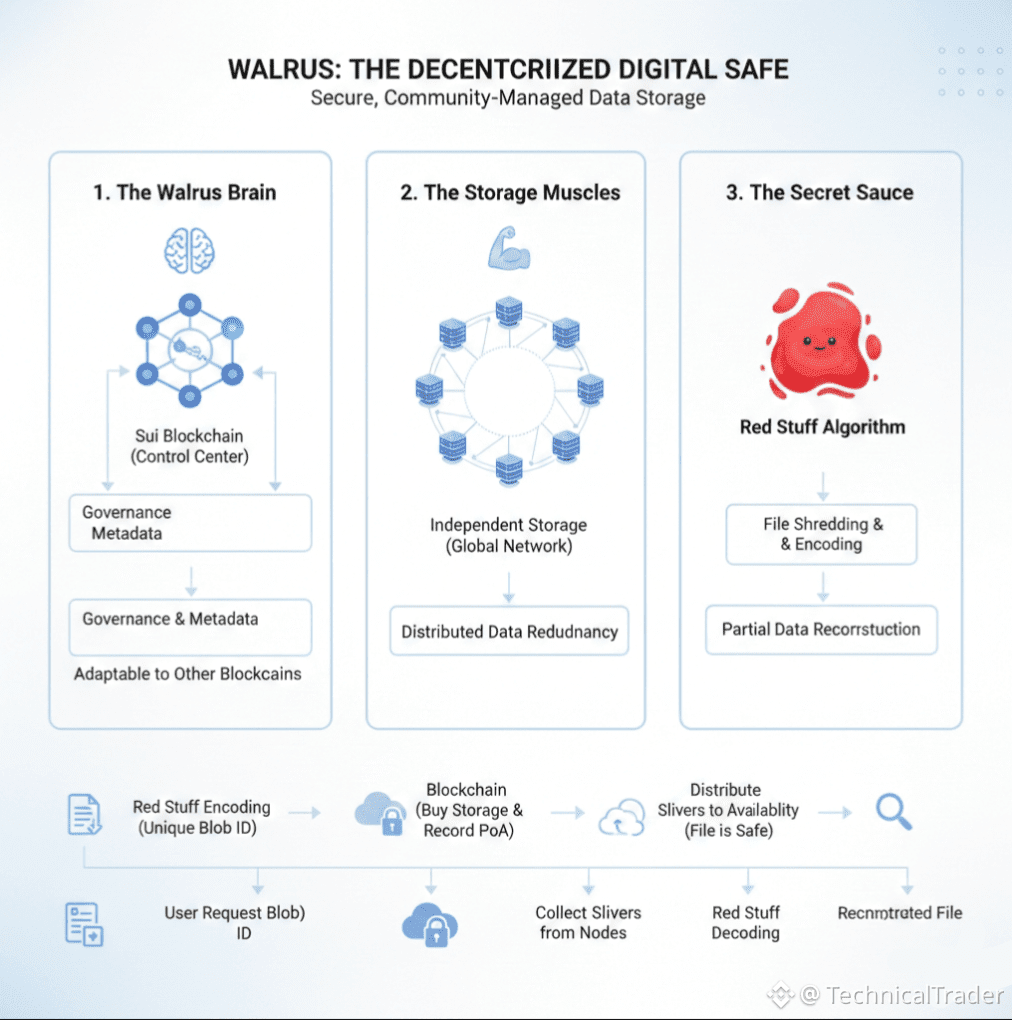
To understand Walrus we first have to look at its brain which is the Sui blockchain. In this system the blockchain acts like a control center or a manager. It does not store the heavy files themselves because that would make the blockchain too slow and bulky. Instead it handles the rules and the maps for where your data is.
When we use Walrus we are using the blockchain to manage things like governance and meta data. This means the blockchain keeps a record of who is allowed to see what and how the storage nodes should behave. It is a transparent way to make sure everyone is following the rules without needing to trust a middleman.
The beauty of this design is that it can be adapted. While it currently uses the Sui blockchain it is built in a way that it could work with other blockchains too. This flexibility is great for us because it means the system can grow and change as technology gets better over time.
Meeting the Storage Nodes
While the blockchain is the brain the storage nodes are the muscles of Walrus. These nodes are separate computers run by different people all over the world. Their only job is to hold onto the pieces of data that you want to save for the long term.
These nodes work together as a committee. When you send a file to Walrus it is not just sitting on one node. It is spread across many of them. This is a huge benefit for us because if one node goes offline or has a technical problem your data is still safe on the other nodes.
I think this is a much better way to handle things than traditional storage. We do not have to worry about a single server crashing and losing our precious memories. The committee of nodes ensures that there is always someone looking after our digital property.
The Secret Sauce Called Red Stuff
You might be asking how we can spread a file across many nodes without losing any information. This is where a very cool algorithm called Red Stuff comes into play. I know it has a funny name but it is the secret sauce that makes Walrus so efficient and reliable.
When you want to store a file you use the Red Stuff algorithm to chop that file into many tiny pieces. These pieces are not just random chunks. They are special encoded slivers. The magic here is that you do not need every single sliver to rebuild your original file.
This means that even if some of the storage nodes disappear we can still get our file back perfectly. It is like having a backup that is built right into the file itself. This makes the system incredibly resilient and gives us peace of mind that our data is protected against almost any kind of failure.
Writing a Blob into the System
Let us talk about the actual process of saving something which we call writing a blob. In the Walrus world a blob is just a fancy word for any piece of data like a video or a document. The first thing you do is use that Red Stuff algorithm to prepare your file and get a unique ID for it.
Once you have your blob ID you go to the blockchain to buy some storage space. You are basically paying for a subscription to keep your data safe for a certain amount of time. The blockchain makes sure that there is enough room for your file and all the extra security pieces that come with it.
After you have your space you send the pieces of your file to the storage nodes. You tell them that they have a new job to do. They check the data and send you back a signed note saying they have it. It is a very organized handshake between you and the network.
Reaching the Point of Availability
The final step in saving your data is reaching what we call the Point of Availability or PoA. Once you have enough signed notes from the storage nodes you show them to the blockchain. This is your proof that the file is safely tucked away in the Walrus system.
When the PoA is recorded on the blockchain it is a big deal. It signals to everyone that the nodes are now officially responsible for your data. At this point you can actually delete the file from your own phone or laptop because you know it is safe in the cloud.
This PoA can also be used as proof for other people. If you want to show a friend or a business partner that a file is available you can point them to this record. It is a fast and trustworthy way to prove that data exists and is ready to be used whenever it is needed.
Getting Your Data Back
Now what happens when you want to see your file again? The reading process in Walrus is designed to be very simple for the user. You just ask the storage nodes for the pieces of your file using that unique blob ID we mentioned earlier.
You only need to collect a certain number of replies from the nodes to put your file back together. Because the Red Stuff algorithm is so smart you do not have to download a huge amount of extra data. It is very fast and does not waste your internet bandwidth.
After you download the pieces you run a quick check to make sure the file is exactly what it is supposed to be. If the ID matches you are good to go. This ensures that nobody has tampered with your data while it was being stored. It is a clean and secure way to get your information back.
Why This Matters for You and Me
I believe Walrus is a huge step forward for our digital lives. We are generating more data than ever before and we need places to put it that we can actually trust. By moving away from central companies and toward a decentralized network we gain more freedom.
With Walrus we are not just customers of a big tech company. We are users of a global public utility. The system is designed to be fair and open which means it can be cheaper and more secure than what we are used to today.
I am really excited to see how people use this technology to build new apps and services. Whether you are a developer or just someone who wants to keep their family photos safe Walrus offers a powerful new way to handle storage. Thank you for joining me on this look into the future of data.
what you think about this? don't forget to comment 💭
Follow for more content 🙂