

Let's be honest. Navigating Web3 can feel like standing in the middle of a hurricane made of information. You’ve got NFT collections dropping by the thousands, endless governance forum threads, alpha threads, long-form research, and protocol documentation scattered across the internet. How do you find what actually matters to you? How do you sift through ten thousand digital artifacts to find the one that fits your interest, your goals, your taste? It’s the ultimate digital haystack problem, and we’re all just looking for a sharper needle.
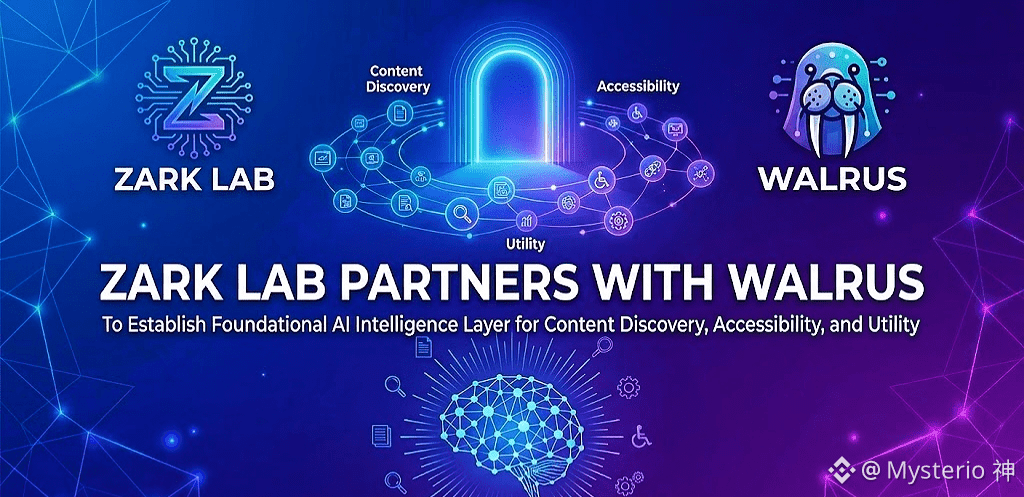
This overwhelming chaos isn't just a user experience fail; it's a fundamental bottleneck for growth. But what if the content itself could become smarter? What if the ecosystem could learn what you need and deliver it, not by spying on you, but by working for you in total privacy? This isn't a distant dream. It's the exact mission behind a pivotal partnership between ZkArk Lab and Walrus Protocol. Together, they’re not just launching another app they’re constructing a foundational AI intelligence layer designed to tackle content discovery, accessibility, and utility head-on.
The Perfect Alliance: Privacy Meets Machine Mind
To understand why this partnership clicks, you need to look at the unique superpowers each brings to the table.
First, there’s Walrus Protocol. Think of Walrus as the ultimate trusted intermediary that doesn’t actually exist. Its magic lies in enabling private computation on public blockchains. Using clever cryptography like commit-reveal schemes, it allows data to be processed and verified without ever being exposed. It’s the perfect pipeline for sensitive information—your preferences, your holdings, your search queries.
Then, enter ZkArk Lab. These folks live at the bleeding edge where zero-knowledge cryptography shakes hands with artificial intelligence. Their expertise is in building practical AI systems that can understand, categorize, and generate insights from data while respecting the sanctity of privacy. They’re the architects of the "machine mind."
Put them together, and the vision becomes clear. Walrus provides the secure, trustless tunnel. ZkArk builds the intelligent engine that runs inside it. One handles the "how" of privacy, the other masters the "what" of intelligence. It's a match made in cryptographic heaven.
What Is This "Intelligence Layer" Anyway?
You hear "layer" thrown around a lot in crypto. This one is different. This isn't about moving assets (Layer 1) or scaling transactions (Layer 2). This is a content and interaction layer. It’s the plumbing for understanding, sitting between you and the vast, unstructured data of Web3. Its job breaks down into three core missions:
Discovery That Actually Discovers: Forget basic keyword searches. We’re talking about semantic, context-aware discovery. Imagine asking, "show me NFT projects with a lore style similar to this one I hold, that have an active development team and a treasury of over 100 ETH." The AI, using private data about your holdings and preferences funneled through Walrus, can parse the entire ecosystem to find those hidden gems. It’s like having a personal curator who knows your taste inside out but has taken a vow of silence.
Accessibility That Adapts: On-chain content is often technical and dense. What if it could adapt to you? This layer could use AI to dynamically generate summaries of lengthy governance proposals, translate developer documentation into plain English, or create audio versions of research reports. The content becomes fluid, morphing to fit your preferred way of consuming information, all processed confidentially.
Utility That Unlocks: This is where it gets exciting. This intelligence layer can create entirely new utilities for content. Think of a "proof-of-reading" attestation: complete an interactive summary of a protocol’s whitepaper, and receive a verifiable credential that grants you access to a token-gated expert chat. DAOs could use it for private, sentiment-weighted polling, where votes are informed by AI analysis of forum discussions without anyone’s individual comments being exposed. Content stops being passive and starts being interactive and rewarding.
The Engine Room: Privacy as a Feature, Not an Afterthought
Here’s the brilliant part of how this works. The process is designed to protect you from the start.
You initiate a search or a request. That intent is immediately encrypted or committed via the Walrus Protocol. This sealed request is then sent to ZkArk’s AI models. These models do their work—analyzing, comparing, summarizing—on this encrypted input. They can’t see the raw data. Finally, a verifiably accurate result is sent back to you. The system proves it did the work correctly without ever knowing the sensitive details it worked with.
You get the power of personalized AI without the creepy feeling that a corporation is building a profile on you. The intelligence works in your service, in your privacy bubble. It's a complete inversion of the traditional surveillance-based AI model.
A Glimpse at a More Intuitive Web3
So, what does this look like in your daily digital life?
You, the Collector: Instead of frantic scrolling, you ask your interface a conversational question. It understands context, style, and on-chain reputation, presenting you with a shortlist of perfect matches you’d never have found manually.
You, the DAO Contributor: Facing a 100-page grant proposal, you get a concise, accurate summary in seconds. You can then ask the AI, via a private poll, to gauge the community’s key concerns from the forum, leading to more informed, efficient governance.
You, the DeFi Degenerate: You can confidentially analyze yield strategies across private datasets, getting risk assessments and comparisons without exposing your own portfolio or viewing anyone else’s sensitive financial data.
The shift is profound. We move from overwhelming, manual, public navigation to assisted, intelligent, and private discovery.
Charting a Smarter, More Private Digital Future
The partnership between ZkArk Lab and Walrus Protocol is more than a technical integration. It’s a statement of principle for the next phase of the internet. It argues that a user-owned web must also be an intelligently assisted web, and that true assistance cannot come at the cost of privacy.
They are building the compass for the vast ocean of Web3 content. A compass that doesn’t just point north, but understands where you want to go, suggests the best route based on conditions you can’t see, and does it all without ever logging your destination. This foundational layer promises to finally cut through the noise, transforming our experience from one of overload to one of insight, and making the promise of a sovereign digital life not just secure, but brilliantly, intuitively simple.@Walrus 🦭/acc #Walrus $WAL