
The Infrastructure Thesis
Title: The Missing Layer: Why Decentralized Storage is the Next Major Web3 Unlock
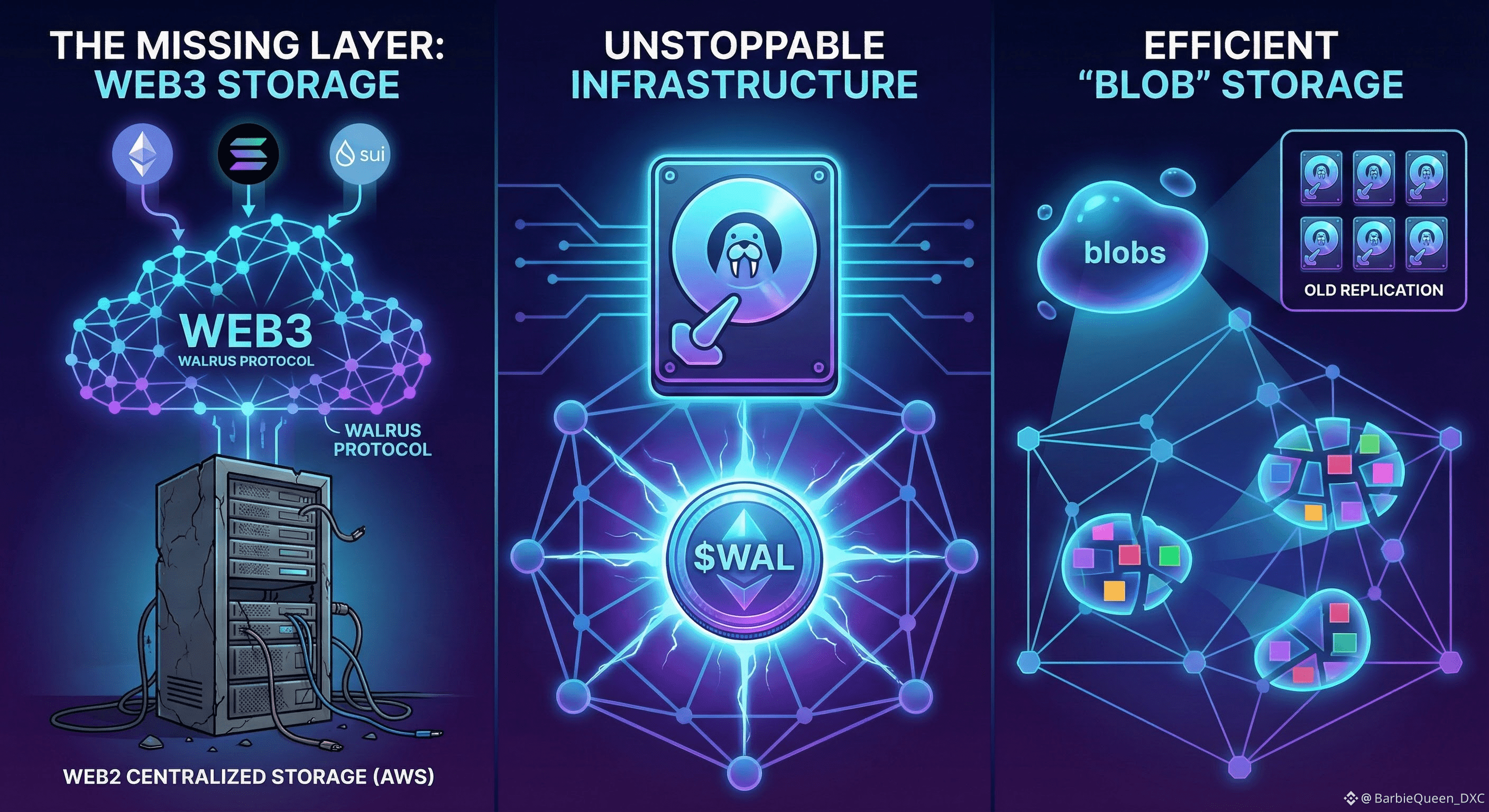
The evolution of Web3 has been lopsided. Over the past decade, we have made immense strides in decentralized computation and financial settlement. Blockchains like Ethereum, Solana, and Sui have proven they can handle complex smart contracts and secure billions of dollars in value without centralized intermediaries. We have successfully decentralized the "processor" of the world computer.
Yet, a critical component remains stubbornly centralized: the "hard drive."
Today, an uncomfortable truth pervades the crypto ecosystem: a significant percentage of "decentralized" applications (dApps) rely heavily on Web2 infrastructure. While the transaction logic lives on-chain, the user interface, the high-resolution NFT images, and the frontend code often reside on AWS buckets or centralized IPFS pinning services. If those centralized servers go down, or if a service provider decides to deplatform the project, the dApp effectively vanishes for the end-user. The smart contract remains, but it becomes inaccessible.
This centralization hangover is the primary bottleneck preventing Web3 from realizing its promise of truly unstoppable applications. To mature beyond decentralized finance (DeFi) into a broader decentralized web encompassing social media, high-fidelity gaming, and massive data datasets, we need a storage layer that matches the resilience of the execution layer.
This is the strategic void that @walrusprotocol is designed to fill.
Walrus is not merely another storage token in a crowded market; it is a fundamental rethinking of how decentralized data availability should function at scale. Built atop the blazing-fast Sui network, Walrus addresses the three critical challenges that have plagued previous storage attempts: cost, efficiency, and permanence.
The Cost of Redundancy
Early attempts at decentralized storage often relied on rudimentary replication strategies. To ensure a file wasn't lost if a node went offline, the protocol would simply create 10, 20, or even 30 full copies of that file and scatter them across the network. While effective for reliability, this method is ruinously expensive and horribly inefficient. It bloats the network and makes storing large datasets economically unviable for anything other than the most critical data.
Walrus fundamentally changes this economic equation through a breakthrough technological approach known as "Red Stuff" (which we will explore deeply in a subsequent article). By moving away from simple replication and toward advanced 2D erasure coding, Walrus can offer extremely high guarantees of data availability with a fraction of the storage overhead.
The Sui Advantage and "Blob" Storage
By leveraging the unique architecture of the Sui network, Walrus is optimized for storing "blobs"—large unstructured binary objects. This is crucial. Blockchains are terrible databases; storing an image directly on Ethereum, for example, costs thousands of dollars. Walrus acts as the efficient sidecar for these large data needs.
Furthermore, because it is native to Sui, developers enjoy a seamless experience. They can interact with storage almost as easily as they interact with native tokens. Yet, critically, Walrus is designed to be chain-agnostic regarding the data it holds. A developer building a game on Solana or a social network on a Layer 2 Ethereum solution can utilize Walrus for their heavy storage lifting, maintaining their execution logic on their home chain while offloading data to Walrus.
The Utility of $WAL
This infrastructure thesis provides the fundamental value proposition for the $WAL token. As the Web3 ecosystem expands, the demand for cheap, censorship-resistant blob storage will grow exponentially. Every high-quality NFT project, every decentralized frontend hosted on "Walrus Sites," and every archival dataset increases the network's utilization.
$WAL is not a speculative meme coin; it is the fuel for this digital real estate. It is required to purchase storage space and is used to incentivize the node operators who maintain the physical hardware powering the network.
We are standing at an inflection point. The era of relying on Amazon Web Services to host the "decentralized" web is drawing to a close. The next generation of the internet requires a robust, scalable, and truly decentralized hard drive. Walrus is currently building that foundation. #Walrus
AI Image Prompt 1 (Macro/Infrastructure Theme):
A futuristic digital illustration showing a glowing, decentralized network structure acting as a foundation. Below, a stylized, old-fashioned server rack labeled "WEB2 CENTRALIZED STORAGE" is crumbling and disconnected. Above it, a sleek, interconnected mesh network of nodes forming a massive data cloud is labeled "WEB3 WALRUS PROTOCOL." Data streams flow from various blockchain logos (Ethereum, Solana, Sui) into the Walrus cloud. A prominent glowing coin with the "$WAL" symbol is at the center of the Walrus network. The overall color palette is deep blues, purples, and neon cyan.

