Hello crypto crew, Ibrina here from Ibrina_eth, sharing a deeper comparative perspective on Walrus Protocol versus the more established decentralized storage networks many of us have followed for years, such as Filecoin and Arweave. I’ve been studying storage protocols since around 2018, watching multiple design philosophies play out across cycles. What stands out today is not just who stores the most data, but who is best positioned for an AI-driven, data-intensive Web3 future. Walrus enters this conversation with a very different set of assumptions, and that’s what makes the comparison interesting.
Filecoin is often considered the backbone of decentralized storage. It has scale, longevity, and real-world integrations, including institutional and cultural archiving use cases. Its proof systems and marketplace model were groundbreaking at launch and remain impressive today. However, Filecoin’s architecture was designed in an era where storage was largely static. Large data retrievals can be slow, costs can be high due to replication-heavy designs, and programmability at the data layer is limited. For workloads that require frequent access, real-time responses, or dynamic datasets—common requirements for AI pipelines—this can become a bottleneck. Walrus takes a fundamentally different approach by using erasure coding and pairing it with the parallel execution environment of the Sui Network, which allows data to be reconstructed efficiently even when parts of the network are unavailable. The result is a system designed around speed, efficiency, and continuous interaction with data rather than long-term cold storage.
Arweave, on the other hand, excels at permanence. Its “pay once, store forever” model is elegant and extremely useful for immutable records, historical archives, and static NFTs. That strength is also its limitation. AI systems, dynamic applications, and evolving datasets don’t always benefit from permanence. They need flexibility—data that can be updated, versioned, restricted, or time-bound. Walrus introduces epoch-based storage, programmable lifecycles, and the ability to merge or split data blobs, which makes it far more adaptable for use cases where data changes over time. From my own experimentation, Arweave feels ideal for content that should never change, while Walrus feels designed for content that is meant to live, evolve, and interact with other on-chain logic.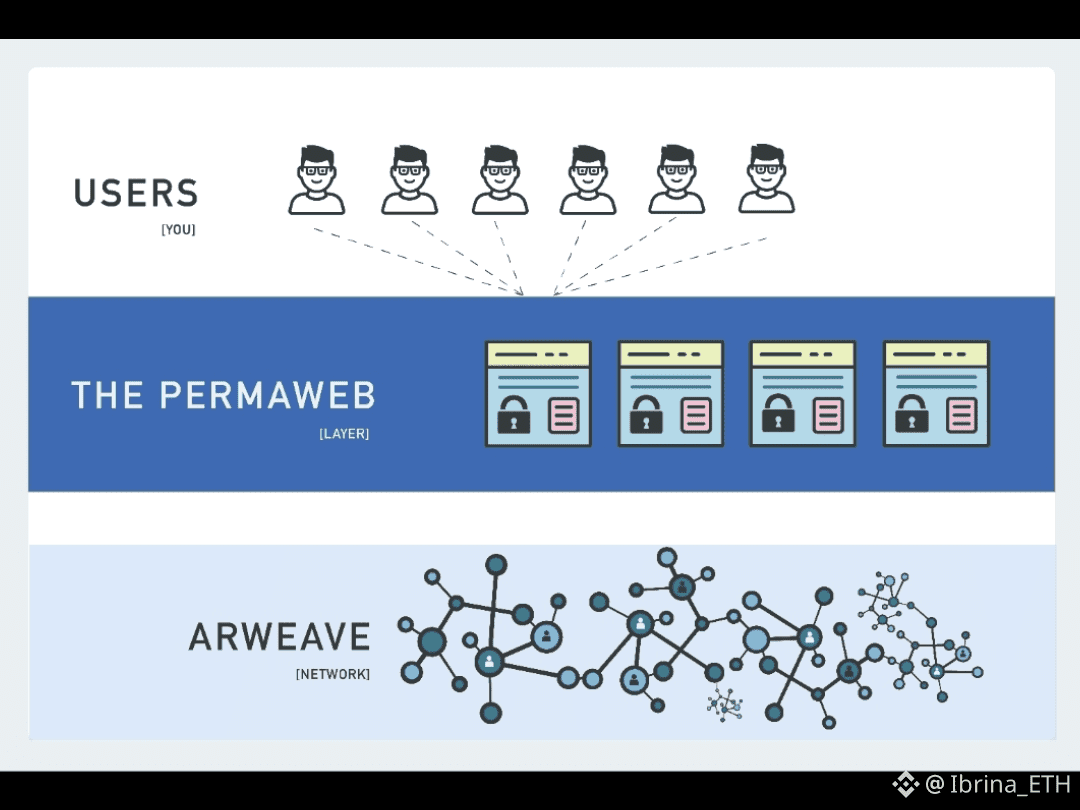
IPFS is often mentioned in these comparisons as well. It is an important foundational protocol, but it lacks built-in economic guarantees. Data availability depends on pinning and goodwill rather than enforced incentives. Walrus addresses this directly by requiring nodes to prove availability and stake value to participate, aligning incentives around reliability. This distinction becomes critical for AI-related workloads, where data availability and integrity are not optional but essential.
Where Walrus really begins to separate itself is in its orientation toward AI-native use cases. Instead of treating AI as an afterthought, Walrus treats data as a programmable, verifiable asset that AI systems can safely consume. Encrypted access via its Seal module, on-chain permissioning, and composable data objects allow developers to build data markets, agent memory layers, and privacy-preserving analytics in ways that legacy storage systems struggle to support without additional layers. This is not about replacing existing networks outright, but about addressing a new category of demand that didn’t meaningfully exist when those networks were designed.
That said, Walrus does face meaningful challenges. Its network is smaller and younger than Filecoin’s, and its close integration with Sui means its growth is partially tied to the success of that ecosystem. Legacy networks benefit from years of battle testing and broader mindshare. Walrus must continue expanding developer tooling, documentation, and cross-chain accessibility to reduce friction for builders coming from other ecosystems.
What gives Walrus credibility, in my view, is that it doesn’t try to compete on hype. It competes on architecture. Backed by the team at Mysten Labs, and supported by a growing number of integrations across AI, data services, media, and Web3 applications, Walrus feels less like a speculative alternative and more like a next-generation evolution of decentralized storage principles.
My overall conclusion is that Walrus is not here to “kill” Filecoin or Arweave. Those networks will continue to serve important roles. What Walrus represents is a shift in priorities—from static, long-term storage toward dynamic, AI-optimized, programmable data infrastructure. As AI, real-world data, and on-chain applications converge, protocols that can handle speed, flexibility, privacy, and verifiability at the data layer will matter more than ever. In that context, Walrus feels like a protocol built for where Web3 is going, not where it has already been.
Curious to hear how others see this comparison. Do you think the future belongs to specialized storage layers, or will one dominant model emerge? Let’s discuss.