


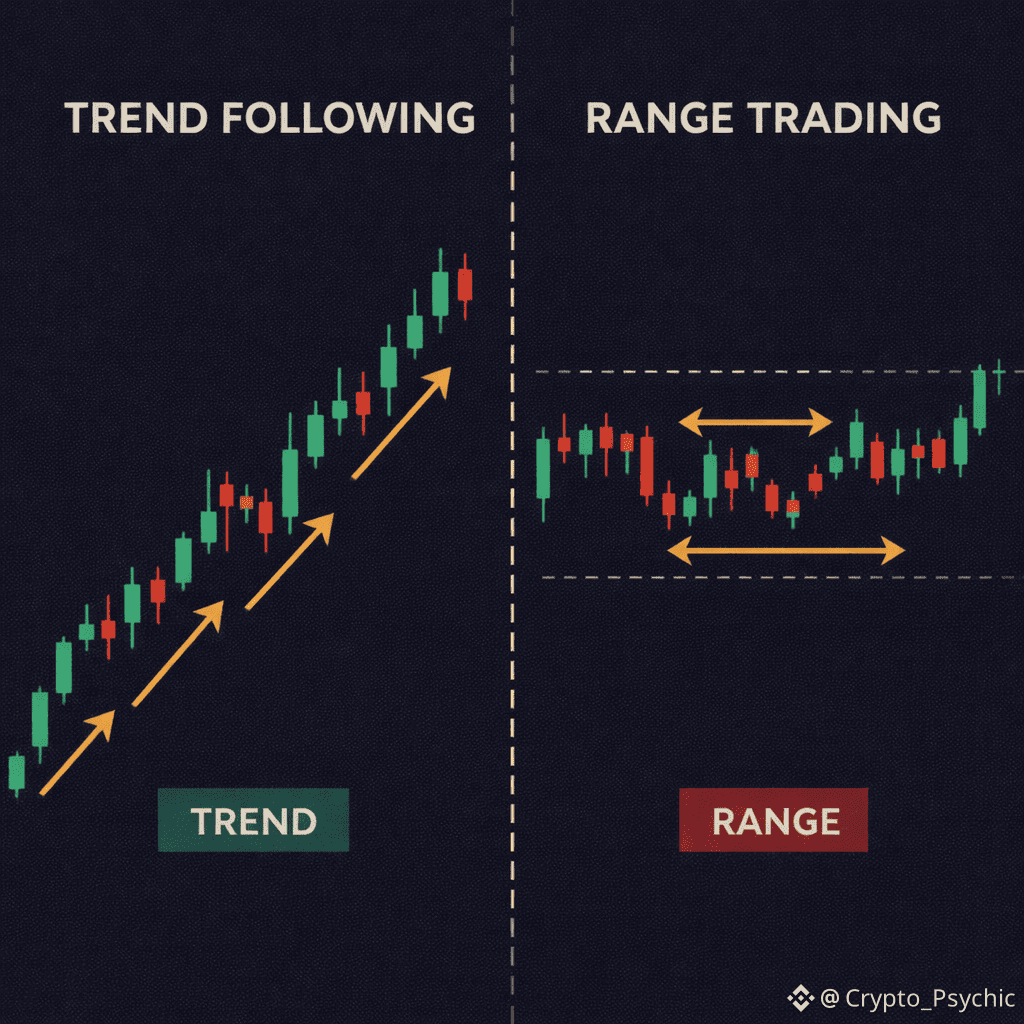
One of the most common reasons traders struggle is not because they lack knowledge, but because they apply the right strategy in the wrong environment. Markets do not behave the same way all the time. They alternate between expansion and consolidation, momentum and balance. Trend following and range trading are not competing strategies — they are responses to different market conditions. Understanding when to use each is a defining skill in long-term trading performance.
Trend following thrives when the market is directional. In these phases, price moves with intent, structure forms clearly, and momentum builds progressively. Higher highs and higher lows or lower highs and lower lows create a rhythm that allows traders to align with the dominant side. The goal in trend following is not to predict tops or bottoms, but to participate in the middle of the move — where probability is highest and emotional pressure is lowest.
Range trading operates in a very different environment. Here, price oscillates between well-defined boundaries, repeatedly rejecting highs and lows without committing to a direction. Momentum fades quickly, breakouts fail often, and patience becomes more valuable than aggression. In ranges, traders who chase continuation are punished, while those who fade extremes with confirmation are rewarded. The market is not weak in these phases — it is balanced.
The danger arises when traders fail to recognize the transition between these states. Applying trend-following logic in a range leads to repeated stop-outs. Applying range-trading logic in a strong trend leads to early exits and missed opportunities. The market does not adapt to the trader — the trader must adapt to the market.
Trend following requires acceptance of pullbacks and volatility. Trades often begin with uncertainty, and profits develop over time. Range trading demands precision and restraint. Entries must be selective, targets must be realistic, and exits must be disciplined. Each approach requires a different mindset, even if the tools appear similar.
Many traders struggle because they develop a bias toward one style and try to force it onto every chart. This rigidity creates friction. Professional traders remain flexible. They read structure first, then choose the strategy that fits the environment. They don’t ask what they want the market to do — they observe what it is doing.
Transitions between range and trend are especially critical. Ranges often precede trends, as liquidity builds and volatility compresses. Trends often end in ranges, as momentum slows and distribution or accumulation takes place. Traders who recognize these transitions early gain a significant advantage. They stop fighting the market and start aligning with its current state.
Neither trend following nor range trading is superior on its own. Each is powerful in the right context and destructive in the wrong one. Mastery comes from recognizing the difference, not from perfecting a single approach.
When traders learn to identify whether the market is expanding or balancing, clarity replaces confusion. Entries become cleaner, exits become more logical, and expectations become realistic. The trader no longer feels that the market is unpredictable — they understand that it is simply changing character.
In trading, adaptability is strength. Those who learn to shift between trend following and range trading stop reacting emotionally and start responding strategically. And in that shift, consistency becomes achievable.