

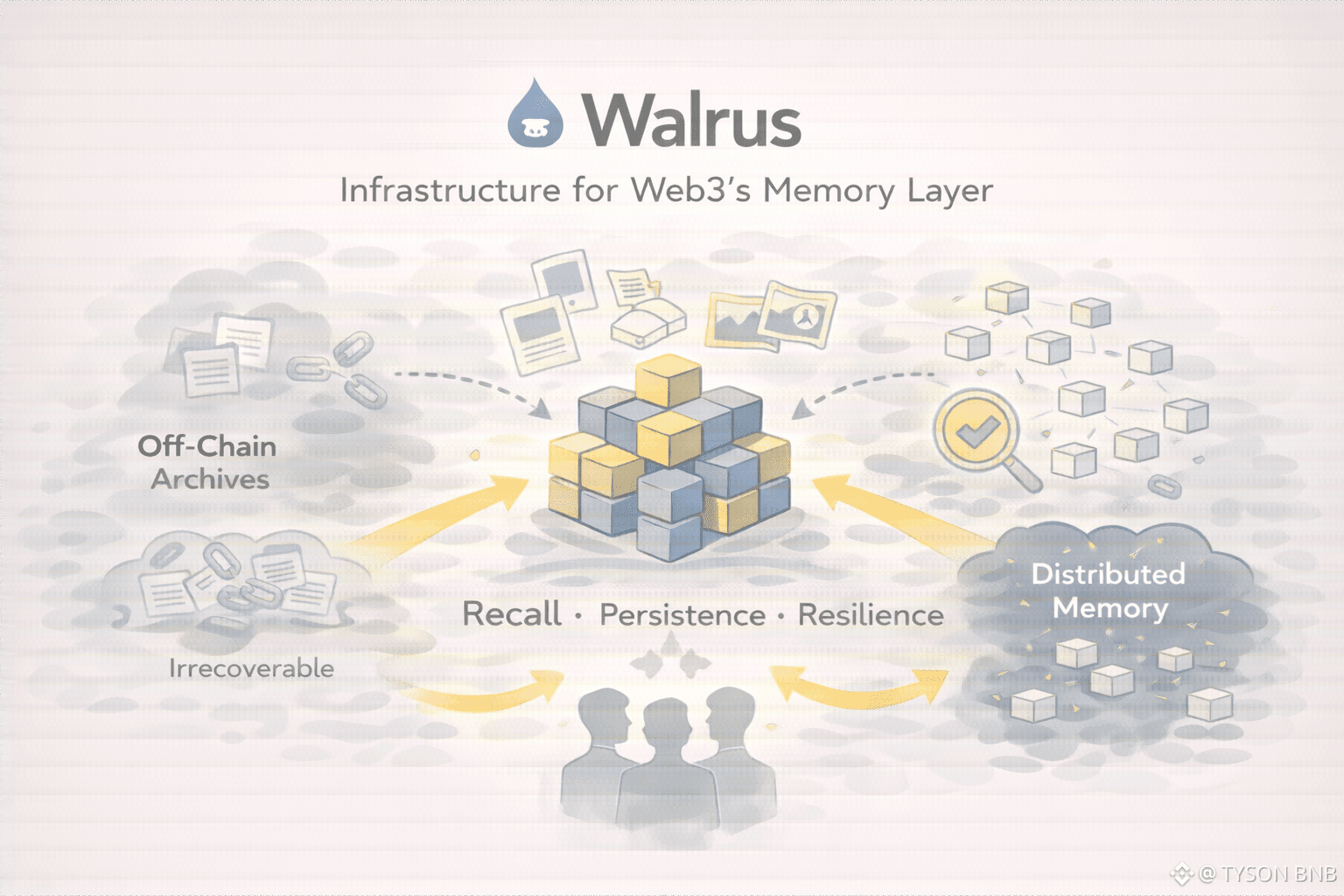
 Web3 has never lacked execution. Blockchains are excellent at agreeing on outcomes, enforcing rules, and moving value without trust. What Web3 has consistently lacked is memory. Not short-term state, but long-term recall the ability to remember what happened, what existed, and why it mattered. Walrus exists because execution without memory produces systems that move forward while slowly forgetting themselves.
In most Web3 architectures, memory lives outside the core system. Large data, histories, media, records, and application state are pushed off-chain and treated as auxiliary. As long as links work and nodes stay online, everything appears fine. When they don’t, nothing on-chain technically breaks, yet meaning disappears. Assets lose context. Identities lose depth. Applications lose continuity. Web3 keeps running, but it stops remembering.
That gap is not accidental. It is the result of treating memory as optional.
Walrus reframes storage as a memory layer rather than a utility. Memory is not just data sitting somewhere. It is the accumulated history that protocols rely on to function correctly over time. For many systems financial protocols, games, governance frameworks, identity layers forgetting is not a minor issue. It is a failure of purpose.
The core challenge of a memory layer is not storing data once. It is keeping data available despite churn, failure, and time. Nodes leave. Operators lose interest. Incentives change. Infrastructure degrades. Most systems quietly assume stability and call loss an edge case. Walrus assumes instability and designs for endurance.
Data in Walrus is encoded and distributed across independent participants so that no single actor controls memory. Failure is expected. Recovery is structural. History survives not because everyone behaves perfectly, but because the system anticipates imperfect behavior. Memory becomes resilient rather than fragile.
This matters because memory shapes behavior. When builders cannot rely on data persisting, they design defensively. They avoid features that depend on history. They centralize backups. They simplify experiences. With reliable memory, those limitations are removed. Protocols can accumulate context. Applications can grow without being reset. Systems can grow rather than rebooting.
Walrus further brings about intentionality in terms of memory. Data is not stored by accident. Availability has duration. Responsibility is also defined. Memory exists because the system is designed to carry it forward, not because conditions happened to remain favorable. This clarity replaces hope with structure and removes ambiguity around what will last.
Economic incentives reinforce this design. Storage providers are not rewarded once and forgotten. They are compensated over time for maintaining availability. Memory is protected because incentives persist as long as memory is required. Forgetting is not neutral. It is discouraged by design.
Calling this a “storage layer” undersells its role. Walrus does not just hold data. It allows Web3 to remember. That distinction becomes critical as systems mature. Short-lived experiments can tolerate forgetting. Infrastructure cannot.
A memory layer is what allows identity to deepen, governance to reference its past, financial systems to rely on records, and applications to feel continuous instead of disposable. Without memory, Web3 remains a collection of stateless machines. With memory, it becomes an ecosystem that accumulates meaning.
Walrus is built for that accumulation. It does not promise perfection. It promises continuity under real conditions. In a decentralized world, memory is not automatic. It has to be designed, incentivized, and protected.
That is what Walrus provides: infrastructure not just for storing data, but for ensuring Web3 can actually remember what it builds.

