

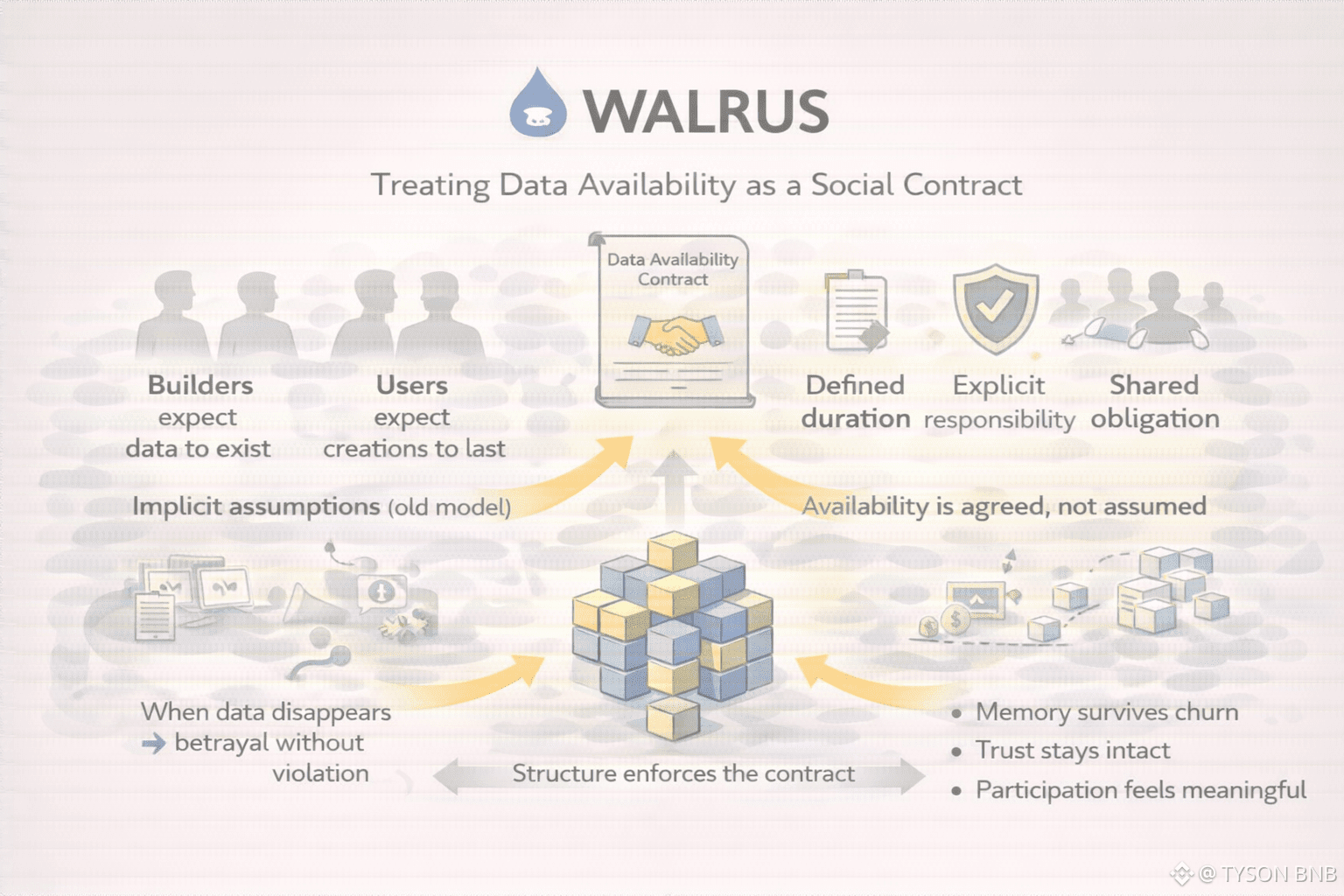
 Data availability is usually framed as a technical promise. Nodes will stay online. Incentives will hold. Replication will be enough. When that promise breaks, it is described as an outage or an operational failure. But this framing misses something deeper. Data availability is not just a technical condition. It is a social agreement between everyone who builds on, maintains, and relies on a system. Walrus exists because this agreement was never made explicit.
A social contract defines expectations. It answers simple but critical questions: What do we owe each other? What happens if those expectations are not met? In Web3, data availability has often lived outside this contract. Builders assume data will be there. Users assume their creations will last. Operators assume responsibility ends after initial storage. When data disappears, everyone feels betrayed, yet no one technically violated a rule.
That is the core problem.
When availability is implicit, responsibility is diluted. No one is clearly accountable for keeping data alive over time. Systems continue to function mechanically, but trust erodes quietly. Assets lose meaning. History fades. Identity fragments. The chain still produces blocks, but the social layer the belief that participation matters starts to weaken.
Walrus treats data availability as something that must be agreed upon, not assumed.
By design, Walrus makes availability intentional. Data is stored with defined expectations around duration and responsibility. It exists because the system explicitly commits to carrying data forward under real conditions. This turns availability from a vague hope into a shared obligation.
In a social contract, incentives matter because they shape behavior. Walrus aligns incentives with time. Storage providers are rewarded not just for accepting data, but for maintaining it. Responsibility does not quietly expire. Participants know what they are committing to, and the system reinforces that commitment economically. "Availability" becomes a quality that people actively maintain rather than simply benefit from.
This design also honors reality. People leave. Hubs fail. The world changes. A social contract that does not account for some lapses will fail. Walrus assumes imperfection and designs around it. Data is encoded and distributed so that the failure of individuals does not break the collective promise. The contract is upheld by structure, not by trust in any single participant.
For builders, this changes the relationship with infrastructure. They are no longer building on top of an unspoken assumption. They are building on a clear agreement: if data is meant to exist, the system is designed to keep it available. That clarity enables long-term design and reduces the need for defensive architectures.
Treating availability as a social contract, in turn, gives users confidence. They feel like their participation makes a difference because the system is responsible for memory. The things that people create do not feel disposable. History does not feel fragile. People know that when they put time, creativity, or capital into a website, it was done knowing that availability was not an afterthought.
From a broader perspective, this reframes decentralization in itself. Decentralization isn't about removing middlemen. It is about constructing systems where collective responsibility replaces blind trust. A social contract around data availability makes that responsibility explicit.
Walrus does not claim that data will never be lost. It claims something more honest: that loss is not acceptable without accountability. When availability is treated as a social contract, failure is no longer invisible. It is something the system is designed to prevent, absorb, and correct.
Decentralized systems succeed not only because of code, but because of shared expectations. By treating data availability as a social contract rather than a background assumption, Walrus strengthens the bond between infrastructure and the people who depend on it.
That bond is what allows decentralized systems to endure.