


Technology alone does not keep a network alive. Incentives do. Many storage systems fail not because the design is flawed, but because participants are rewarded in ways that encourage short-term behavior. Walrus approaches this problem carefully. Instead of paying storage providers everything upfront, @Walrus 🦭/acc releases rewards gradually over time and ties them to measurable performance. Providers earn $WAL by remaining reliable throughout the entire lifecycle of the data they store. If availability drops or obligations are not met, penalties and slashing apply. This creates a system where reliability is not assumed, it is economically enforced.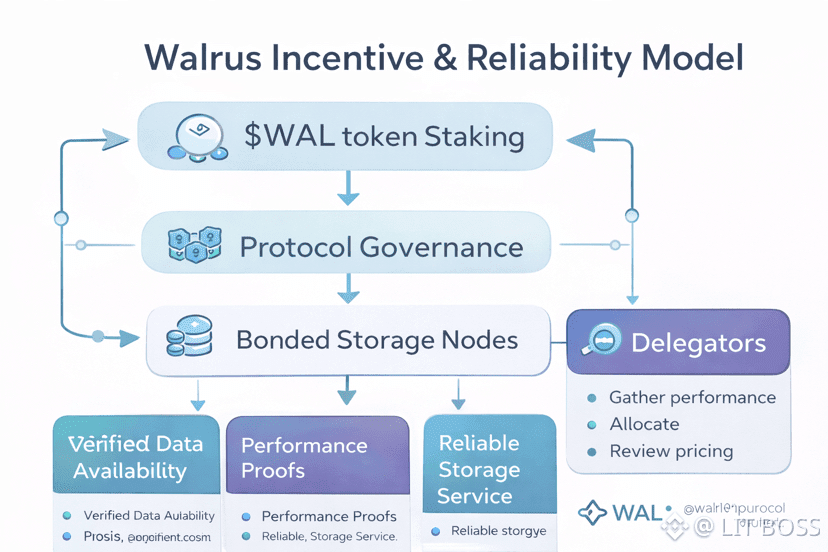
This incentive model changes how trust works. In many systems, users are asked to trust that providers will behave honestly. Walrus removes much of that trust requirement by making performance observable and enforceable. Cryptographic proofs are used to confirm that data remains available. Rewards flow only when obligations are fulfilled. Over time, this creates a strong signal about which providers are reliable and which are not. Delegators and participants can make decisions based on observed behavior instead of marketing or reputation. This is especially important for storage, because storage failures are rarely forgiven. When data disappears, users leave quietly and do not come back.
The economic design also gives $WAL a role beyond speculation. It circulates as payment for storage, staking collateral, governance weight, and incentive alignment. As demand for decentralized storage grows across AI, media, DeFi, and data-heavy applications, the pressure on this system increases. Walrus does not try to manage that growth through centralized control. It manages it through incentives that scale naturally. Good behavior is rewarded over time, bad behavior becomes expensive, and the network slowly becomes more reliable as usage increases.
This is not the kind of design that creates instant hype. It is the kind that creates compounding reliability. Over long periods, systems like this tend to outlast flashier alternatives. Walrus is betting that Web3 will eventually value durability more than speed and structure more than excitement. The incentive model reflects that belief. It is calm, strict, and patient. Those qualities are often underestimated, but they are exactly what long-lived infrastructure requires. #Walrus

