
For a long time, Web3 convinced itself that once execution was decentralized, the hard problems were solved. Smart contracts could run without trust. Transactions could not be reversed. Ownership could be verified by anyone. From a technical point of view, this was impressive. From a systems point of view, something was still missing. Blockchains could prove actions, but they could not remember systems.
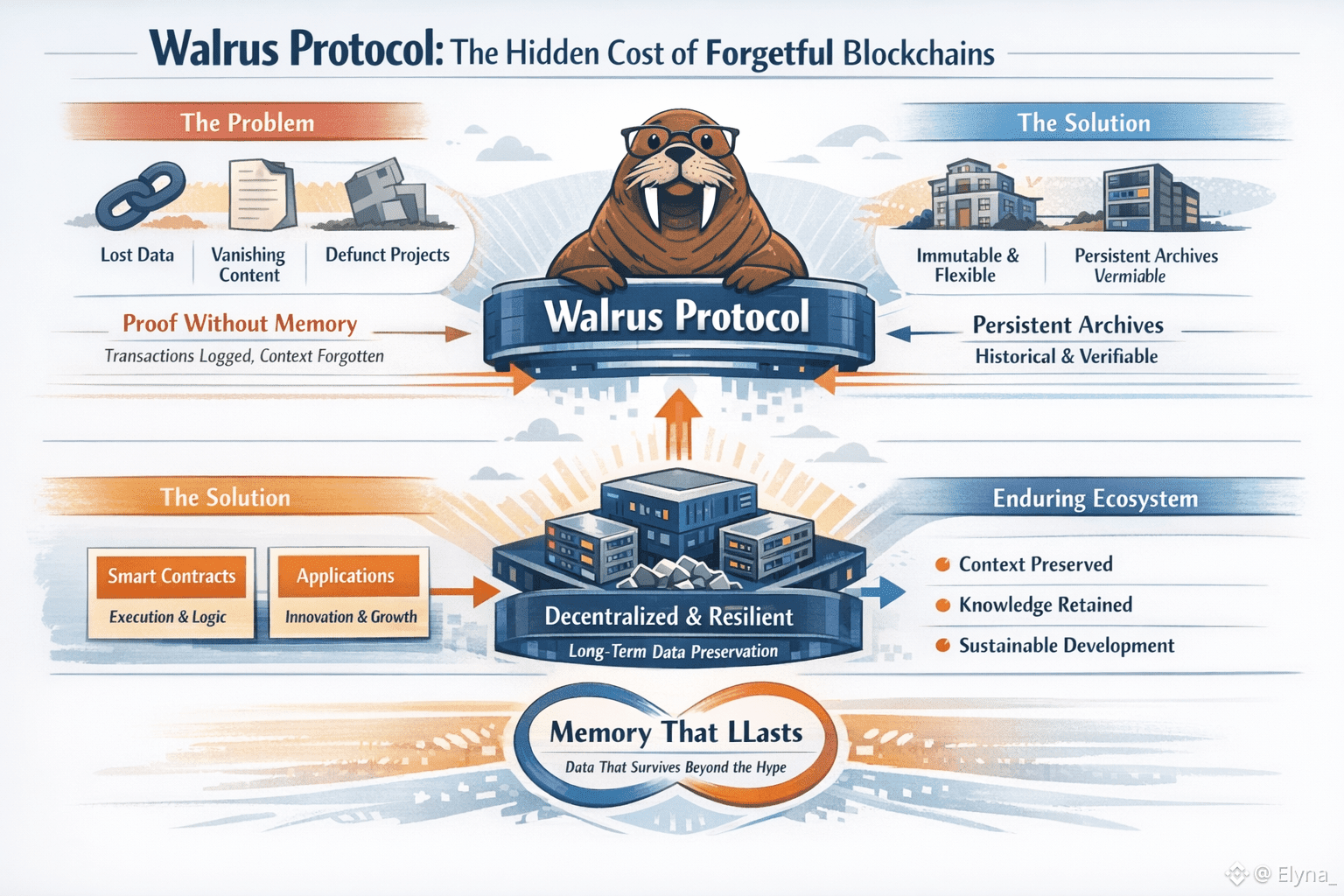
This is the gap Walrus Protocol is built around.
Most people do not notice this problem at first because it does not break loudly. Applications launch. Users interact. Data is stored somewhere “off-chain.” Everything works — until time passes. Links stop resolving. Files disappear. Teams shut down. Infrastructure changes. The chain still exists, but the application no longer makes sense. What remains is proof without substance.
Walrus starts from an uncomfortable truth: most decentralized systems are forgetful by design. They remember transactions, but they forget context. And context is where meaning lives.
A transaction can tell you that a vote passed. It cannot tell you what information voters saw, what arguments mattered, or why the outcome was important. A contract can tell you that an NFT was minted. It cannot preserve the media, history, or relationships that give it value. All of that lives in data — and data has been treated as disposable.
This is not because developers are careless. It is because blockchains were never meant to store real application data at scale. Storage is expensive, rigid, and difficult to evolve on-chain. So developers did the practical thing: they pushed data elsewhere. Cloud servers, centralized storage, temporary pinning services. The chain kept hashes. Everyone hoped the rest would stay online.
Hope is not a design.
Walrus approaches the problem from the opposite direction. Instead of asking how to squeeze more data into smart contracts, it asks how to give contracts something reliable to depend on. Storage becomes a dedicated layer whose job is not speed or novelty, but survival. Data is expected to live longer than applications, teams, and hype cycles.
This changes how systems are designed. Smart contracts no longer pretend to be self-contained worlds. They become interfaces over persistent data. They execute rules, while Walrus preserves memory. Each layer does what it is good at, instead of one layer pretending to do everything.
A key idea behind Walrus is that data loss is usually silent. There is no error message when history disappears. Things simply stop making sense. Users leave. Developers rebuild. Ecosystems fragment. By the time the problem is obvious, it is too late to fix. Walrus is designed to reduce that risk before it shows up.
Another important shift is how Walrus treats change as normal. Many Web3 narratives are built around immutability, as if systems should never evolve. Reality is messier. Software updates. Formats change. Security assumptions improve. Walrus assumes this from day one. Its goal is not to freeze data in one perfect shape, but to keep it accessible and verifiable as everything around it moves forward.
This long-term thinking makes Walrus feel less like a product and more like infrastructure. Infrastructure is not judged by excitement. It is judged by whether it is still working years later when no one is paying attention. Storage, more than almost anything else, must survive boredom.
Decentralization plays a specific role here. Walrus does not treat it as an ideology. Distribution, redundancy, and fault tolerance are tools to reduce real risks: single points of failure, silent outages, and dependency on one operator’s decisions. When decentralization helps data survive, it matters. When it does not, it is unnecessary.
This pragmatic attitude is why Walrus avoids loud promises. It does not sell itself as a miracle solution or a quick win. It presents itself as something slower and harder: a system that earns trust by not failing when conditions change.
From a builder’s perspective, this opens new possibilities. Data no longer has to be treated as fragile or temporary. It can be shared across applications. Histories can be reused. Knowledge can accumulate instead of resetting every cycle. When memory is reliable, ecosystems compound naturally.
There is also a subtle economic implication. When data persists independently of applications, projects can end without destroying what they created. New teams can build on old work. This reduces waste and lowers the barrier to meaningful innovation. Instead of rebuilding foundations, builders can focus on new ideas.
Walrus also sends a clear signal through what it does not emphasize. There is little obsession with token price or short-term traction. The assumption seems to be that value emerges when people depend on a system because it works. Storage earns relevance by being boring and dependable, not by being loud.
Web3 has spent years optimizing for execution, composability, and financial primitives. It has spent far less time thinking about memory. Yet without memory, decentralized systems are temporary by nature. They exist in moments rather than over time.
Walrus is trying to change that. Not by rewriting blockchains, but by completing them. By giving smart contracts something reliable to lean on, it allows decentralized applications to grow up.
In the long run, the biggest risk to Web3 is not attack or regulation. It is forgetting. Forgetting why systems were built, what they depended on, and how they were meant to work together. Walrus is built to resist that slow erosion.
It may never be the loudest project in the room. But if decentralized systems are going to last, the layer that remembers will matter more than the ones that shout.

