
As I look around at the pace of global climate action in twenty twenty six, I keep noticing something interesting. Blockchain is no longer being talked about only as a trader’s playground. It is slowly becoming an engine for real world environmental progress. Yet when I think about how traditional systems handle green bonds, carbon credits, and renewable energy investments, it is obvious why things have been stuck. Privacy risks, cross border delays, and regulatory friction slow everything down. That is the exact space where Dusk Network steps in. The @Dusk Foundation is taking a different approach by treating privacy and regulation as partners instead of opposing forces. Dusk was never meant to be another generic Layer One. It was built specifically for sustainable finance, using zero knowledge technology to allow institutions to tokenize real world green assets and move them across borders with confidence.
Before I dive into how Dusk solves this, I want to set the bigger picture. The United Nations estimates that the world needs trillions of dollars in climate funding before twenty thirty. Yet the current financial system is slow and messy. A green bond can take weeks to settle across borders. Carbon credit markets still struggle with manipulation. Even basic privacy is difficult to maintain because financial data leaks easily. What I find clever about Dusk is the framework it calls sustainable privacy. A company can issue a green asset on chain and keep its sensitive details hidden from the public while still giving regulators full audit access when required. This is possible because of Dusk’s Hedger technology, which uses zero knowledge proofs to verify compliance without exposing raw information. Think of a wind energy company in Europe issuing bond tokens. Through Dusk the entire settlement can be completed in seconds, while still meeting EU rules like MiCA and the environmental taxonomy.
The $DUSK token is at the center of this ecosystem. I see it less as a speculative coin and more as a governance instrument that shapes which projects the network prioritizes. Holders can stake to secure the network and vote on sustainable development proposals. The latest upgrade turned Dusk into a fully compatible DuskEVM environment, which means developers can now build green applications using regular Solidity tools. That opens the door to private carbon credit markets, renewable tracking solutions, or even automated reporting systems for green funds. I can imagine a scenario where a solar project in Africa issues digital tokens, Asian investors pay using $DUSK, the settlement remains private, and carbon metrics are verified through Chainlink data feeds before being stored on chain. That is the type of workflow that solves fraud problems, especially since traditional carbon markets still deal with questionable certificates. Dusk’s approach gives regulators verifiable oversight without exposing sensitive information.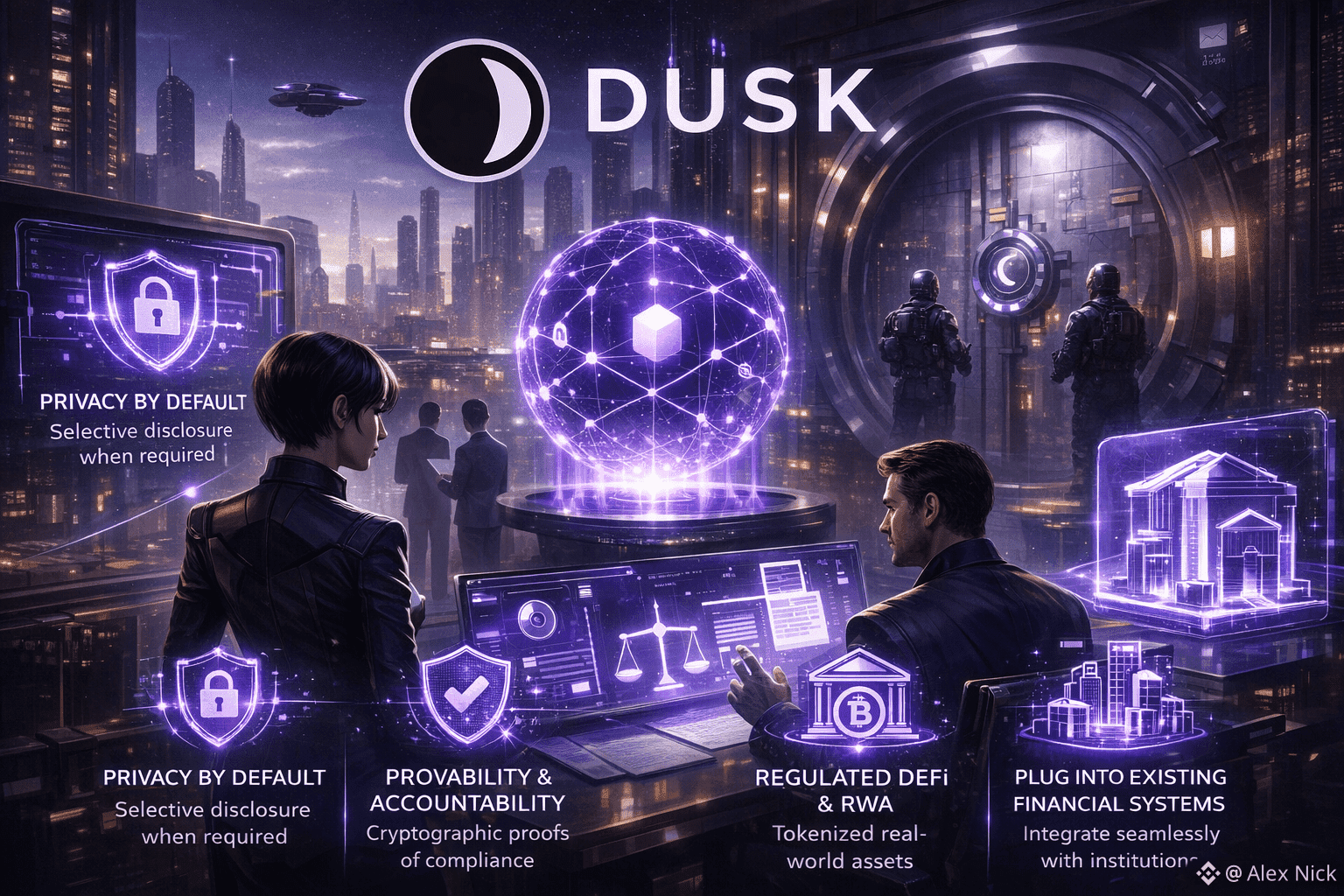
Dusk’s modular system reinforces this direction. The underlying DuskDS brings strong data availability and fast settlement, while running on a low energy consensus model that naturally fits the environmental narrative. Unlike energy heavy proof of work chains, Dusk’s consensus uses minimal power and produces far lower emissions. In the coming upgrades, the DuskVM layer will push privacy computing even further, allowing ESG scoring models to be processed privately on chain. That is something banks have needed for years. It is no surprise that regulated institutions like NPEX in the Netherlands are already experimenting with Dusk for tokenizing hundreds of millions in green assets. They want a system that handles issuance, settlement, and secondary markets in one place without compromising rules or transparency.
When I zoom in on use cases, carbon markets immediately stand out. Analysts predict global carbon trading could exceed five hundred billion dollars in twenty twenty six. But companies hate exposing emission data. Dusk solves this with its Bulletin Board system, which acts as a shared source of truth. Issuers upload encrypted information, buyers verify authenticity without seeing the details, and regulators can reveal data selectively for compliance checks. I also like how $DUSK staking plays a role here. Stakers can vote on improvements such as integrating satellite feeds to validate forest carbon capture. This turns Dusk into more than just a blockchain. It becomes a sustainability focused community where participants influence how the network evolves.
Another area that benefits is renewable energy financing. Smaller projects such as rural solar or micro wind farms often cannot attract global capital because compliance is expensive. Dusk Vault gives institutions a compliant custody environment so they can issue tokens without exposing confidential information. Investors can join directly from a mobile wallet, and the privacy layer protects sensitive business data. With the upcoming launch of DuskTrade, I expect this market to grow quickly. The first wave of tokenized green assets is projected to include large renewable installations, and liquidity will be supported through bridges that connect Dusk to chains like Ethereum and Solana. This creates a smooth flow of capital, especially between developing regions and established financial hubs.
Now, it would be unfair to pretend Dusk has no obstacles. Zero knowledge systems require heavy computation, so Dusk must continually refine its algorithms to remain energy efficient. There is also the challenge of global regulatory fragmentation since the United States, Europe, and Asia enforce different ESG rules. But honestly, these challenges highlight Dusk’s strengths. As a non profit foundation, @dusk_foundation can prioritize long term sustainability rather than chasing quick market momentum. Leaders like Jelle Pol often talk about how privacy itself is a form of sustainability, because it prevents exploitation and data abuse. The team is already exploring low carbon proof systems and plans to achieve network carbon neutrality by twenty twenty seven.
Looking toward twenty thirty, I can see Dusk becoming one of the essential pillars of the sustainable finance world. The green bond market alone could reach ten trillion dollars and infrastructure that supports compliant privacy will become the backbone of that system. For investors who want exposure to the intersection of ESG and blockchain, Dusk is more than a token. It is an entry point into the global green transition. And if this momentum continues, Dusk will quietly power a future where sustainability and privacy finally work together.
