
As India celebrates its **77th Republic Day today, January 26, 2026**, the contrast between the nation's economic standing now versus its founding era is perhaps the most dramatic transformation of any major country in modern history.
While India gained independence in 1947, it officially became a Republic when the Constitution came into effect on January 26, 1950. The economic baseline used here reflects the reality of that founding era (1947–1950).
Here is a detailed comparison of the economy and GDP growth between the dawn of the Republic and present-day 2026.
---
### **At a Glance: The Great Transformation (1950 vs. 2026)**
| Economic Metric | The Dawn of the Republic (c. 1950) | Republic Day 2026 (Present) |
| --- | --- | --- |
| **Global Economic Ranking** | 6th (But heavily agrarian and poor) | **5th Largest** (Closing in on 4th/3rd) |
| **GDP Size (Nominal)** | approx. **$20 – $30 Billion** | approx. **$4.5 Trillion** |
| **Share of Global GDP** | roughly 3% (mostly raw materials) | roughly **7.5% - 8%** (PPP terms) |
| **GDP Growth Rate** | Average ~3.5% (1950s-80s) *(The "Hindu Rate of Growth")* | **~7.0% - 7.3%** (Current Fastest Growing Major Economy) |
| **Per Capita Income** | approx. **$60 - $80** (Annual) | approx. **$2,800 - $3,000** (Annual) |
| **Dominant Sector** | Agriculture (~55% of GDP) | Services (>54% of GDP) |
| **Life Expectancy** | ~32 Years | **70+ Years** |
| **Forex Reserves** | < $2 Billion (mostly Sterling balances) | **>$620 Billion** (4th largest globally) |
---
### **1. The Economy at the Dawn of the Republic (c. 1947–1950)**
When India adopted its Constitution, the economy was shattered by two centuries of colonial extraction. It was characterized by stagnation, extreme poverty, and a complete lack of industrial self-sufficiency.
* **The "Ship-to-Mouth" Existence:** The most glaring characteristic of the 1950 economy was food insecurity. Despite over 70% of the workforce being in agriculture, India could not feed its 350 million people. Famines were a recent memory (Bengal Famine of 1943), and the nation relied heavily on foreign food aid (like the US PL-480 program) just to survive.
* **Industrial Vacuum:** Under British rule, India served as a source of raw materials (cotton, jute, indigo) and a captive market for finished British goods. In 1950, India made almost no machinery, steel, or complex manufactured goods. The industrial base was nonexistent.
* **The "Hindu Rate of Growth":** For the first three decades post-independence, India adopted a mixed economy with heavy state control (the License Raj). While this built foundational public sector industries, it stifled innovation. GDP growth averaged around 3.5% annually—barely enough to keep up with population growth, leading to stagnant per capita income.
### **2. The Economy of Republic Day 2026**
On January 26, 2026, India stands as the undisputed "bright spot" in a slowing global economy. It has transitioned from a nation fighting for survival to a primary engine of global growth.
* **A $4.5 Trillion Powerhouse:** Having recently crossed the $4 trillion mark, India is firmly established as the world's 5th largest economy and is rapidly closing the gap with Germany and Japan to enter the top 3.
* **Fastest Growing Major Economy:** While much of the developed world faces recessionary pressures in 2026, India is growing at over **7%**. This growth is driven by robust domestic demand, unprecedented government infrastructure spending (capex), and a resurgence in manufacturing.
* **The Services & Digital Giant:** India's economy is no longer defined by agriculture (now about 17-18% of GDP, though still the largest employer). The primary driver is the Services sector (IT, finance, healthcare). Furthermore, India has become the world leader in Digital Public Infrastructure (DPI)—its UPI payment system is the global gold standard for fintech.
* **Infrastructure Boom:** Unlike the fragmented railways of 1947 designed for resource extraction, the India of 2026 is defined by massive highway construction, new airports, and indigenous high-speed rail (Vande Bharat).
### **3. Key Structural Shifts**
The journey between these two dates highlights fundamental changes in the country's economic DNA:
#### **From Scarcity to Surplus (Agriculture)**
* **1950:** A food-deficit nation begging for wheat.
* **2026:** Through the Green and White Revolutions, India is now the world's largest milk producer, second-largest rice and wheat producer, and a net agricultural exporter, ensuring food security for 1.4 billion people.
#### **From Aid Recipient to Global Investor**
* **1950:** India was heavily dependent on foreign aid and loans from the World Bank just to build basic dams and roads.
* **2026:** India is a major destination for Foreign Direct Investment (FDI) due to its massive consumer market. Conversely, Indian multinational conglomerates are major investors in Europe, Africa, and the US.
#### **From "License Raj" to "Make in India"**
* **1950-1990:** A closed economy where producing anything required government permission, leading to shortages and black markets.
* **2026:** An open, liberalized economy aggressively courting high-tech manufacturing through Production Linked Incentive (PLI) schemes, aiming to become a global hub for semiconductors, electronics (iPhones), and defense hardware.
### **Conclusion**
The difference between Republic Day 1950 and Republic Day 2026 is not just numerical; it is existential.
In 1950, the primary economic goal was **survival** and basic unification. In 2026, the economic goal is **global leadership** and a march toward becoming a developed nat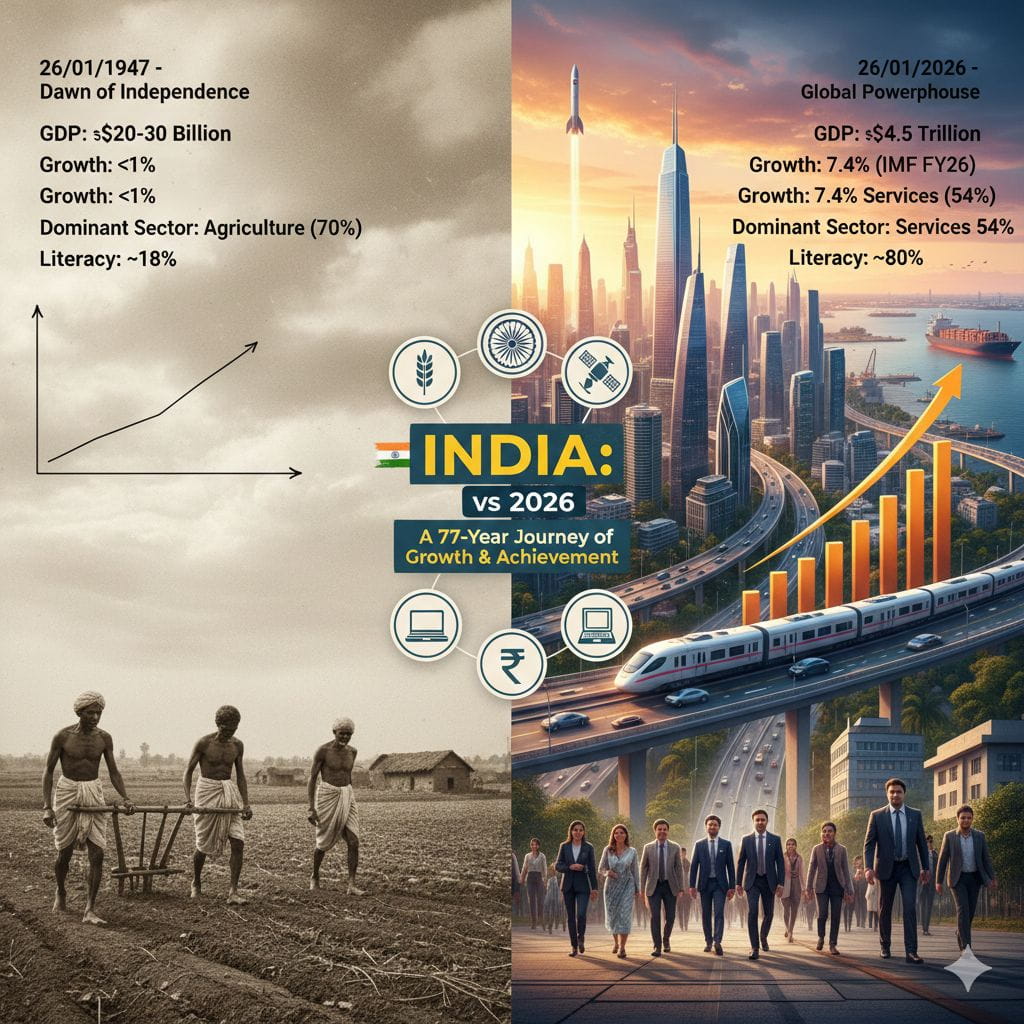 #INR RTrading $BTC ion (*Viksit Bharat*) by the centenary of independence in 2047.$ETH
