

Markets have stopped rewarding noise. In 2026, capital flows toward infrastructure that can survive audits, regulators, and institutional scrutiny. The speculative premium has thinned; what’s left is execution. This is where Dusk Network quietly fits—building a privacy-first blockchain that doesn’t run from regulation, but uses cryptography to meet it head-on.
What Dusk Is Actually Solving
Dusk is not trying to be another generalized Layer-1. Its focus is narrow by design: regulated financial assets on-chain, executed privately, but verifiably. In a market obsessed with Real World Assets (RWAs), that distinction matters.
Traditional finance doesn’t reject blockchains because of throughput—it rejects them because of compliance risk. Public ledgers leak sensitive data. Permissioned chains reintroduce trust. Dusk targets the middle ground.
Core Value Proposition
Privacy-preserving RWAs using zero-knowledge proofs (ZKPs)
Selective disclosure, not full opacity
On-chain compliance primitives, not off-chain workarounds
In short: institutions can transact privately, while regulators can still verify correctness when legally required.
ZK-Proofs as Infrastructure, Not a Feature
By 2026, ZK has matured from novelty to necessity. Dusk treats zero-knowledge proofs as a base layer, not a marketing hook.
Key architectural elements:
Confidential smart contracts: transaction logic executes without exposing sensitive inputs
Selective auditability: data remains private unless disclosure is explicitly authorized
ZK-friendly execution environment optimized for financial logic
This matters for RWAs like:
Tokenized bonds and equities
Private funds and structured products
Regulated secondary markets
Most chains can tokenize assets. Very few can do it without leaking counterparty data, positions, or settlement logic.
Why Dusk Is Positioned for the 2026 RWA Cycle
The RWA narrative has matured. Institutions are no longer asking if assets can be tokenized—they’re asking under what legal conditions.
Dusk aligns with this reality:
Identity and compliance are native, not bolted on
Privacy is granular, not absolute
Governance and staking reinforce network security without compromising confidentiality
This makes Dusk less attractive to yield tourists—and more attractive to entities managing billions under strict mandates.
Token Utility and Network Economics
The DUSK token is not a passive governance chip.
Primary functions:
Staking to secure the network
Transaction fees for confidential execution
Governance participation over protocol parameters
In a world where many tokens struggle to justify demand, DUSK’s utility is tightly coupled to actual network usage—especially if RWA issuance scales.
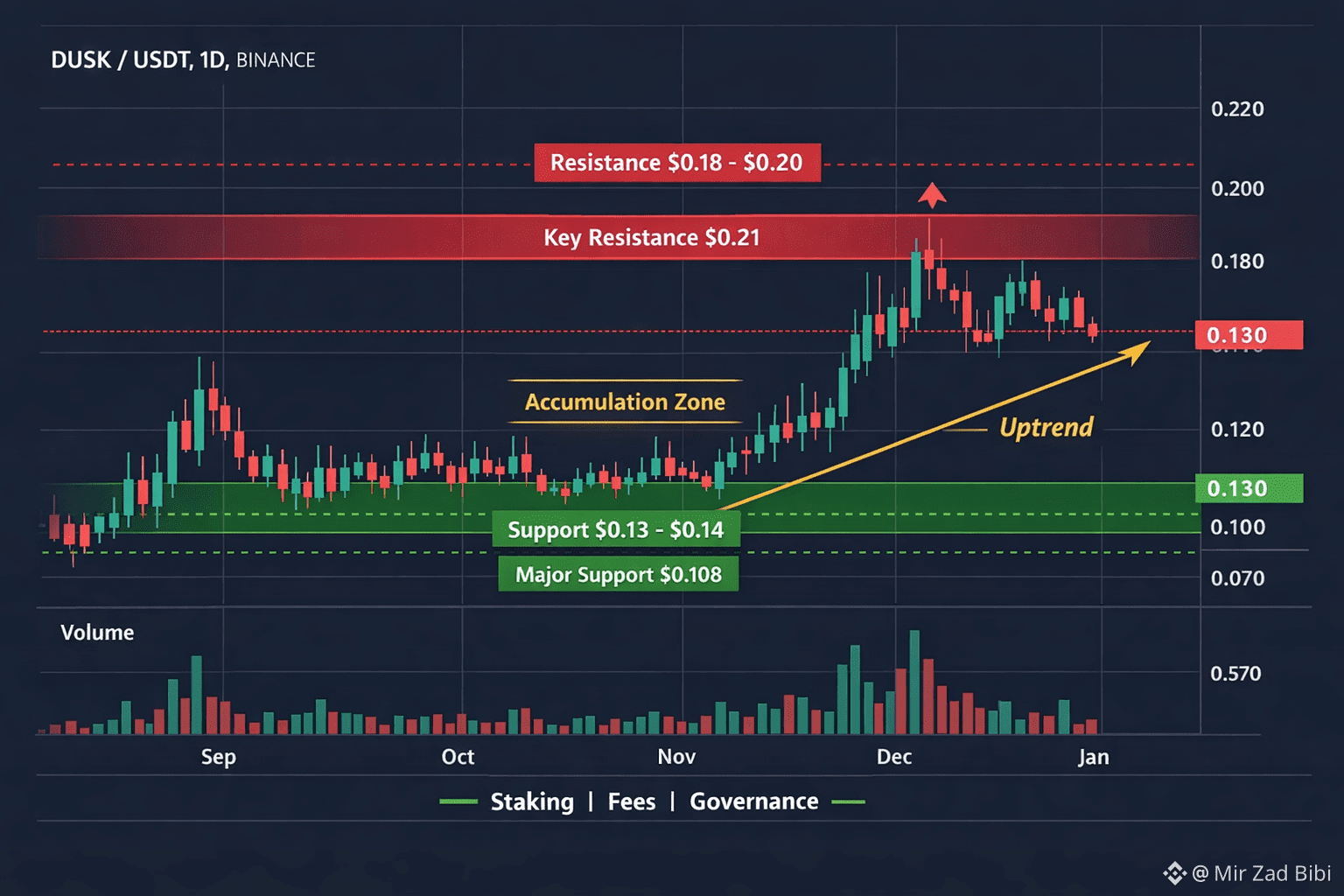
Technical Analysis: Key Levels to Watch
Market context: late January 2026
Support Zones
$0.13 – $0.14: short-term demand zone; buyers have repeatedly defended this range
$0.108 – $0.11: structural support; loss of this level weakens mid-term structure
Resistance Levels
$0.18 – $0.20: near-term supply zone aligned with previous breakdowns
$0.21 – $0.22: psychological and technical pivot; reclaiming this shifts momentum decisively
Structure & Momentum
Higher lows suggest accumulation behavior, not distribution
Pullbacks have remained controlled, indicating patient capital rather than speculative churn
A clean break above $0.20 with volume would confirm trend continuation
Price action reflects a market that is evaluating fundamentals, not chasing hype.
Key Takeaways
Dusk targets regulated finance, not retail speculation
Zero-knowledge proofs are used for compliance-compatible privacy
RWA infrastructure is the core thesis, not an add-on narrative
Technical structure suggests accumulation, not exhaustion
Success depends on institutional adoption—not influencer cycles
Final Thought for the Community
If RWAs become the dominant on-chain narrative, does the market eventually favor selective privacy models like Dusk, or will regulators force full transparency even at the cost of institutional confidentiality?
Where do you think that balance ultimately lands?
