
VanarChain going AI native is often described as putting AI into the core of the blockchain, instead of simply attaching a few extra utilities on the outside. I think the real competitive question is not whether VanarChain has many features, but whether the advantage comes from infrastructure, or from applications. If applications do not build habits, infrastructure is still just a good looking skeleton.
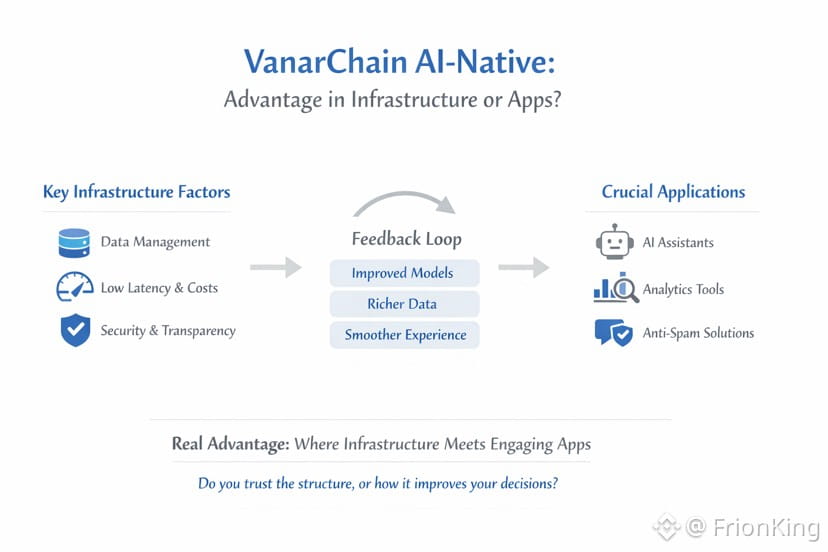
In an AI native system, infrastructure must handle data properly. AI survives on data, while dapps survive on context, who did what, when, and why. Blockchains usually store data in a fragmented way that is difficult to reuse. That is why the value of VanarChain’s infrastructure can lie in how it organizes data so applications can call it, understand it, and verify it. Have you ever seen an on chain dashboard produce a conclusion, but you could not tell what evidence it was built on. If infrastructure helps applications not only read data but also explain it, trust increases.
Second is execution. AI related tasks need low latency and predictable costs. If every time an application calls an AI module it becomes slow, or the fee suddenly spikes, users will leave. Strong infrastructure is when it turns complexity into simplicity for developers, reduces the number of extra layers they must build on their own, and reduces dependence on centralized servers.
Third is control. When AI participates in decision making, the risk is not only code errors, it is also bad data and bad incentives. So infrastructure needs constraints and traceability, so users can see where verification happens and who is accountable. Would you be comfortable letting an AI assistant influence a financial decision when you cannot audit the data sources and the operating rules behind it.
Still, sustainable advantage is often locked in by applications. Users do not pay for architecture, they pay for saving time and making fewer mistakes. If VanarChain produces applications that bring you back every day, like a trading assistant that enforces discipline, an analytics tool that explains its reasoning clearly, or a social product that fights spam and keeps long term memory, then the phrase AI native starts to carry real weight. Have you ever opened an application daily without needing to remind yourself.
The key point is that infrastructure and applications create a feedback loop. The more an application is used, the richer the data becomes, the better the models can get, the smoother the experience feels, and the longer users stay. If applications are weak, data stays thin, models do not improve, and the ecosystem stalls. That is why I lean toward an answer that the true competitive advantage sits at the intersection, where VanarChain’s infrastructure matches what AI applications actually need in reliability, and where those applications actively exploit the infrastructure strengths.
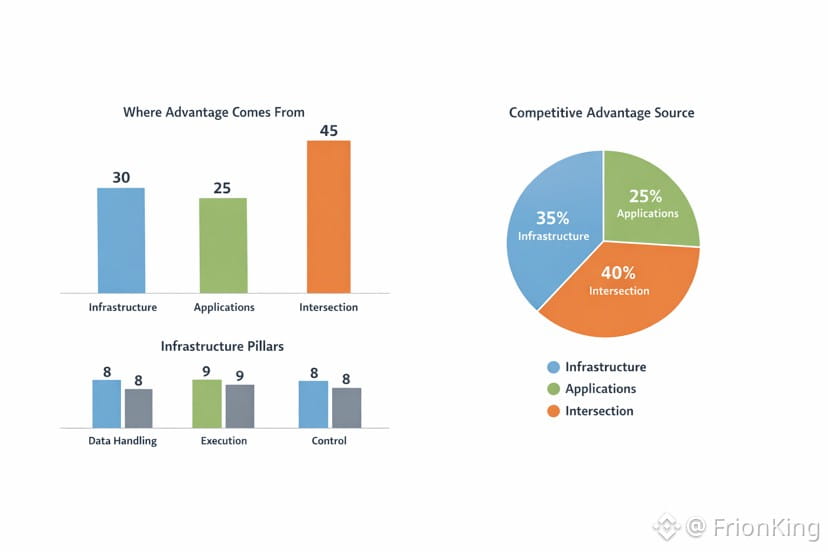
In the end, ask yourself this. Would you trust a chain because of its structure, or because an application on it helps you make better decisions. Would you follow AI native as a slogan, or as an experience you can feel every day.
