

AI has become the new checkbox in blockchain design. If a chain claims to be “AI-native,” it’s often enough to grab attention, attract headlines, and spark short-term excitement. But beneath the surface, many of these AI-added blockchains carry hidden costs that don’t show up in demos or pitch decks costs that surface only when real users, real workloads, and real expectations arrive.
Vanar takes a quieter, more deliberate approach. Instead of bolting AI onto an existing chain, it builds the conditions AI systems actually need from the ground up. The difference matters more than it seems.
Most AI-added blockchains start with a traditional architecture designed for human-driven transactions. After launch, AI is layered on top through agents, plugins, or external compute systems. On paper, this looks efficient. In practice, it creates friction. AI agents don’t behave like users. They operate continuously, generate dense transaction patterns, and require predictable execution. When the base layer wasn’t designed for that behavior, inefficiencies multiply quickly.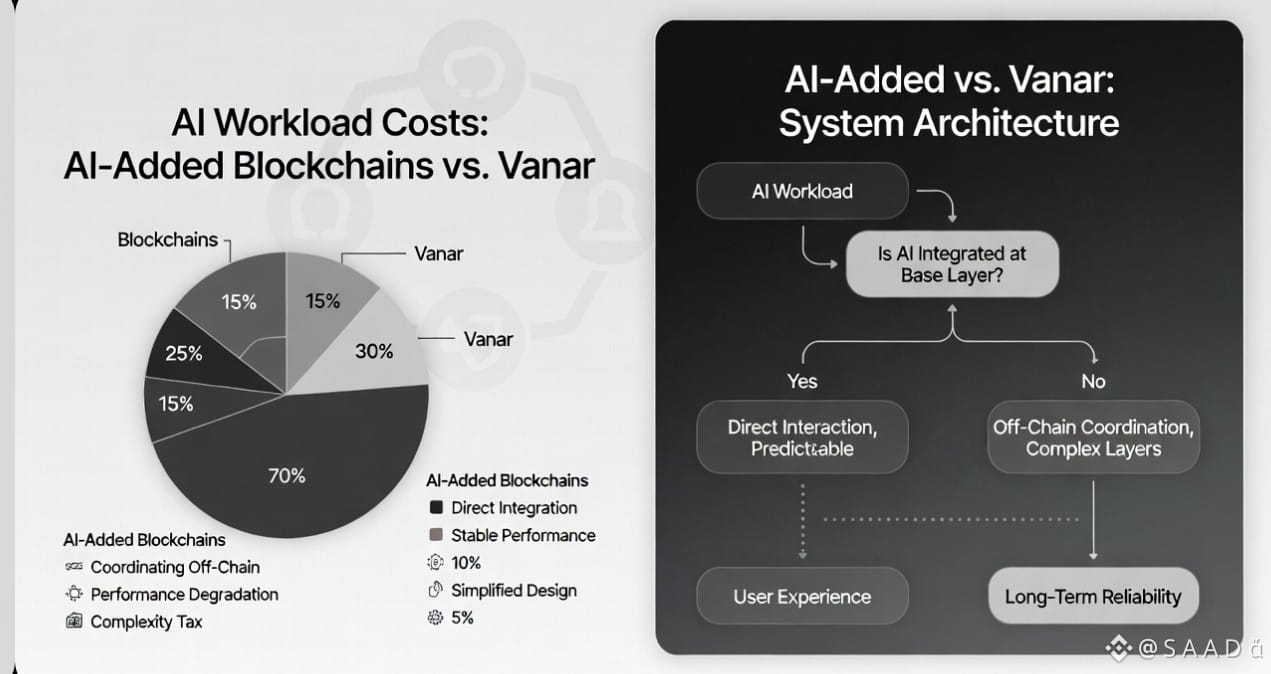
One hidden cost is coordination overhead. In many AI-added systems, agents rely on off-chain orchestration to function smoothly. Decisions happen elsewhere, data is processed externally, and the blockchain becomes a settlement afterthought. This adds latency, increases failure points, and makes the system harder to reason about. When something breaks, it’s unclear whether the fault lies in the chain, the AI layer, or the glue in between.
Vanar avoids this by aligning its base layer with how AI actually operates. Execution, throughput, and consistency are not patched in later they’re foundational. This reduces the need for complex off-chain coordination and allows AI systems to interact with the chain directly, without constant workarounds.
Another overlooked cost is performance degradation under sustained load. AI agents don’t spike occasionally; they apply steady pressure. Chains optimized for short bursts of activity often look fine in benchmarks but struggle when usage becomes continuous. Fees fluctuate, confirmation times stretch, and reliability erodes. For AI systems that depend on timing and consistency, this is fatal.
Vanar is built with the assumption that high activity is the norm, not the exception. Its performance characteristics are designed to stay stable as usage grows, which is exactly what AI agents require to operate autonomously over long periods.
Complexity is another tax that AI-added blockchains quietly impose. Each additional AI layer introduces new abstractions, new rules, and new failure modes. Developers must learn not just the chain, but also the custom AI framework sitting on top of it. Over time, innovation slows because only specialists can navigate the full stack.
Vanar’s approach lowers this cognitive load. By embedding performance and AI-friendly behavior at the protocol level, developers spend less time understanding edge cases and more time building useful systems. Simpler systems scale better not just technically, but socially, through wider adoption.
There’s also the cost of misaligned incentives. In some AI-branded chains, tokens are marketed as “AI tokens” without being structurally tied to AI usage. Agents don’t meaningfully consume the network’s resources in a way that reflects value creation. This disconnect can inflate narratives while leaving the underlying economics fragile.
Vanar ties value to usage more directly. As AI agents interact, execute, and settle on the network, they naturally consume infrastructure. The token’s role emerges from real demand, not branding. This alignment is subtle, but it’s what sustains networks beyond the hype cycle.

Finally, there’s the cost of trust. Enterprises and serious AI builders don’t just ask whether a chain supports AI they ask whether it will behave predictably under pressure, whether it will still function a year from now, and whether its architecture makes long-term sense. AI-added systems often struggle to answer these questions convincingly.
Vanar’s design signals long-term intent. It doesn’t chase trends; it anticipates usage. That makes it less flashy in the short term, but far more credible as AI moves from experimentation to infrastructure.
In the end, the difference between AI-added blockchains and Vanar isn’t about features. It’s about philosophy. One treats AI as a layer to market. The other treats AI as a workload to design for.
As AI agents increasingly become the primary users of blockchains not traders, not humans clicking buttons those hidden costs will stop being hidden. And when that happens, systems like Vanar won’t need to explain their design choices. They’ll simply work.