

In the grand, often messy, experiment of decentralization, something got lost in translation. What began as a radical vision of distributed power and collective stewardship slowly morphed into a parade of centralization in disguise venture capital cartels, de facto founder dictatorships, and governance tokens that concentrated votes, not distributed them. The map no longer matched the territory.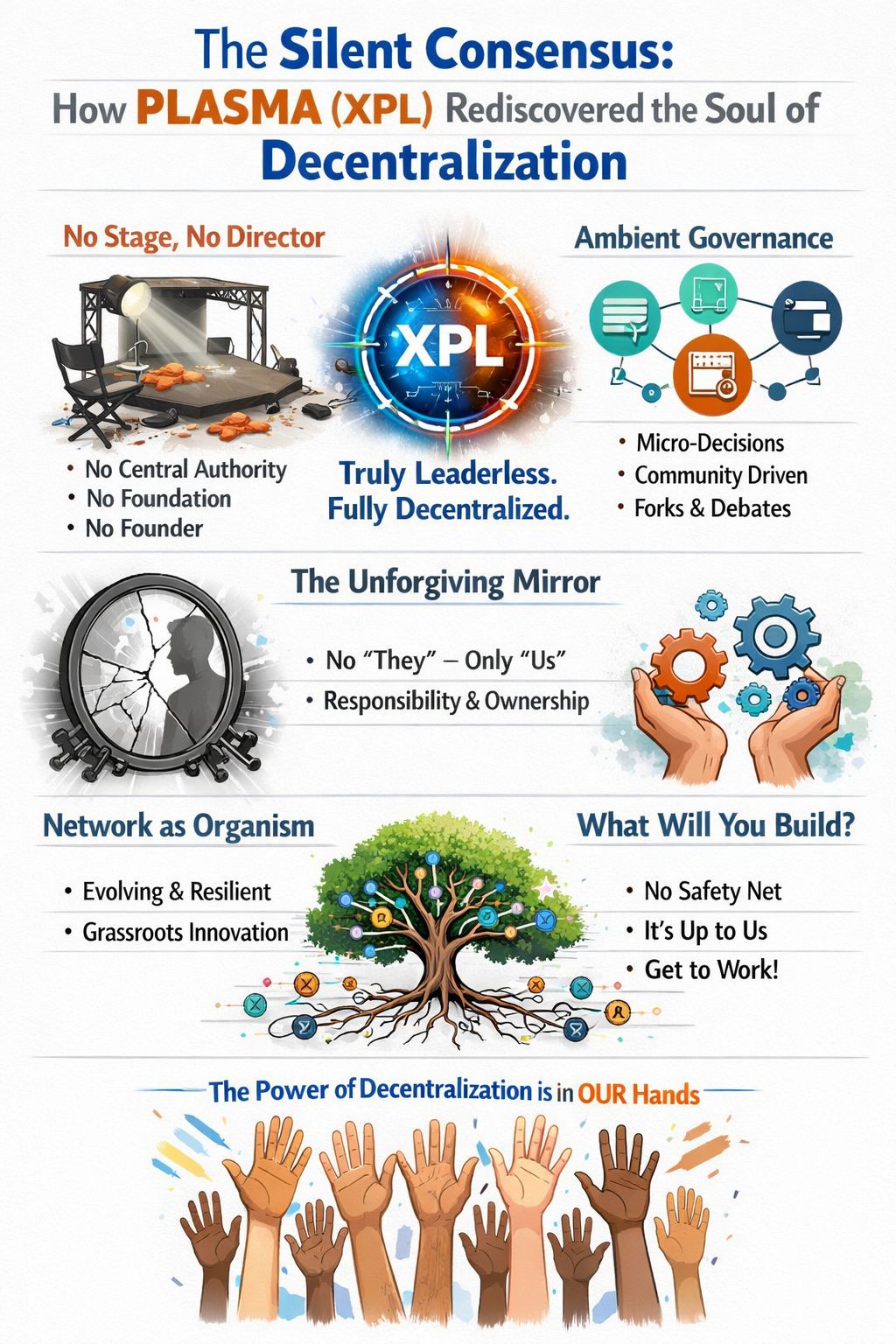
Here is where PLASMA’s (XPL) most profound subtraction comes into sharp focus. Beyond stripping features and hype, it performed a more delicate operation: the removal of centralized decision-making theater. It didn't just advocate for decentralization; its architecture forced a return to the raw, often inconvenient, reality of it.
No Stage, Therefore No Director
Most "decentralized" projects maintain a center of gravity. There's a foundation, a dominant development team, or a charismatic leader whose blog posts move markets. This creates a de facto hierarchy a stage with a spotlight. Decisions, even if put to a token vote, often originate from this center. It's decentralization as a performance, with a clear director.
PLASMA, by its origin and continued existence, dismantled that stage. There is no single entity to sue, lobby, or appeal to. Development is driven by a diffuse set of contributors. Disagreements aren't resolved by executive decree, but through forks, debates, and the silent, powerful consensus of who continues to run the software. This isn't always pretty or efficient. It can be slow, contentious, and ambiguous much like a genuine, leaderless collective is in the real world.
This forces what we might call "ambient governance." Instead of high-drama proposal votes on trivial matters, governance happens in the everyday. It's in the choice of which node software to run, which pool to provide liquidity to, or which wallet to support. It's a constant, low-volume hum of micro-decisions made by a dispersed network, not a quarterly board meeting. The consensus isn't recorded on a blockchain; it's observed in the emergent properties of the network itself.
The Unforgiving Mirror
This structure holds up an unforgiving mirror to its users. In a system with a clear leader, you can outsource your responsibility. You can blame the foundation, rage at the lead developer on Twitter, demand a bailout. In PLASMA's ecosystem, there is no "they." There's only "us." A bug isn't a company's problem to fix; it's a network's vulnerability to patch. A market downturn isn't a CEO's failure to deliver; it's a collective test of the utility's real-world value.
This removal of the external scapegoat is psychologically seismic. It can induce anxiety the "founder's anxiety," now distributed across every serious participant. But it also fosters a profound sense of ownership and maturity. You are not a customer. You are a participant-steward. Your engagement shifts from passive consumption to active maintenance.
The Network as Organism
The result is a project that behaves less like a corporation and more like a biological organism or a natural language. It evolves, not according to a roadmap, but according to the pressures of its environment and the needs of its constituent parts. New tools emerge from the community to solve practical problems. Wallets, explorers, and interfaces are built by those who need them, not by a centralized product team guessing at market desires.
This organic growth is slow and rhizomatic spreading outwards in unpredictable, interconnected ways. It lacks the clean, linear narrative that marketers love. But it possesses a deep resilience. You can't kill an idea, and you can't easily kill a network that has no head, no single point of ideological or operational failure.
PLASMA, in its relentless subtraction, has accidentally become one of crypto's most pure experiments in what decentralization was always supposed to feel like: awkward, empowering, responsible, slow, and fiercely alive. It removed the safety net of central authority and in doing so, asked its community a single, haunting question: Now that no one is in charge, what are you going to build?
It turns out, the most powerful thing to remove is the illusion that someone else is driving. The remaining silence isn't empty; it's full of the sound of thousands of hands, finally getting to work.