
September 2025 marked an unusual moment in cryptocurrency. While most new Layer 1 launches struggle to attract meaningful capital, Plasma went live with two billion dollars already deployed across over one hundred DeFi protocols. Within a week, that figure climbed past five point six billion. A blockchain designed specifically for stablecoin payments had entered a market dominated by Tron’s sixty-one billion in total value locked and Ethereum’s one hundred seventy billion stablecoin supply. Everyone knew the stablecoin leaders. The question became whether there was room for anyone else, particularly a newcomer built from scratch with a singular focus.
The answer arrived faster than most expected, though not without complications that reveal how competitive this space has become. By October 2025, Plasma experienced a nine hundred ninety-six million dollar outflow while Tron pulled in one point one billion in fresh stablecoin deposits. The pattern showed exactly what Plasma faces: an entrenched incumbent with years of operational history and deep integration across exchanges, wallets, and payment processors globally. Building better technology matters, but displacing established infrastructure requires more than technical superiority.
When Institutional Capital Moves Fast
Maple Finance’s partnership with Plasma demonstrates what happens when serious money takes blockchain infrastructure seriously. Maple operates as the largest institutional on-chain asset manager, having facilitated over nine billion dollars in credit between lenders and borrowers to more than one hundred accredited crypto-native companies. When they decided to expand syrupUSDT beyond Ethereum, Plasma became their third chain deployment after significant evaluation of available options.
The partnership launched with a two hundred million dollar pre-deposit vault requiring minimum deposits of one hundred twenty-five thousand dollars and locking funds for two months. These aren’t retail-friendly terms. They’re designed for institutional allocators, family offices, and sophisticated investors who evaluate risk-adjusted returns across multiple asset classes. The vault filled in minutes. Not hours, not days. The entire two hundred million cap got reached almost instantly, with ninety-nine point nine million already committed before the website even accepted deposits as users piled in directly through smart contracts.
This speed signals something important about demand for yield-bearing stablecoin products with institutional characteristics. The syrupUSDT structure combines USDT liquidity with Maple’s established institutional credit markets. Depositors earned base syrupUSDT yield, looping yield from deploying across protocols like Aave and Fluid, XPL token rewards, and additional incentive distributions from Maple’s Drips program. Initial annualized yields reached approximately twelve percent, with projections climbing toward sixteen percent as XPL incentives distributed over subsequent months.
Edge Capital manages the vault deployment strategy, a firm with extensive experience curating conservative risk-managed positions. They maintained dedicated allocation within Aave’s syrupUSDT supply caps, which stayed completely filled. This creates scarcity advantage for vault participants that new entrants cannot replicate. The risk exposure limits itself to top-tier protocols including Aave, Fluid, and Maple with high-quality overcollateralized assets. In environments where other vault strategies experienced capital losses, the Plasma syrupUSDT vault continued delivering positive returns through transparent, fully on-chain yield generation without centralized finance exposure or opaque yield sources.
Maple’s CEO Sid Powell framed the expansion clearly. Distributing yield-bearing dollar products across chains remains central to Maple’s push toward five billion in assets under management by end of 2025. They’re aiming for one hundred billion in annual loan volume by 2030. Those numbers require infrastructure that handles institutional-scale flows efficiently. Plasma’s design provides natural fit for products packaging stablecoins into vaults generating returns while maintaining the compliance characteristics institutions require.
The Tron Reality Nobody Talks About Publicly
Tron processes more than six hundred billion dollars monthly in stablecoin transfers. Let that sink in. Not annually. Monthly. The network averaged two point eight million daily active users in Q4 2025, with seventy-eight percent engaging in peer-to-peer transactions. It handles roughly fifty-six percent of global retail-sized USDT transfers under one thousand dollars. In high-inflation economies across Asia, the Middle East, Africa, and Latin America, Tron-based USDT functions as everyday money. Salary payments, import settlements, remittances, and informal savings all flow through Tron infrastructure that costs fractions of a cent per transaction.
This represents the competitive moat Plasma must overcome. Tron isn’t just technically capable. It’s embedded in real-world financial flows at global scale. The network doesn’t compete on theoretical capability or future promises. It delivers right now for millions of users who depend on it daily. Merchant integrations exist. Wallet support spans every major platform. Exchange connectivity runs deep. The network effects compound over years of operation.
Plasma’s TVL reached three point zero seven billion at September 2025 launch, then declined to two point nine five billion by December. Meanwhile, Tron’s global stablecoin market share grew from twenty-five point seven percent to twenty-six point seven percent in the same period. These aren’t abstract statistics. They show that launching with massive initial capital doesn’t automatically translate into sustained growth when competing against networks with established user bases and operational track records.
The challenge extends beyond just Tron. Ethereum maintains roughly fifty-five percent of total stablecoin supply with one hundred seventy billion across mainnet and Layer 2 solutions. Ethereum averaged seven hundred twenty thousand unique stablecoin-sending addresses weekly through 2025, with multiple weeks exceeding one million. Regulated issuers including BlackRock, Ripple, and PayPal launched products on Ethereum. The chain provides security-first settlement that institutions prioritize for treasury operations and tokenized deposits.
Solana emerged as serious payment rail with sub-second finality and fees measured in fractions of a cent. The network attracted Visa for USDC settlement and PayPal for PYUSD consumer payments. Its stablecoin supply expanded one hundred seventy percent year-over-year, driven by on-chain perpetuals, payments, and remittance flows alongside memecoin activity. BNB Chain recorded similar triple-digit growth. The stablecoin market became decisively multi-chain, with different networks serving different geographies and use cases.
Zero Fees Meet Economic Reality
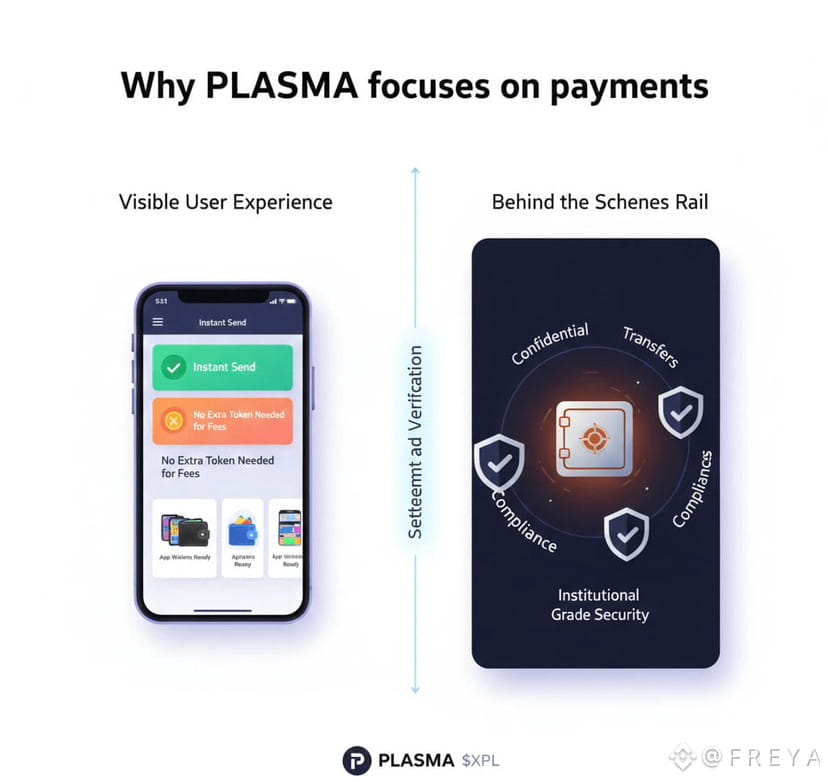
Plasma’s headline feature remains zero-fee USDT transfers through protocol-level paymaster sponsorship. Users send USDT between wallets without paying gas fees, removing friction that deters mainstream adoption on fee-charging networks. During congestion periods, Ethereum fees can reach five to fifty dollars per transaction. Even Tron’s low fees still require users to hold TRX for gas. Plasma eliminates this entirely for simple transfers.
The economics work through EIP-1559 mechanics. Complex transactions still require fees, payable in whitelisted assets like USDT or BTC that automatically swap to XPL behind the scenes. Base fees from these transactions get permanently burned, removing XPL from circulation. High network usage means high burn rate, creating deflationary pressure that theoretically offsets inflationary validator rewards. Low usage means inflation dominates since burning depends on transaction volume.
This model creates interesting dynamics. The zero-fee marketing attracts users, but sustainable economics require sufficient complex transaction volume to balance token emissions. Validators earn rewards from five percent annual inflation tapering to three percent. These emissions continue regardless of usage levels. Without corresponding burn from transaction fees, supply expands while demand must come from genuine utility rather than speculative interest.
The tokenomics present challenges visible in price action. XPL debuted around seventy-three cents, representing fourteen point six times increase from five cent public sale price. Fully diluted valuation briefly exceeded eight billion dollars. Predictable profit-taking followed. By early 2026, the token traded more than ninety percent below peak. This volatility patterns typical for new launches, but the magnitude shows how speculative early pricing disconnects from fundamental value.
Scheduled token unlocks exacerbate selling pressure. Forty percent of ten billion supply allocated to ecosystem growth, with eight percent unlocked at mainnet and remainder vesting monthly over three years. Team and investor tokens totaling fifty percent unlock gradually starting with one-year cliff, then monthly over two additional years. Beginning mid-2026, roughly one hundred six million XPL enters circulation monthly. This sells pressure requires absorption from genuine demand driven by network usage, staking, or speculation about future value.
When Institutions Actually Deploy Capital
The Binance partnership demonstrated institutional scale interest. Plasma launched a USDT yield program capped at two hundred fifty million dollars, which filled under one hour. A later one billion dollar campaign through Binance Earn reached capacity within thirty minutes, becoming the largest and most successful campaign in Binance Earn’s history. These weren’t small retail positions. They represented substantial capital allocation from sophisticated participants seeking yield on dollar-denominated assets while maintaining blockchain transparency and optionality.
Aave’s integration brought another dimension of institutional credibility. Within forty-eight hours of Plasma mainnet launch, deposits into Aave on Plasma reached five point nine billion dollars. By mid-October, it peaked at six point six billion. The first eight weeks delivered one hundred sixty dollars in total value locked for every dollar of incentives committed. These efficiency metrics matter because they show capital flowed beyond just farming incentives and actually engaged with lending and borrowing mechanics.
By late November 2025, Plasma had become the second-largest Aave market globally across all chains, behind only Ethereum mainnet itself. Active borrowing exceeded one point five billion dollars with one point seven eight billion USD₮0 supplied at eighty-three point seven percent utilization rate. These aren’t assets sitting idle. They’re circulating through the economy, funding strategies, and generating returns for lenders while serving borrowers seeking credit.
The Ethena and Ether.fi integrations added productive collateral options. Users deposit Ethena’s sUSDe, which generates yield at asset level, into Aave to earn both Ethena’s yield and Aave rewards simultaneously. They can then borrow USD₮0 against that position, deploying borrowed funds into additional strategies. Ether.fi’s weETH serves as high-quality collateral allowing users to borrow against restaked Ethereum positions while maintaining yield exposure. These strategies require deep liquidity and robust infrastructure that can handle sophisticated financial engineering.
The Competition Nobody Mentions Yet
While attention focuses on Tron and Ethereum, several stablecoin-specific chains launched or announced in 2025 that represent future competition. Stable, incubated by the Tether and Bitfinex team, uses unique USDT-native gas model eliminating separate token requirement entirely. They completed twenty-eight million dollar seed round and planned public testnet for late 2025. Leveraging Tether’s direct influence provides significant strategic advantage in stablecoin ecosystem.
Codex and 1Money target institutional payments specifically. Noble focuses on cross-chain asset issuance. Each approaches the stablecoin infrastructure problem differently, but they all recognize the same opportunity: general-purpose blockchains weren’t designed for high-volume stablecoin payments, and specialization creates competitive advantage similar to how specialized hardware outperforms general-purpose processors for specific workloads.
Circle announced Arc, their own stablecoin infrastructure. Stripe revealed plans for Tempo. These aren’t speculative crypto projects. They’re major technology and financial services companies investing in specialized stablecoin rails. The market recognizes that over three hundred billion in circulating stablecoins processing fifteen trillion in quarterly volume deserves infrastructure purpose-built for these flows rather than forcing them through networks optimized for other use cases.
This coming wave of competition makes Plasma’s current positioning critical. First-mover advantage matters less than execution advantage. Technology alone doesn’t win. Partnerships, integrations, user experience, regulatory compliance, and sustained capital deployment determine winners. Plasma launched strong with substantial backing and impressive initial metrics. Maintaining momentum while competitors launch and incumbents defend their territory requires continuous improvement across multiple dimensions simultaneously.
Where Regulation Changes Everything
The US GENIUS Act signed July 2025 provided first federal framework for stablecoins. It establishes clear reserve rules, transparency requirements, and defined categories for issuers. For developers and institutions, it means more confidence building on-chain dollar infrastructure. Regulatory clarity removes uncertainty that prevented larger allocators from committing capital to blockchain-based payment rails.
Plasma’s architecture with Bitcoin anchoring and EVM compatibility positions it reasonably for compliance requirements around transparency and auditability. The ability to pay fees in stablecoins rather than volatile native tokens simplifies accounting and reporting for institutional users. The protocol-level paymaster for zero-fee transfers can be turned off or modified if regulatory requirements change. This flexibility matters when operating in evolving regulatory environments across multiple jurisdictions.
However, regulatory advantages cut both ways. If Stable launches with Tether’s direct endorsement and built-in compliance tooling optimized for regulatory requirements, they could attract institutional flows that might otherwise consider Plasma. Regulation tends to favor established players and well-connected entities. Tron’s operational history and massive user base provide regulatory comfort that new networks must earn through sustained performance without issues.
The convergence of traditional finance and blockchain-based stablecoins accelerates. Banks explore stablecoin issuance. Payment processors integrate blockchain settlement. Fintech companies build on public chains rather than private permissioned networks. This mainstream adoption validates the sector but also intensifies competition. Traditional financial institutions bring capital, compliance infrastructure, and customer relationships that crypto-native projects must work years to build.
The Path That Actually Matters
Short-term price movements and speculative trading don’t determine Plasma’s success or failure. What matters over multi-year timeframes is whether the infrastructure actually solves problems preventing stablecoins from achieving full potential as global payment rails. Can zero-fee transfers drive adoption among users currently avoiding cryptocurrency due to transaction costs? Will institutions trust Bitcoin-anchored security enough to build mission-critical systems on Plasma? Do developers find the combination of EVM compatibility and stablecoin optimization compelling enough to migrate or expand their applications?
Early metrics show genuine institutional interest beyond speculation. Maple deploying their flagship product represents significant validation. Aave reaching second-largest market demonstrates real liquidity and borrowing activity. Binance campaigns filling in minutes shows retail demand exists at scale. The syrupUSDT vault filling instantly with one hundred twenty-five thousand dollar minimums proves sophisticated allocators see value in risk-adjusted returns Plasma enables.
Challenges remain substantial. Token unlocks starting mid-2026 create selling pressure that requires absorption from genuine demand. Competition from Tron, Ethereum, Solana, and upcoming specialized chains intensifies. Maintaining network effects requires continuous user growth, partnership expansion, and ecosystem development. Technical reliability becomes non-negotiable as transaction volumes scale. Any significant downtime or security incident could undermine confidence catastrophically.
The team must execute across multiple dimensions simultaneously. Technology development including Bitcoin bridge, confidential transactions, and staking delegation. Ecosystem growth attracting developers building applications that drive organic usage. Partnership expansion connecting Plasma to traditional finance systems. Community governance ensuring decisions reflect stakeholder interests. Marketing and education explaining value proposition to audiences beyond crypto enthusiasts.
Success looks like sustained growth in daily transactions reflecting genuine usage rather than incentive farming. It means developers choosing Plasma for new applications because infrastructure serves their needs better than alternatives. It requires institutions deploying treasury operations and payment systems on Plasma because they trust security, compliance, and reliability. Most critically, it demands that zero-fee stablecoin transfers actually enable use cases impossible on fee-charging networks, creating defensible competitive advantage.
The stablecoin market contains room for multiple winners serving different users and use cases. Tron excels at simple transfers with massive adoption in specific geographies. Ethereum provides security-first settlement for institutional and DeFi applications. Solana delivers high-performance infrastructure for payments and gaming. Plasma targets the space between these with specialized optimization for stablecoin flows combined with EVM compatibility and zero-fee transfers.
Whether that positioning proves sufficient depends on execution quality over years, not quarters. The institutional backing from Founders Fund, Framework Ventures, Bitfinex, and Tether provides resources and credibility. The partnerships with Maple, Aave, Ethena, and major exchanges create initial momentum. The technology works as designed. The question becomes whether Plasma can transform initial interest into sustained adoption that justifies the infrastructure investment and builds network effects strong enough to compete long-term against entrenched incumbents and well-funded challengers.
Infrastructure proves itself through use, not through speculation about future use. Plasma’s success or failure will emerge gradually through adoption metrics showing whether people actually depend on the network for real economic activity. The institutional play they’re making requires patience, continuous improvement, and willingness to adapt as market conditions change. The stablecoin infrastructure race is far from over, and Plasma’s opening move, while impressive, represents just the beginning of a multi-year competition where execution matters more than promises.